Node.js Pointer Compression: Cut Heap Memory ~50%
V8 pointer compression finally lands in Node.js: one Docker image swap cuts heap memory ~50%, improves P99 latency, and can save $80K-$300K a year.

Somewhere in AWS us-west-2, a Node.js cluster is running. Six replica pods. 2 GB memory per pod. Half of that memory is pointers — 64-bit addresses pointing to other objects, arrays, closures, and strings. Node.js pointer compression is the V8 build flag that shrinks those 64-bit pointers to 32 bits, halving that overhead with zero code changes. If you build services in this stack, it connects directly to Node.js for frontend developers and the cost math in Docker Swarm vs Kubernetes. See also React Performance Optimization.
Not your data. Not your business logic. Just directions for getting around inside the heap.
What if every single one of those pointers could be cut in half? No code changes. No refactoring. No migration.
Just swap one line in your Dockerfile.
# Before
FROM node:25-bookworm-slim

# After
FROM platformatic/node-caged:25-slim
That is the change that cuts your Node.js heap memory by approximately 50%.
The results from production-level benchmarks on AWS EKS: 50% memory reduction, 2-4% average latency overhead, and a 7% improvement in P99 latency. That last number is not a typo. The compressed heap actually makes tail latency better.
For most teams running Node.js in production, this is the closest thing to free money you will find in infrastructure.
TL;DR
- V8 pointer compression finally works in Node.js after a six-year wait — and you enable it by swapping one Dockerfile line to
platformatic/node-caged:25-slim, with no code changes. - Heap memory drops ~50% on real production workloads (AWS EKS benchmarks, plus a real Next.js SSR app confirmed by Platformatic).
- The trade-off is small: 2-4% average latency overhead, but ~7% better P99 tail latency, because the garbage collector has less heap to traverse.
- Across a fleet, that memory cut can translate to roughly $80K-$300K/year in saved infrastructure.
- It took Cloudflare (funding), Igalia (the IsolateGroups engine work), and Platformatic (packaging) to remove the shared-4GB-cage blocker that held it up since 2020.
WHY THIS MATTERS
Pointer compression is not a micro-optimization story. It is a systems-level cost and density change with unusually low adoption friction.
IMMEDIATE WIN
Roughly 50% heap reduction
The headline is simple: you can often cut Node.js heap memory in half with a Docker image swap instead of an application rewrite.
- Same app behavior
- No code changes
- Direct infra savings
LATENCY TRADE
Small average overhead, better tail latency
The median cost is modest, but P99 and max latency can improve because the garbage collector has less heap to traverse.
- 2 to 4 percent average overhead
- Tail latency improvement in real workloads
ADOPTION FRICTION
One Docker line is the operational unlock
Platformatic made the feature usable for normal teams instead of leaving it as a source-build science project.
- `FROM platformatic/node-caged:25-slim`
- Staging-first rollout is straightforward
WHY NOW
A six-year blocker finally got removed
Chrome had the optimization years earlier. Node.js needed the IsolateGroups fix to avoid the shared 4 GB cage problem.
- Cloudflare funded the upstream fix
- Igalia did the deep engine work
- Platformatic packaged it for production teams
The $300,000 Secret Hiding in V8 — For Six Years
Chrome has been using pointer compression since 2020. For six years, Google’s browser has been running JavaScript with roughly 40-50% less memory than Node.js for the exact same heap operations.
The feature — V8 pointer compression — shrinks every internal pointer from 64 bits to 32 bits. Since V8’s own analysis found that tagged values (mostly pointers) make up roughly 70% of all heap memory, cutting each pointer in half has an outsized impact on total memory usage.
Seven out of every ten bytes on your V8 heap are not your data. They are addresses pointing to other locations in memory. And the overwhelming majority of those 64-bit addresses are pointing to locations within a tiny fraction of the 64-bit address space. Most Node.js heaps are well under 1 GB. You are using 8-byte addresses to point to things that could be addressed with 4 bytes.
It is like printing every street address in your neighborhood using full GPS coordinates.
Chrome fixed this in 2020. Node.js could not. Not because the optimization did not work. Because of a cage.
The Cage Problem: Why Node.js Was Locked Out
V8’s pointer compression stores 32-bit offsets relative to a fixed base address instead of full 64-bit addresses. All compressed pointers must live within a contiguous 4 GB region — the “pointer cage.” In x86 assembly, decompression is two instructions:
movl r11, [rax+0x13]   ; load the 32-bit compressed pointer
addq r11, r13          ; add the base to decompress
One load, one addition. That is it.
In Chrome, this works perfectly. Each browser tab runs in its own process, so each tab gets its own 4 GB cage. Plenty of room.
But Node.js is not Chrome. The main thread and all worker threads share a single process. Under V8’s original design, they would all share a single 4 GB cage. Spin up 8 worker threads? They all compete for space in the same 4 GB heap. For a modern Node.js application running multiple workers with complex workloads, that is a hard blocker.
The second concern was performance overhead. Compressing and decompressing every pointer on every heap access sounds expensive. Early microbenchmarks showed alarming numbers — up to 56% overhead on a basic Next.js starter app. That result spooked the community.
Both problems are now solved. And the story of how they got solved is a masterclass in open-source collaboration — and corporate strategy.
The Three-Company Fix: Cloudflare, Igalia, and Platformatic
In November 2024, James Snell — a member of the Node.js Technical Steering Committee and engineer at Cloudflare — initiated the effort to kill the shared cage.
Cloudflare had serious skin in the game. Their Workers runtime runs millions of JavaScript isolates in single processes. Pointer compression would let them pack dramatically more customer workloads onto each host. But a shared 4 GB cage across thousands of isolates was a non-starter.
Think about the strategic calculus: the cost to sponsor the fix was probably $100K-$500K. The annual savings from pointer compression at Cloudflare’s scale? Potentially tens of millions. ROI timeline: months, not years.
So Cloudflare sponsored engineers Andy Wingo and Dmitry Bezhetskov at Igalia — a worker-owned open-source consultancy specializing in browser and compiler engineering — to implement a new V8 feature called IsolateGroups. The concept: instead of every isolate sharing one pointer cage, each isolate (or group of isolates) gets its own independent 4 GB cage.
The V8 API change is elegant in its simplicity:
// Before: shared cage — all isolates in one 4GB space
v8::Isolate* isolate = v8::Isolate::New(create_params);

// After: IsolateGroups — each gets its own 4GB cage
v8::IsolateGroup group = v8::IsolateGroup::Create();
v8::Isolate* isolate = v8::Isolate::New(group, create_params);
Your main thread gets 4 GB. Each worker thread gets 4 GB. The total is limited only by system memory. Each IsolateGroup also gets its own security sandbox, meaning each worker is sandboxed separately — a bonus for multi-tenant architectures.
Snell’s Node.js integration landed in October 2025: 62 lines across 8 files. The code was reviewed and approved by Joyee Cheung (Igalia), Michael Zasso (Zakodium), Stephen Belanger (Platformatic), and Nicolo Ribaudo (Platformatic). Cheung also fixed the pointer compression build itself, which had been broken since Node.js 22.
62 lines. Less than one commit’s worth of changes. That is all it took to unblock a 50% memory reduction for the entire Node.js ecosystem after years of V8 engine work and cross-company collaboration.
But it still required a compile-time flag. Official Node.js builds do not include it yet. So Platformatic built node-caged — a drop-in Docker image that makes the feature accessible without custom builds.
And then they did not just ship it and hope for the best. They proved it works.
The Microbenchmark Trap (And Why It Almost Killed This Feature)
Before we look at the real numbers, we need to address the elephant in the room: that 56% overhead result.
When pointer compression was first tested on a basic Next.js starter app — a “hello world” SSR page — it showed catastrophic performance degradation. That number would terrify any engineering team.
But a hello-world SSR page is a pathological case. It is almost entirely V8 internal work: compiling templates, diffing the virtual DOM, joining strings. There is no I/O, no data loading, no real application logic. Every operation goes through pointer decompression.
Real applications are fundamentally different. A typical production request spends its time on:
- I/O wait: Database queries, cache lookups, API calls to downstream services
- Data marshaling: JSON parsing, response body construction
- Framework overhead: Routing, middleware chains, header processing
- OS/network: TCP handling, TLS, kernel scheduling
V8 heap access — the operation that triggers pointer decompression — is only one slice of that pie. As the ratio of real work to pure V8 pointer chasing increases, the overhead of pointer compression shrinks proportionally. A 1ms database query dominates a sub-nanosecond pointer decompression by six orders of magnitude.
The takeaway that applies to every performance decision you will ever make: always benchmark with realistic workloads. Microbenchmarks can give you exactly the wrong answer.
The Production Benchmark: Numbers That Matter
Platformatic built a real test. Not a hello-world page. A Next.js e-commerce marketplace — a trading card platform with 10,000 cards, 100,000 listings, server-side rendering, full-text search, pagination, and simulated 1-5ms database delays to mimic real data access.
Infrastructure
- Platform: AWS EKS with m5.2xlarge nodes (8 vCPUs, 32 GB RAM), us-west-2
- Plain Node.js: 6 replicas
- Platformatic Watt: 3 replicas with 2 workers each (6 processes total)
- Base: Same Debian bookworm-slim, same Node.js 25, only pointer compression differs
Workload
k6 with a ramping-arrival-rate executor: 400 requests/second sustained for 120 seconds after a 60-second ramp-up. Realistic traffic distribution:
- 25% search (full-text with pagination)
- 20% homepage (SSR with featured cards and recent listings)
- 20% card detail (individual product page SSR)
- 15% game category pages
- 10% games listing
- 5% sellers listing
- 5% set detail pages
Every request follows the server-side rendering path: load JSON data from disk, apply query filters, render React components to HTML, send the response.
Result 1: Plain Node.js — Standard vs Pointer Compression
| Metric | Standard | Pointer Compression | Change |
|---|---|---|---|
| Average latency | baseline | +2.5% | ~1ms on 40ms median |
| Median latency | baseline | unchanged | — |
| P99 latency | baseline | lower | improved |
| Max latency | baseline | lower | improved |
| Memory usage | baseline | -50% | half |
Average overhead: 2.5%. That translates to approximately 1 millisecond of additional latency on a 40ms median. But P99 and max latency are actually lower with pointer compression. A smaller heap means the garbage collector has less work, resulting in fewer and shorter GC pauses. Pointer compression does not just keep up — it performs better at the tail.
Result 2: Platformatic Watt (2 Workers) — Standard vs Pointer Compression
| Metric | Standard | Pointer Compression | Change |
|---|---|---|---|
| Average latency | baseline | +4.2% | slightly higher |
| Median latency | baseline | unchanged | — |
| Max latency | baseline | -20% | dramatically lower |
| Memory usage | baseline | -50% | half |
Same pattern. Slightly higher average, unchanged median, 20% lower max latency.
Result 3: The Full Picture — Watt + Pointer Compression vs Bare Node.js
This is the comparison that matters for production decisions:
- Average latency: 15% faster
- P99 latency: 43% faster
- Memory: 50% less
No code changes. A Docker image swap and an application server change. That is performance improvement territory that typically requires rewriting parts of a system in a lower-level language.
Why the Garbage Collector Actually Gets Faster
The improved tail latencies are not a fluke. They are a direct, predictable consequence of how V8’s garbage collector (Orinoco) works — and the physics of CPU cache lines.
V8 performs two main types of garbage collection:
Minor GC (Scavenge): Copies live objects from the young generation. Time is proportional to the number and size of live objects.
Major GC (Mark-Sweep-Compact): Marks all reachable objects, sweeps dead ones, optionally compacts. Time depends on total heap size and fragmentation.
When every object is physically smaller, four things cascade:
Cache efficiency improves. A compressed object that fits in a single 64-byte cache line instead of two means the GC’s marking phase generates half as many cache misses while traversing the object graph. Cache misses are orders of magnitude more expensive than the pointer decompression operation itself.
Young generation fills more slowly. Smaller objects mean more allocations before a minor GC triggers. Fewer minor GCs per unit of work.
Major GC scans less data. A 1 GB compressed heap contains the same logical data as a 2 GB uncompressed heap. The GC scans half the bytes to process the same application state.
Compaction moves fewer bytes. When the GC compacts to reduce fragmentation, smaller objects mean less data to copy.
The result: GC pauses are both shorter and less frequent. When a long-tail request coincides with a GC pause, that pause is now shorter. That is exactly what the P99 and max latency numbers reflect.
The counterintuitive takeaway: pointer compression trades 1ms of median latency for 8-34ms of improvement in tail latency. Users do not notice 1ms. They absolutely notice 34ms.
What This Means for Your Infrastructure Bill
Let us translate benchmarks into the language CFOs understand.
Kubernetes: Cut Your Node Count
If you run Node.js on Kubernetes with 2 GB memory limits per pod, pointer compression lets you cut that to 1 GB. Same application, same performance. But now you can run twice as many pods per node, or half as many nodes.
The math:
A 6-node m5.2xlarge EKS cluster costs roughly $0.384/hour per node — about $16,600/year. Dropping to 3 nodes saves $8,300/year.
In a production fleet with 50+ nodes, savings reach $80,000 to $100,000/year. Without changing a single line of application code.
For platform teams running hundreds of Node.js microservices, every service carries a baseline memory cost from the V8 heap, framework, and modules. Pointer compression reduces that baseline across all services simultaneously.
Multi-Tenant SaaS: Double Your Density
Multi-tenant platforms where each tenant runs in an isolated Node.js process hit memory as the binding constraint for density. If each tenant’s worker uses 512 MB, pointer compression drops it to roughly 256 MB. That is 2x tenants per host.
The math:
- 10,000 tenants at $5/month infrastructure cost each = $600,000/year
- With pointer compression: $2.50/month per tenant = $300,000/year
- Annual savings: $300,000
For one configuration change. At that scale, the CFO notices.
Edge Computing: Fit Where You Could Not Before
Edge runtimes enforce strict memory limits — Lambda@Edge: 128-512 MB, Cloudflare Workers: 128 MB, Deno Deploy: 512 MB per isolate. This is precisely why Cloudflare sponsored the IsolateGroups work. Pointer compression can be the difference between your application running at the edge or falling back to the origin server.
Every 100ms of latency measurably reduces conversion rates. Moving SSR to the edge shaves 50-200ms off Time to First Byte depending on user location. For a $50M/year e-commerce business, that latency improvement can translate to hundreds of thousands in incremental annual revenue.
WebSocket Applications: Double Your Connections
For chat systems, collaboration tools, live dashboards, and multiplayer games, each persistent connection holds state in memory. A server handling 50,000 connections at ~10 KB heap per connection uses 500 MB. With pointer compression, that drops to ~250 MB — allowing the same server to handle 100,000 connections, or halving your WebSocket server fleet.
The Compatibility Reality Check
Honest assessment of the constraints.
The 4 GB Ceiling
Each V8 isolate’s pointer cage is 4 GB. If your service genuinely needs more than 4 GB of V8 heap per isolate — large ML model inference, massive in-memory caches, heavy ETL pipelines — pointer compression is not an option.
Critical nuance: only the V8 JavaScript heap lives inside the cage. Native addon allocations and ArrayBuffer backing stores do not count against the 4 GB limit. If you are using native modules or Buffers for large data, you may still be fine.
For the vast majority of production Node.js services running well under 1 GB of heap, the 4 GB limit is academic.
Native Addon Compatibility
Native addons built with the legacy NAN (Native Abstractions for Node.js) will not work with pointer compression. NAN exposes V8 internals directly, and pointer compression changes the internal object representation. When you recompile, the ABI is different.
Addons built on Node-API (formerly N-API) are completely unaffected. Node-API abstracts away V8’s pointer layout entirely. The most popular native packages have already migrated: sharp, bcrypt, canvas, sqlite3, leveldown, bufferutil, and utf-8-validate all use Node-API.
The main holdout is nodegit, which still depends on NAN. Quick check:
npm ls nanIf nothing shows up, you are clear.
Not a Silver Bullet for Memory Leaks
Pointer compression reduces memory usage for everything — including leaked objects. If your application leaks 2 GB of objects, pointer compression will reduce that to 1 GB of leaked objects. It still leaks. It just leaks slower. Fix your leaks first, then optimize.
How to Actually Deploy This
A step-by-step guide for production adoption.
Step 1: Check Compatibility
Verify your heap stays under 3.5 GB (leaving headroom for the 4 GB cage):
node -e "
setInterval(() => {
  const mem = process.memoryUsage();
  console.log('Heap:', (mem.heapUsed / 1024 / 1024).toFixed(0), 'MB');
}, 5000);
"
Check for NAN-based native addons:
npm ls nanStep 2: Swap the Docker Image
# Before
FROM node:25-bookworm-slim

# After
FROM platformatic/node-caged:25-slim
Available tags: latest, slim, 25, 25-slim, 25-alpine (experimental).
The platformatic/node-caged image is built from Node.js v25.x with --experimental-enable-pointer-compression. Same Node.js, same APIs, same everything. No runtime flags needed.
Step 3: Deploy to Staging and Monitor
# Compare before/after memory
kubectl top pods -n your-namespace

# Or in Docker
docker stats --no-stream container-name
Expect approximately 50% reduction in heap usage.
Step 4: Load Test Against Your SLOs
Run your standard load tests. Compare throughput, P50/P95/P99 latency, error rate, and CPU. Average latency should increase by 2-4%. P99 should stay the same or improve. Error rate should be unchanged.
Step 5: Canary Rollout
- Deploy 10% of replicas with
node-caged - Monitor for 24-48 hours
- If stable, increase to 50%
- Monitor another 24-48 hours
- Complete rollout
Step 6: Right-Size Resources
Once stable, reduce pod memory limits:
# Before
resources:
  requests:
    memory: "2Gi"
  limits:
    memory: "2Gi"

# After
resources:
  requests:
    memory: "1Gi"
  limits:
    memory: "1Gi"
This is where the cost savings actually hit. Smaller pods = more pods per node = fewer nodes needed.
A Timeline of Persistence
This did not happen overnight. It is the culmination of years of work across multiple organizations:
- 2020: Chrome enables V8 pointer compression after 300+ commits of optimization, achieving up to 43% heap reduction and 20% total renderer memory reduction. Node.js cannot follow due to the shared cage limitation.
- November 2024: James Snell (Cloudflare, Node.js TSC) initiates the effort to fix the cage problem.
- 2024-2025: Cloudflare sponsors Igalia engineers Andy Wingo and Dmitry Bezhetskov to build IsolateGroups in V8, giving each isolate its own independent pointer cage.
- October 2025: Snell’s 62-line Node.js integration lands. Joyee Cheung (Igalia) fixes the pointer compression build, broken since Node.js 22.
- 2026: Platformatic releases
node-cagedDocker images, production benchmarks on AWS EKS validate 50% memory savings with negligible overhead.
Six years from Chrome shipping the feature to Node.js developers being able to use it with a one-line Dockerfile change. That is how long it takes to get a systems-level optimization right — not just the algorithm, but the safety, compatibility, and tooling that make it production-ready.
The Deafening Silence — And What It Reveals
Here is the strange part. This breakthrough has not gone viral. No Hacker News firestorm. No rush of companies announcing migrations. Relative quiet.
Why?
The “Unknown Unknown” problem. Most Node.js teams do not know about pointer compression. They do not know it exists, they do not know how much memory it saves, and they do not know it is now available. DevOps teams know their pods use 2 GB. They do not know that half of that is pointer overhead they can eliminate.
The “If It Ain’t Broke” problem. Node.js applications work fine without pointer compression. The memory usage seems normal. The costs seem normal. There is no visible error, no alarm, no incident. It is only when you see the benchmarks side-by-side that you realize: you have been paying 2x what you needed to for years.
The vendor incentive misalignment. Cloud providers charge by resource consumption. AWS will not email you saying “enable pointer compression and cut your EC2 costs in half.” GCP will not suggest your pods are overprovisioned. The optimizations exist. The documentation exists. But unless you are specifically looking, you will never know.
This is why open-source infrastructure work matters. Companies like Platformatic can publish optimizations that directly reduce cloud bills — because they do not profit from your infrastructure spending.
The Bigger Pattern: Hidden Waste at Scale
The pointer compression story is not unique. It follows a pattern that repeats across the entire infrastructure stack:
- A platform has an optimization opportunity worth millions in aggregate
- The optimization exists in an underlying technology
- A technical constraint prevents enabling it
- Nobody fixes the constraint because it is genuinely hard
- Waste accumulates for years — invisibly
- Someone finally solves the constraint
- Massive savings unlock instantly for everyone
Other examples of this exact pattern:
- Kubernetes resource overprovisioning: Industry average is 87% idle CPU. Companies pay $165K-$460K/year for “small” clusters.
- Database connection pooling: Applications open 100 connections, use 10.
- Image optimization: Shipping 5 MB images when 500 KB would suffice.
- Logging overhead: Writing debug-level logs to disk in production.
Every one of these represents systematic waste that compounds at scale. The 80/20 rule applies: 80% of the savings come from a few architectural fixes (like pointer compression). 20% come from hundreds of small tuning exercises. Most teams spend all their time on the 20%.
What Cloudflare Understood Before Everyone Else
Cloudflare Workers serves billions of requests daily across millions of customer workloads. At that scale, every percentage point of memory efficiency translates to millions in infrastructure costs.
They knew pointer compression was the answer. The 4 GB cage was the blocker. So they paid to fix the blocker — not with a proprietary hack, but by funding the fix in V8 upstream, benefiting every V8 embedder: Node.js, Deno, Bun, and every other JavaScript runtime.
And Igalia — a worker-owned cooperative — did the deep V8 engine work. Not because a corporate board mandated it, but because their engineers have spent years specializing in JavaScript engine internals.
Then Platformatic made it accessible. Instead of leaving the feature behind a compile-time flag that 99% of developers would never touch, they built Docker images that reduce the adoption barrier to a single line change. And published full benchmarks to prove it works.
The Node.js TSC members who reviewed the code ensured it met the project’s standards. 62 lines of code, reviewed by engineers from four different organizations.
This is open source working exactly as it should: competing companies collaborating on shared infrastructure because the rising tide lifts all boats.
Should You Turn This On?
DEPLOY NOW OR WAIT?
Most teams should evaluate this in staging immediately, but not every workload is a clean fit today.
DEPLOY CANDIDATE
Good fit for current production evaluation
This is most attractive when memory is a real cost driver and your app sits comfortably inside the compatibility envelope.
- Services stay well below 4 GB V8 heap per isolate
- You mostly use Node-API-based native addons
- You can trade 2 to 4 percent average overhead for 50 percent memory savings
- You want better P99 latency, denser multitenancy, or lower Kubernetes node counts
WAIT
Cases where caution is still reasonable
A few constraints still make this an opt-in experiment instead of a universal default.
- Workloads need more than 4 GB V8 heap per isolate
- You depend on NAN-based native addons
- You require Node.js LTS right now instead of Node.js 25
- Compliance rules prohibit non-official builds in production
The Future: Will This Become Default?
The feature still requires a compile-time flag and is not in official Node.js builds. There is no guarantee it will ship enabled by default.
But the economics are too compelling to ignore forever. Chrome has been running it for six years without issues. IsolateGroups solved the technical blocker. The benchmarks show negligible overhead on real workloads.
The most likely trajectory: experimental in 2026, opt-in stable feature by 2027, potentially default in new Node.js versions by 2028-2029. The transition will be slow because Node.js prioritizes stability, but the directional momentum is clear.
The One Number That Should Change Your Mind
If none of the technical details convince you, consider this single data point:
Nicolo Ribaudo at Platformatic tested node-caged with real-world Next.js SSR applications and confirmed a ~50% reduction in heap usage before approving Snell’s Node.js integration.
Not a microbenchmark. Not a synthetic test. A real Next.js application doing real server-side rendering — the kind of workload running in thousands of production deployments right now.
Half the memory. Same behavior. One line in a Dockerfile.
The Docker image is live. The benchmarks are public. The benchmark infrastructure and raw results are available in the node-caged repository. Your staging environment is waiting.
FROM platformatic/node-caged:25-slimThe question is not “should we try this?” It is “how many other 80% fixes are hiding in your stack that you do not know about yet?”
If your stack also has Rust services caching or pooling structs by the million, the same layout-first instinct applies there too — see reducing a Rust struct’s memory footprint for the struct-level version of this fix.
Frequently Asked Questions
Questions readers usually have
This analysis is based on Platformatic’s blog post published February 17, 2026, V8 pointer compression documentation, and IsolateGroups implementation details from Igalia. For technical deep-dives, see the V8 pointer compression blog and Dmitry Bezhetskov’s multi-cage explainer.
Google Search · Preferred sources
Prefer this site on Google
If you already read this writing, add umesh-malik.com as a Preferred Source. Google can then highlight it with a preferred badge in Top Stories, AI Overviews, and AI Mode — for you, not as a site-wide ranking boost.
Related Articles

Web Engineering
Docker Swarm vs Kubernetes: $166/yr Beats a $200K Cluster
Docker Swarm vs Kubernetes: a live SaaS runs for $166/year with zero crashes in 10 years, while the average Kubernetes cluster wastes 87% of its CPU.

Web Engineering
Node.js Backend for Frontend Developers: A Practical Guide
A frontend developer's guide to building a Node.js backend: Express, REST APIs, middleware, databases, auth, and deployment — plus the mindset shift you need.
Web Engineering
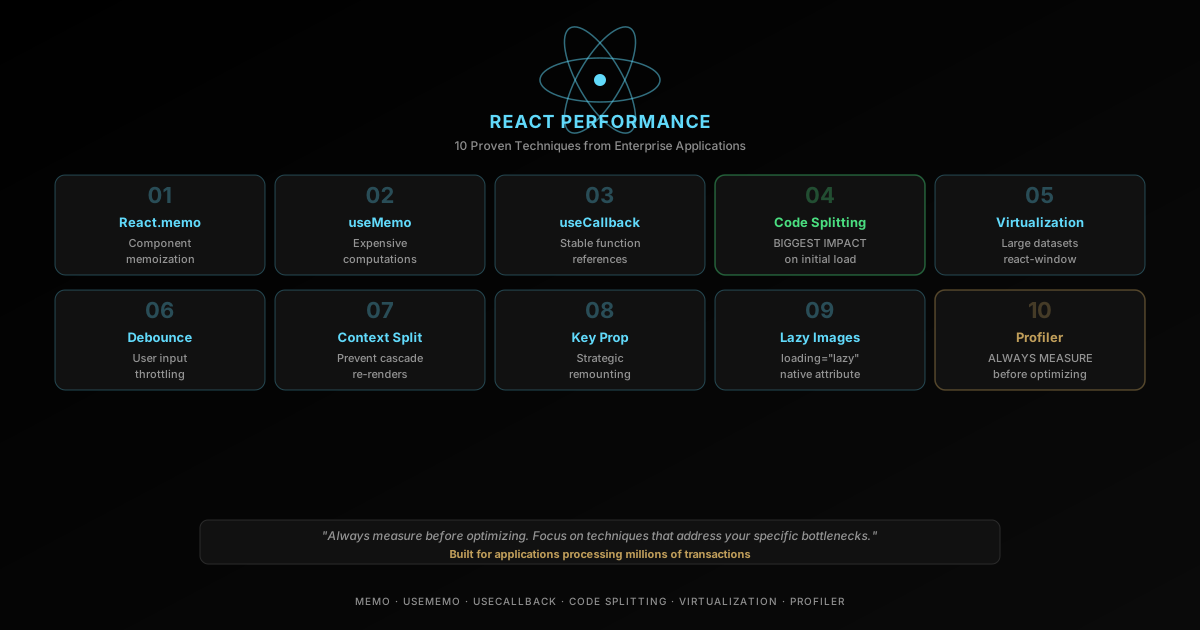
React Performance Optimization: 10 Proven Techniques
React performance optimization techniques — memoization, code splitting, virtualization, and 7 more battle-tested strategies from real apps.
Keep reading
Get new posts on AI, Claude Code & LLMs
New deep-dives on AI engineering, Claude Code, and developer tooling — follow along however you prefer.
About the Author

Software engineer writing about AI, Claude Code, LLMs, OpenAI, Anthropic, and developer tooling. 5+ years building production systems at Expedia Group, Tekion, and BYJU'S.