Spec-Driven Development for AI Agents (Addy Osmani)
Why AI coding agent prompts fail — and how spec-driven development fixes it, per Addy Osmani's 5-principle framework backed by GitHub's 2,500-config analysis.
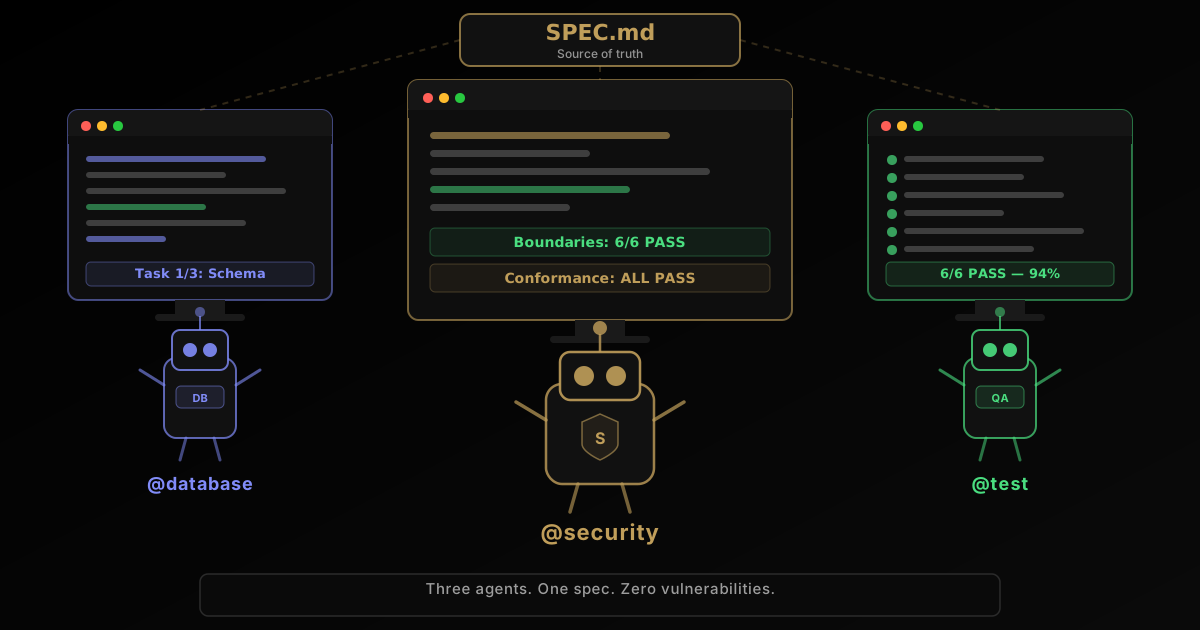
A senior engineer types into Claude Code: “Build me a user authentication system.” The AI agent generates 2,000 lines of code. Tests pass. The code gets merged to production. This is exactly the failure mode spec-driven development is built to prevent.
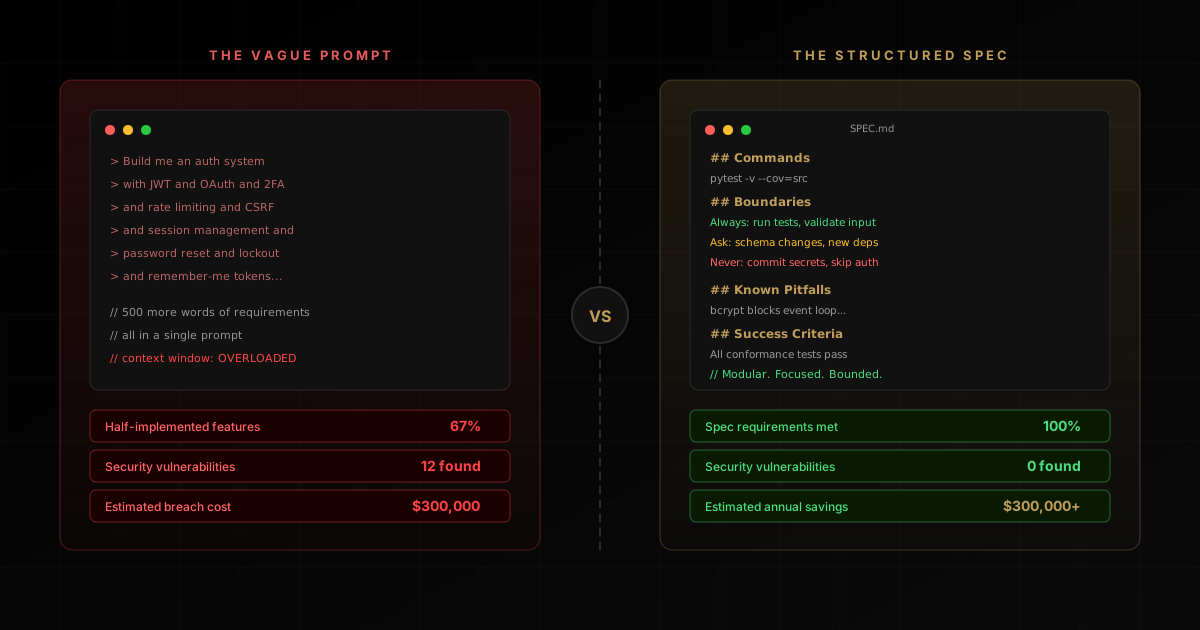
Three weeks later, user data leaks. The password hashing was plain text. Rate limiting did not exist. SQL injection vulnerabilities sat in every query that touched user input.
The estimated cost of the breach: $300,000 in incident response, legal fees, and customer compensation.
The root cause was not the AI model. It was not the context window. It was not the tooling.
It was the spec.
On February 20, 2026, Addy Osmani — the engineering leader behind Google Chrome’s DevTools and the author whose work on web performance has shaped how millions of developers build software — published a piece on O’Reilly Radar that should be mandatory reading for every developer working with AI agents: “How to Write a Good Spec for AI Agents.”
His thesis is uncomfortable: the AI is not the bottleneck. Your specification is. And he has a five-principle framework, backed by GitHub’s analysis of over 2,500 agent configuration files, that proves it.
This is not another “prompt engineering tips” article. This is spec-driven development — a fundamental shift in how software gets built when your coworker is an LLM. And the gap between teams that get this right and teams that don’t is measured in six figures.
TL;DR
- Spec-driven development is the fix. Vague prompts, not weak models, are why AI-generated code fails in production.
- Osmani’s framework has five principles: draft from vision, structure like a PRD, break work into modular tasks, build in self-checks, and treat the spec as a living artifact.
- GitHub’s analysis of 2,500+ agent config files found teams covering all six spec areas (commands, testing, structure, style, git workflow, boundaries) shipped far fewer post-deployment bugs.
- The Curse of Instructions research shows piling more rules into one prompt makes an agent worse at following any of them — modular, focused prompts beat one giant instruction dump.
- Teams with real spec discipline report 60% fewer AI-related bugs, 40% faster reviews, and 3-5x higher code acceptance rates.
What Is Spec-Driven Development, Exactly?
Spec-driven development is the practice of writing a structured, version-controlled specification — not a one-off chat prompt — that an AI coding agent reads, drafts a plan against, and gets human-reviewed before it writes a single line of code.
WHY SPEC-DRIVEN DEVELOPMENT MATTERS
The core idea is simple: AI coding quality usually fails at the specification layer before it fails at the model layer.
FAILURE MODE
Vague prompts produce shallow, brittle code
The model fills in missing intent with guesses, which is exactly how security gaps and edge-case debt slip into production.
- Happy paths look complete
- Edge cases get skipped
- Reviewers inherit hidden ambiguity
RESEARCH
More instructions is not the same as better instructions
GitHub and Stanford research both point to the same constraint: overloaded prompts degrade adherence and output quality.
- 2,500+ config files analyzed
- Curse of Instructions effect is measurable
- Verbose specs can still fail badly
WORKFLOW
Specs become the shared source of truth
A stable `SPEC.md` lowers context loss, keeps future sessions aligned, and makes human review easier before any code lands.
- Write once, reuse repeatedly
- Approve plan before implementation
- Reduce session-to-session drift
ECONOMICS
Spec quality is a direct cost lever
Bad specs create review drag, incident risk, and rework. Good specs increase acceptance rates and reduce AI-related bugs.
- Less AI rework
- Faster review cycles
- Higher confidence in generated code
The Research That Broke the Illusion
Two studies converged in early 2026 to shatter the assumption that more instructions produce better AI output.
GitHub’s 2,500-file analysis. After studying over 2,500 AI agent configuration files across production repositories, GitHub’s team found that the vast majority fail because they are too vague — or, paradoxically, too verbose. Teams that covered all six core specification areas (more on those below) saw dramatically fewer post-deployment bugs. Teams that covered fewer than four saw code quality drop below human-written baseline.
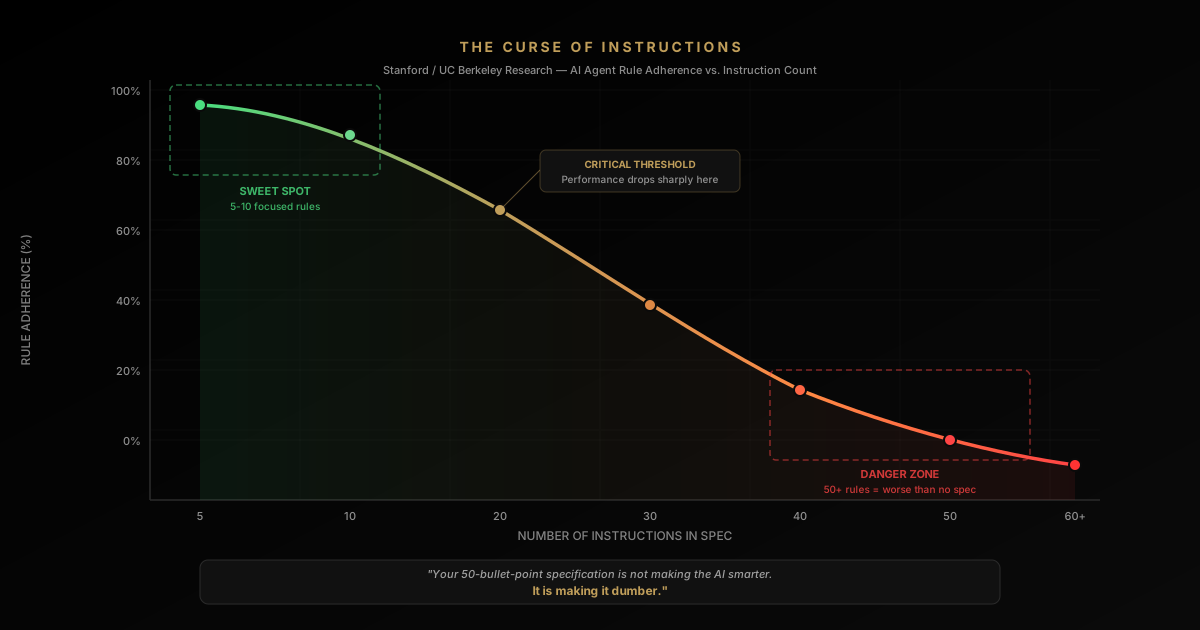
Stanford and UC Berkeley’s “Curse of Instructions.” Researchers published a study showing that as you pile more requirements into an AI prompt, performance in adhering to each individual rule drops significantly. Even GPT-5 and Claude Opus struggle when asked to satisfy dozens of requirements simultaneously.
Your 50-bullet-point specification is not making the AI smarter. It is making it dumber.
The DigitalOcean AI team arrived at the same conclusion from a different angle: “One task focus and relevant info only to the model, avoiding dumping everything everywhere.”
Simon Willison, the veteran developer whose brutally honest commentary on AI tools has made him one of the most trusted voices in the space, frames the whole dynamic in human terms:
“Working with AI agents is a very weird form of management. Getting good results feels uncomfortably close to managing a human intern.”
Managing an intern. Not programming a computer. That distinction is the key to everything that follows.
The Hidden Cost of Bad Specs
Before diving into the framework, it is worth quantifying what bad specs actually cost — because this is not theoretical.
Wasted development cycles. The average time to discover an AI-generated bug in production is two to three weeks. The average fix takes four to eight hours. Multiply that by 15 to 30 incidents per quarter, and you are looking at tens of thousands of dollars in engineering time alone.
Technical debt compound interest. AI-generated code that “works” but was not properly specified creates what engineers call “house of cards code” — it passes tests, it handles the happy path, and it collapses the moment a real user touches an edge case. Refactoring this code costs three to five times the original development time.
Trust erosion. When AI-generated code repeatedly causes incidents, teams stop trusting AI tools. Adoption declines. Code review overhead increases by 40-60%. The AI investment that was supposed to accelerate delivery becomes a drag on velocity.
Meanwhile, teams with robust spec frameworks report the inverse: 60% reduction in AI-related bugs, 40% faster code review, and three to five times higher code acceptance rates.
The math is straightforward. Investing in spec quality is not overhead. It is the highest-ROI activity in AI-assisted development.
BAD PROMPTS VS GOOD SPEC SYSTEMS
The distinction is not “short prompt” versus “long prompt.” It is unmanaged instruction dumping versus a staged specification workflow.
BAD PROMPT SYSTEM
One giant instruction blob
- Everything stuffed into a single prompt
- No boundaries, no approval gates, no reviewable stages
- The model half-remembers too many requirements
- Failures are discovered late, usually in code review or production
GOOD SPEC SYSTEM
A staged source of truth for the agent
- Start from intent, then let the model draft the detailed plan
- Review and refine the spec before implementation
- Break work into small, focused tasks with explicit success criteria
- Embed guardrails and self-checks directly into the process
The Five Principles That Separate Success From Disaster
Osmani’s framework distills years of production experience into five core principles. Each one addresses a specific failure mode that GitHub’s study identified. Each one is immediately actionable.
Principle 1: Start With Vision, Let the AI Draft the Details
Stop writing exhaustive specs from scratch. Start with a product brief.
This is counterintuitive for experienced engineers. We are trained to think through every edge case, every failure mode, every integration point before writing a line of code. But Osmani argues that LLMs excel at elaboration when given clear direction — and drift badly without it.
Here is the difference in practice:
The approach that fails:
Build an authentication system with JWT tokens, bcrypt password hashing
(12 rounds), rate limiting (10 requests per minute per IP), email
verification, password reset flow with expiring tokens, OAuth integration
for Google and GitHub, 2FA support, session management, remember-me
functionality, CSRF protection, account lockout after 5 failed attempts...
This continues for 500 words. The agent reads all of it, retains a fraction of it, and produces code that half-implements everything while fully implementing nothing.
The approach that works:
You are an AI software engineer. Draft a detailed specification for a
secure user authentication system for a SaaS application. Cover:
- Authentication methods (local + OAuth)
- Security requirements (industry standards)
- User flows (signup, login, password reset, 2FA)
- Constraints (must integrate with existing PostgreSQL database)
- Step-by-step implementation plan

Prioritize security and simplicity over feature completeness.
The agent expands this into a detailed plan. You review the plan. You refine it. Then — and only then — does the agent write code.
Tools already support this workflow. Claude Code’s Plan Mode restricts agents to read-only operations — the agent reads your codebase, analyzes the architecture, and produces a plan without touching a single file. GitHub’s approach goes further: their AI team promotes “spec-driven development where specs become the shared source of truth — living, executable artifacts that evolve with the project.”
Save the approved spec as SPEC.md in your repository. It becomes a persistent artifact for every future session — no re-explaining, no context loss, no drift.
Principle 2: Structure Like a Professional PRD
If your spec reads like a stream-of-consciousness Slack message, you are going to get stream-of-consciousness code.
Osmani argues that AI specs should be treated as formal, well-organized documents — structured like a Product Requirements Document (PRD) or System Requirements Specification (SRS). GitHub’s data backs this up. Their analysis of 2,500+ agent configuration files identified six core areas that consistently appear in effective specs:
| Section | What It Contains | Example |
|---|---|---|
| Commands | Full executable commands with flags | pytest -v --cov=src --cov-report=html |
| Testing | Framework, file locations, coverage targets | “Jest tests in __tests__/, 80% coverage minimum” |
| Project Structure | Explicit paths and conventions | ”src/ for app code, tests/ for unit tests” |
| Code Style | Real code snippets over prose descriptions | One example beats three paragraphs |
| Git Workflow | Branch naming, commit formats, PR rules | “Feature branches: feat/description” |
| Boundaries | What agents must never touch | Secrets, vendor dirs, production configs |
Notice the specificity. Not “run tests” — the full command with flags. Not “follow good practices” — a concrete code example. Not “be careful” — explicit boundaries.
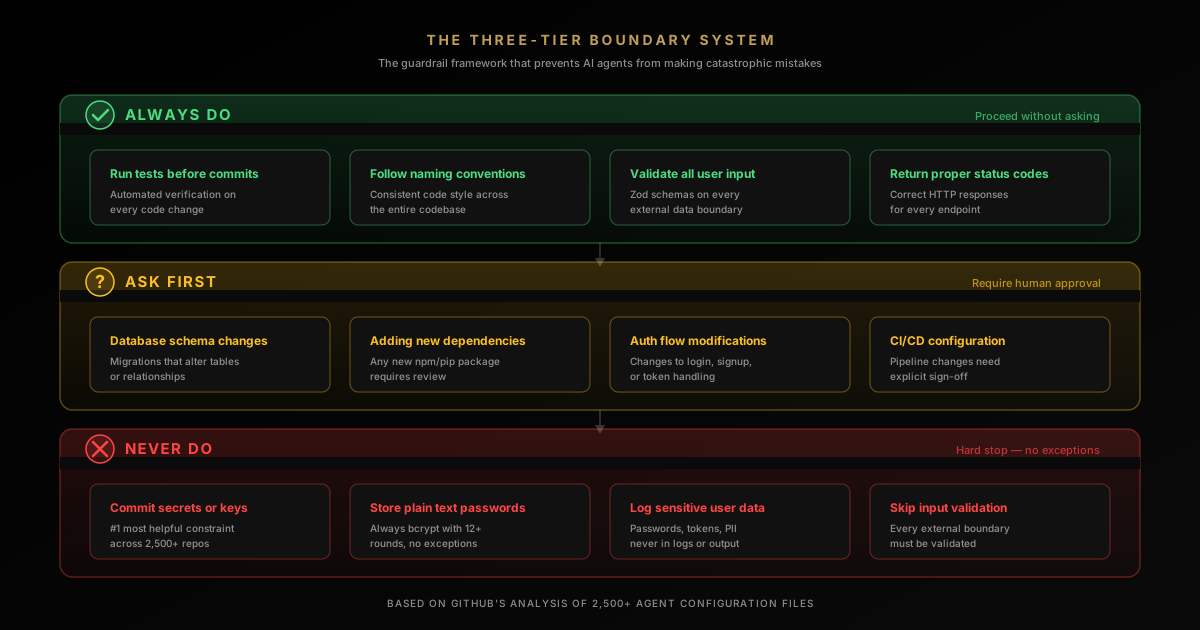
That last area — boundaries — is where the framework gets its teeth. “Never commit secrets” was the single most commonly helpful constraint across all analyzed repositories. Not architecture guidance. Not style preferences. A simple, hard boundary.
Osmani introduces a Three-Tier Boundary System that formalizes this:
Always (proceed without asking):
- Run tests before commits
- Follow naming conventions
- Validate all user input with Zod schemas
- Return appropriate HTTP status codes
Ask First (require human approval):
- Database schema changes
- Adding new dependencies
- Authentication flow modifications
- Changes to JWT secret rotation
Never (hard stops):
- Store passwords in plain text
- Commit secrets or API keys
- Log sensitive user data
- Edit
node_modulesor vendor directories - Skip input validation for any reason
When you codify these boundaries into a spec that lives in version control, every agent session starts with guardrails already in place. No more hoping the model remembers your verbal instruction from three prompts ago. No more discovering in production that the agent cheerfully committed your .env file.
Principle 3: Break Tasks Into Modular Prompts
This is the principle that will change most developers’ workflows overnight.
The instinct is to write one comprehensive prompt and let the agent figure it out. Osmani’s framework says the opposite: divide work into focused, sequential tasks. Feed the agent only the relevant section of your spec for each task.
The Curse of Instructions research makes the case quantitatively. An agent asked to simultaneously handle authentication, database design, API structure, frontend components, testing, and deployment will do all of them poorly. The same agent, given those tasks one at a time with focused context, will do each one well.
Here is modular prompting applied to the authentication example:
Task 1 — Database Schema:
Context: Auth service needs user storage.
Spec section: [Paste database schema requirements only]
Task: Generate migration file for users table.
Success criteria: Includes email (unique), password_hash, created_at, updated_at
Task 2 — Password Hashing:
Context: User model needs password methods.
Spec section: [Paste security requirements only]
Task: Add hashPassword() and verifyPassword() methods to User model.
Success criteria: Uses bcrypt with 12 rounds, includes error handling
Task 3 — JWT Generation:
Context: Login endpoint needs token generation.
Spec section: [Paste JWT requirements only]
Task: Create generateAuthToken() function.
Success criteria: Expires in 7 days, includes user ID and email claims
Each task is self-contained. The AI’s context window focuses on one problem. Review is easier. Debugging is simpler. And if task 2 fails, it does not contaminate tasks 1 or 3.
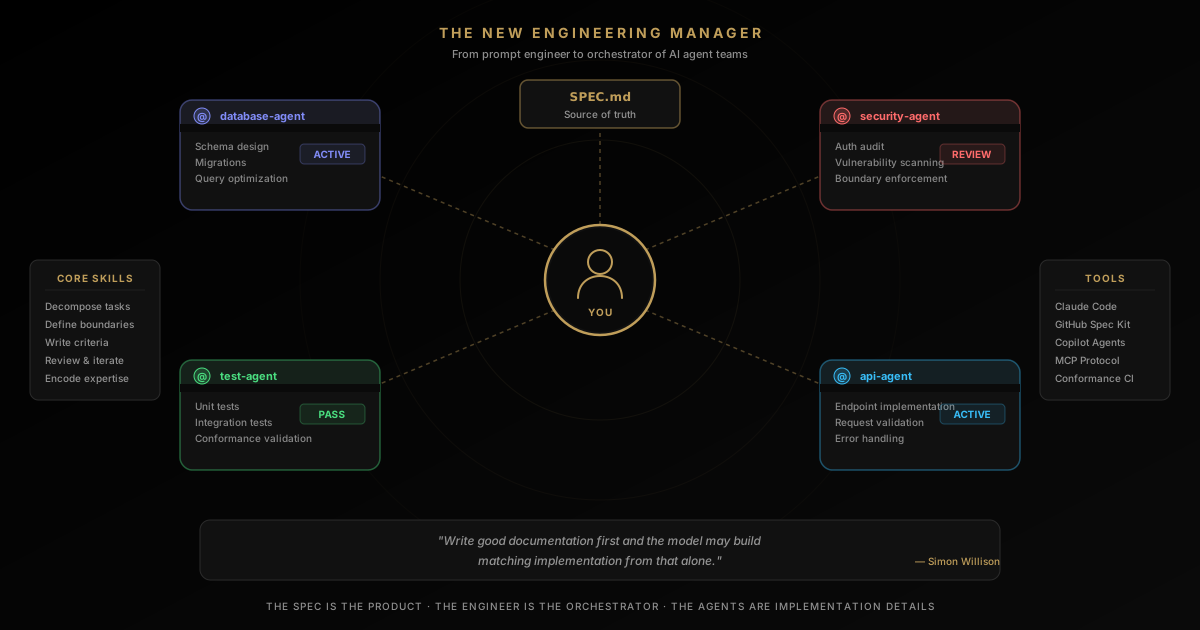
For larger codebases, Osmani recommends subagent specialization — multiple agents for different domains. A @database-agent handles schema design. A @security-agent audits for vulnerabilities. A @test-agent writes and runs tests. Each gets only the relevant portion of the spec. A main agent orchestrates the flow.
Simon Willison has been vocal about this approach, describing the experience of embracing “parallel coding agents” as “surprisingly effective, if mentally exhausting.” He recently coined the term “parallel agent psychosis” after losing track of code across multiple development environments — a real hazard of this workflow that developers need to plan for.
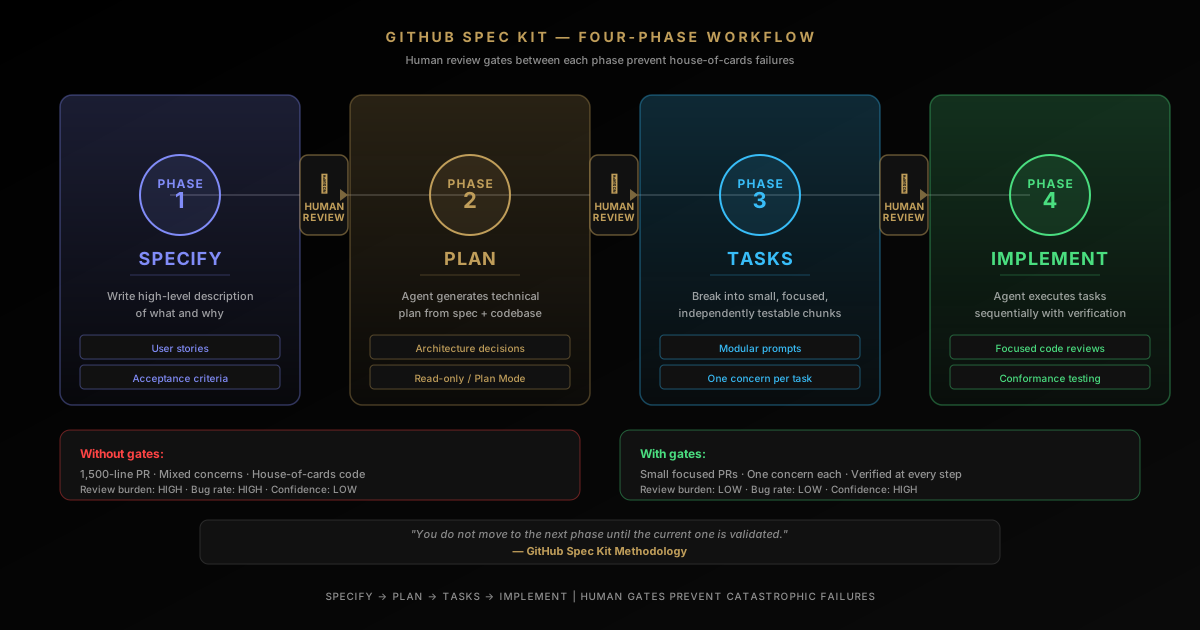
GitHub has formalized the overall approach into their Spec Kit Four-Phase Workflow:
- Specify — Write high-level description; agent generates detailed specification
- Plan — Agent produces comprehensive technical plan based on stack and constraints
- Tasks — Agent breaks spec and plan into small, reviewable, independently testable chunks
- Implement — Agent tackles tasks sequentially; focused reviews replace thousand-line code dumps
You do not move to the next phase until the current one is validated. This prevents the house-of-cards failure mode — AI output that looks solid in a 1,500-line PR but collapses the moment a real user touches it.
Principle 4: Build In Self-Checks and Domain Knowledge
Here is where Osmani’s framework addresses the thing most “prompt engineering” advice completely ignores: your expertise matters more than ever.
AI agents are confidently wrong. They will generate insecure code, skip edge cases, and violate best practices — all while passing basic tests and producing output that looks professional. The relationships between your database tables, the gotchas in your third-party libraries, the business rules that exist only in the heads of your senior engineers — none of that lives in the training data.
Osmani’s framework says to inject this knowledge directly into specs as Known Pitfalls:
## Known Pitfalls

### bcrypt Performance
On high-traffic endpoints, bcrypt hashing can block the event loop.
Solution: Use worker threads for password operations.

### JWT Token Rotation
Never invalidate active tokens immediately — users will be logged
out mid-session.
Solution: Support both old and new JWT secrets during rotation window.

### Rate Limiting Edge Cases
IP-based rate limiting fails with corporate NAT/proxies.
Solution: Also rate-limit by account ID after authentication.
This is mentorship embedded in the spec. The AI benefits from your ten years of production battle scars. No amount of training data contains the knowledge that your Stripe integration throws CardError for declined cards, not a generic PaymentError, and that you need to handle both.
Beyond domain knowledge, the framework introduces three self-verification patterns that turn specs into quality control mechanisms:
Post-implementation review prompts. Append to every task:
After implementing the authentication endpoint:
1. Verify password hashing uses bcrypt with 12 rounds
2. Confirm rate limiting is enabled (10 req/min per IP)
3. Check that JWT tokens expire in 7 days
4. Ensure all inputs are validated with Zod
5. List any spec requirements not yet addressed
This simple addition catches a remarkable number of omissions.
LLM-as-Judge. Use a second agent or prompt to review the first agent’s output against your quality guidelines:
You are a senior security engineer reviewing authentication code.
Check for:
- Password storage (must be hashed, never plain text)
- Input validation (all user input must be sanitized)
- Rate limiting (must be applied to all public endpoints)
- Error messages (must not leak sensitive information)

Flag any violations with severity (critical/high/medium/low).
This adds a layer of semantic evaluation beyond syntax checks. The reviewing agent does not need to understand the full codebase — it only needs the spec and the output.
Conformance testing. Build language-independent test suites derived directly from your spec and treat them as contracts:
# auth-conformance.yaml
tests:
  - name: "Register with valid email"
    request:
      method: POST
      endpoint: /auth/register
      body:
        email: "test@example.com"
        password: "SecureP@ss123"
    expect:
      status: 201
      response:
        contains: ["token", "user"]

  - name: "Register with duplicate email fails"
    request:
      method: POST
      endpoint: /auth/register
      body:
        email: "test@example.com"
        password: "SecureP@ss123"
    expect:
      status: 409
      response:
        contains: ["error"]
Include this in your spec: “Must pass all tests in auth-conformance.yaml.” The spec becomes enforceable, not aspirational.
The governing principle behind all of this: “You remain the exec in the loop.” Specs empower agents, but human judgment is the final filter. Always.
Principle 5: Test, Iterate, and Evolve
Specs are not documents. They are software.
This final principle is what separates Osmani’s framework from static “best practices” guides. He argues that specs should be treated as living artifacts subject to the same version control, testing, and iteration cycles as the code they describe.
The continuous loop:
- Write spec — initial requirements and structure
- AI implements — agent generates code from spec
- Run tests — automated and manual verification
- Find gaps — discover missing requirements or ambiguities
- Update spec — incorporate learnings
- Resync agent — “Spec updated as follows… adjust accordingly”
- Repeat — continuous improvement
Version control the spec alongside the code:
git add SPEC.md
git commit -m "feat(spec): add JWT token rotation requirements"
Track what changed and why. When the agent’s output reveals a gap in your spec — and it will — update the spec before fixing the code. The spec is the source of truth; the code is derived from it.
For large projects where feeding the entire spec in every prompt is impractical, Osmani recommends tooling-level solutions: RAG (Retrieval-Augmented Generation) to let agents pull relevant spec chunks on demand, MCP (Model Context Protocol) to automate context feeding based on the current task, and Context7 to auto-fetch relevant documentation snippets based on what the agent is working on.
Cost optimization matters here too. Use cheaper, faster models for initial drafts and routine tasks. Reserve top-tier models for critical implementation steps and complex reasoning. Not every task needs Opus-level intelligence. A test runner agent needs far less capability than a system architecture agent.
The Anti-Patterns That Kill AI Projects
GitHub’s analysis and production experience across thousands of repositories reveal failure modes that recur with remarkable consistency. Osmani’s framework implicitly addresses all of them — but it is worth naming them explicitly so you can recognize them in your own workflows.
Anti-Pattern 1: The Vague Prompt
❌ "Build me a REST API for user management."What the AI hears: “Generate something API-shaped with users and hope for the best.”
Result: Basic CRUD endpoints. No authentication. No validation. No error handling. No tests.
✅  "Build a REST API for user management with:
    - Endpoints: POST /users, GET /users/:id, PUT /users/:id
    - Auth: JWT tokens required (except POST /users)
    - Validation: Email format, password strength (8+ chars, mixed case)
    - Error handling: Consistent JSON error responses with status codes
    - Tests: Unit tests for all endpoints (Jest + Supertest)
    - Tech: Express 4.18+, TypeScript, PostgreSQL via Prisma"
Result: Functional, secure, testable API.
Anti-Pattern 2: The Context Dump
Pasting an entire 50-page product specification into a single prompt. The Curse of Instructions research proves this degrades performance. The agent loses focus. Key requirements get buried. You pay more tokens for worse output.
The fix: extended table of contents. After drafting your full spec, prompt: “Summarize the spec above into a concise outline with each section’s key points and reference tags.” Feed the outline per task, referencing the full spec only when needed.
Anti-Pattern 3: Skipping Human Review
AI passes tests. Code gets merged. Nobody reads it.
What gets missed: edge cases not covered by tests, security vulnerabilities in “clever” AI solutions, performance issues under scale, code that “works” but violates every best practice in the codebase.
Willison’s rule applies: never commit code you could not explain to someone. AI-generated code can look solid while being structurally fragile.
Anti-Pattern 4: Confusing Vibe Coding With Production
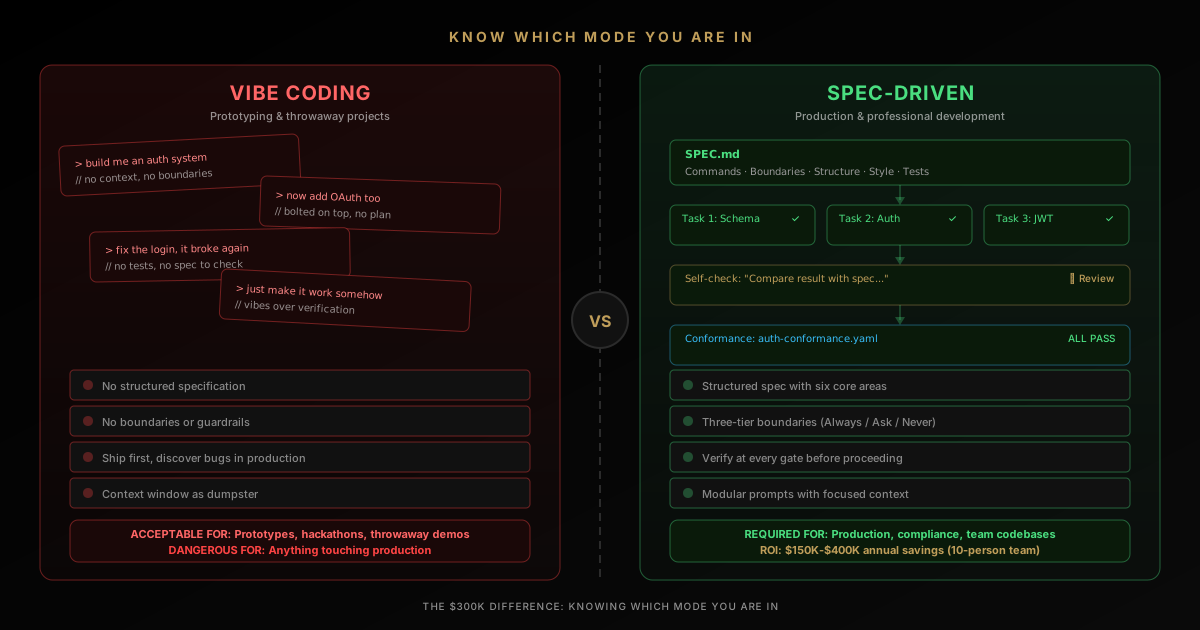
Vibe coding — rapid prototyping with AI for throwaway projects — is genuinely useful. The mistake is applying vibe coding practices to production systems.
Prototype with loose specs. Ship with tight specs. Know which mode you are in. The $300,000 authentication breach at the top of this article did not happen because the AI was bad at coding. It happened because someone used a prototype-grade prompt for production-grade work.
Why Does Spec-Driven Development Matter Right Now?
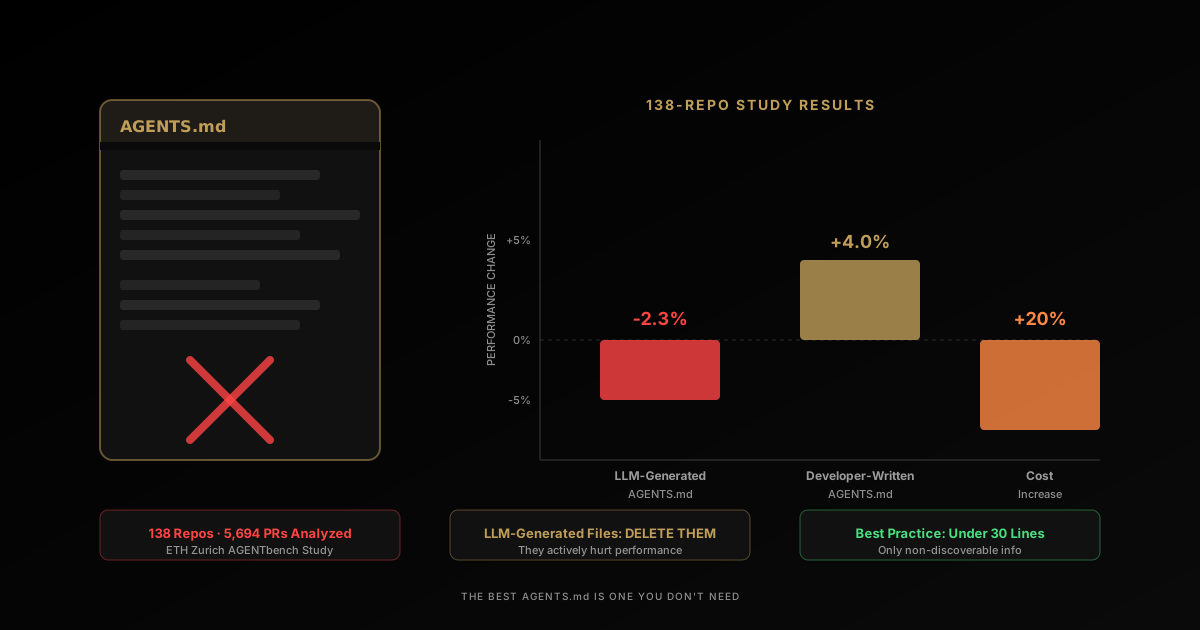
A few weeks ago, I covered the ETH Zurich study that tested AGENTS.md files across 138 repositories and 5,694 pull requests. The findings were stark: LLM-generated instruction files actually hurt agent performance by 2-3%, while even hand-written ones improved it by only 4% — and both increased inference costs by over 20%.
That study answered the question of what is not working. Osmani’s framework answers why — and more importantly, what to do instead.
The patterns align perfectly:
ETH Zurich found agents spent 14-22% more reasoning tokens processing context files. Osmani’s modular prompting approach directly addresses this by feeding only relevant context per task.
The researchers found that repository overviews did not guide agents to relevant files. Osmani’s framework says to skip overviews entirely and provide explicit paths, specific commands, and real code examples.
The researchers found that LLM-generated context files primarily duplicate existing documentation. Osmani’s framework says to start with vision and let the agent draft details from the actual codebase — not from a meta-document about the codebase.
This is convergent evidence from independent sources pointing to the same conclusion: the era of “throw everything at the context window” is over. Spec-driven development — structured, modular, iterative, boundary-aware — is what actually works.
The Tooling Is Already Here
What makes this framework immediately actionable is that the tooling ecosystem has caught up to the methodology:
- Claude Code ships with Plan Mode for read-only analysis before code generation, and supports subagent architectures for parallel task execution
- GitHub’s Spec Kit implements the four-phase specify-plan-tasks-implement workflow with human gates between each phase
- GitHub Copilot supports
agents.mdpersona files for specialized agent configurations —@docs-agent,@test-agent,@security-agent— each with focused specs for their domain - MCP (Model Context Protocol) standardizes how tools feed context to agents, enabling spec-aware context management
- Anthropic Skills provide reusable, Markdown-based agent behaviors that snap into existing workflows
This is not a “maybe someday” situation. Every piece of the framework can be implemented today.
The Real Shift: From Prompt Engineer to Engineering Manager
Here is the part Osmani implies but never quite says outright, so I will.
Spec-driven development is not a prompting technique. It is a management discipline. Writing a good spec for an AI agent requires the same skills as writing a good brief for a junior engineer: clarity of vision, explicit boundaries, structured deliverables, built-in checkpoints, and the discipline to review work incrementally rather than waiting for a big-bang delivery.
The developers who will thrive in the AI-augmented era are not the ones who master exotic prompt syntax. They are the ones who can:
- Decompose ambiguous requirements into clear, testable tasks
- Define boundaries that prevent catastrophic errors
- Write acceptance criteria that leave no room for interpretation
- Review and iterate with discipline, not just once at the end
- Encode domain knowledge that no training dataset contains
These are not new skills. They are the skills that made senior engineers valuable before AI agents existed. The difference is that now, instead of applying them to human teams of five or ten, you are applying them to AI agents that can execute at the speed of inference.
Willison captured this shift with his usual precision: “Write good documentation first and the model may build matching implementation from that alone.”
Documentation. Specifications. Clear requirements. The boring stuff. The stuff that every engineer knows they should write but most don’t.
It turns out the boring stuff is the whole game now.
Your First AI Agent Spec: The Template
Copy this. Fill it in. Commit it to your repo. The 30 minutes you spend on this will save you 30 hours of debugging over the next month.
# [Project Name] — AI Agent Specification

## Overview
[2-3 sentences: what you are building and why]

## Tech Stack
- Language/Framework: [exact versions]
- Database: [type + version]
- Key libraries: [list with versions]

## Commands
- Build: `[exact command with flags]`
- Test: `[exact command with flags]`
- Lint: `[exact command with flags]`
- Type check: `[exact command with flags]`

## Project Structure
- src/ → [describe organization]
- tests/ → [describe organization]
- docs/ → [describe organization]

## Code Style
[Include 1-2 real code examples showing preferred patterns]

## Git Workflow
- Branch naming: [format]
- Commit format: [format]
- PR requirements: [list]

## Testing
- Framework: [name]
- Coverage minimum: [percentage]
- Location: [directory]
- Run before: [every commit / merge / deploy]

## Boundaries

### Always Do
- [Action agents should always take without asking]
- [Action agents should always take without asking]
- [Action agents should always take without asking]

### Ask First
- [Action requiring human approval before proceeding]
- [Action requiring human approval before proceeding]

### Never Do
- [Hard stop — agent must never do this under any circumstance]
- [Hard stop — agent must never do this under any circumstance]
- [Hard stop — agent must never do this under any circumstance]

## Known Pitfalls
- [Common mistake 1 — what goes wrong + the correct solution]
- [Common mistake 2 — what goes wrong + the correct solution]

## Success Criteria
- [How you will know it is done]
- [What good looks like]
- [Edge cases that must be handled]
Then start your first agent session with: “Read SPEC.md and draft an implementation plan. Do not write any code yet.”
FAQ
Questions readers usually have
Sources
- Addy Osmani, How to Write a Good Spec for AI Agents (O’Reilly Radar, February 2026)
- GitHub, Lessons from over 2,500 repositories — how to write a great AGENTS.md
- GitHub, Spec Kit — the open-source four-phase spec-driven development toolkit
- Stanford / UC Berkeley, The Curse of Instructions
- Simon Willison, simonwillison.net — ongoing commentary on AI coding agent workflows
The Bottom Line
Addy Osmani did not write a prompt engineering guide. He wrote a management handbook for the age of AI agents. And the core message is both simple and profound:
The spec is the product.
When your specification is clear, structured, modular, boundary-aware, and continuously tested — the agent is almost an implementation detail. It will follow good specs the same way a competent engineer follows good requirements.
When your specification is vague, monolithic, boundary-free, and static — no model on earth will save you. Not Opus. Not GPT-5. Not whatever ships next quarter.
One approach costs six figures a year in preventable bugs, security incidents, and technical debt. The other saves six figures a year in faster reviews, higher acceptance rates, and code that actually works in production.
The bottleneck was never the AI. It was always the brief.
Now we have a framework to fix it.
Explore more: AI Coding Agents — Agentic AI for Developers · Claude Code
This article is based on Addy Osmani’s How to Write a Good Spec for AI Agents (O’Reilly Radar, February 2026), GitHub’s analysis of 2,500+ agent configuration files, Stanford/UC Berkeley’s Curse of Instructions research, and production observations from Simon Willison, the Anthropic engineering team, and the DigitalOcean AI team.
Google Search · Preferred sources
Prefer this site on Google
If you already read this writing, add umesh-malik.com as a Preferred Source. Google can then highlight it with a preferred badge in Top Stories, AI Overviews, and AI Mode — for you, not as a site-wide ranking boost.
Related Articles
AI Coding Agents & DX
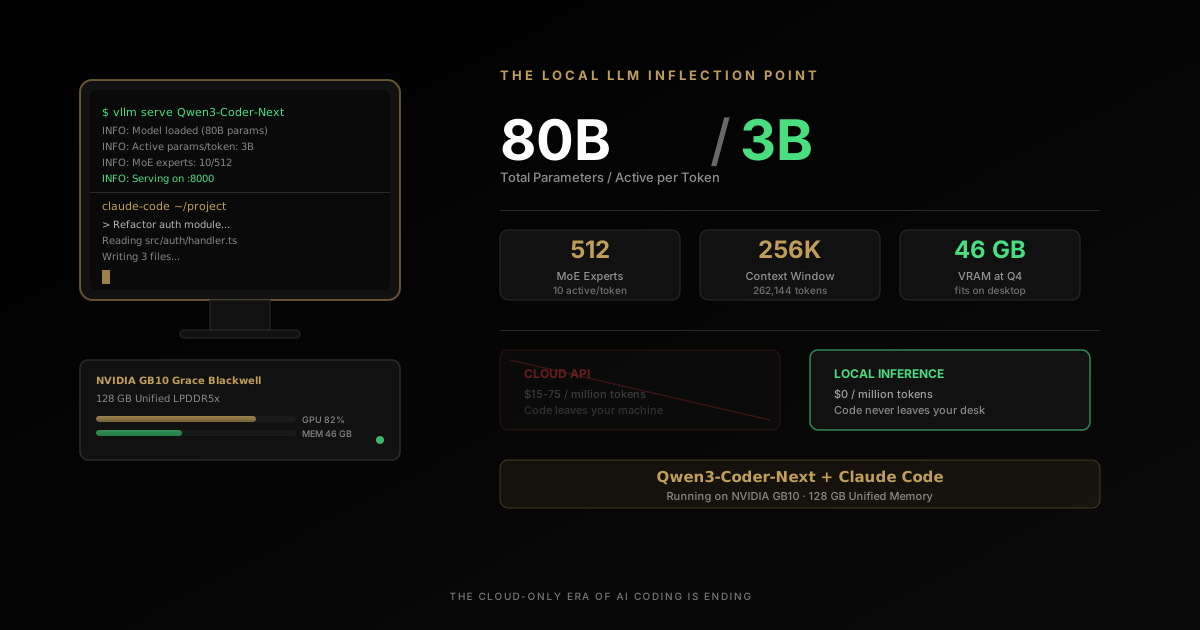
Qwen3-Coder: Run an 80B-Parameter LLM on Your Desktop
Qwen3-Coder runs 80B parameters on a desktop with only 3B active per token — and plugs into Claude Code. Why the cloud-only era of AI coding is ending.
AI Coding Agents & DX
AGENTS.md Files Don't Work the Way You Think — A 138-Repo Study
A 138-repo study: AGENTS.md files hurt performance by 2-3% and raised costs 20%+. What the research found — and what actually works instead.

AI Coding Agents & DX
How to Switch Between Multiple Claude Code Accounts Without Re-Logging In (claude-swap Guide)
claude-swap is an open-source CLI that switches Claude Code accounts in seconds — no browser re-login. How it works, how to use it, and what it misses.
Keep reading
Get new posts on AI, Claude Code & LLMs
New deep-dives on AI engineering, Claude Code, and developer tooling — follow along however you prefer.
About the Author

Software engineer writing about AI, Claude Code, LLMs, OpenAI, Anthropic, and developer tooling. 5+ years building production systems at Expedia Group, Tekion, and BYJU'S.