How to Switch Between Multiple Claude Code Accounts Without Re-Logging In (claude-swap Guide)
claude-swap is an open-source CLI that switches Claude Code accounts in seconds — no browser re-login. How it works, how to use it, and what it misses.

If you use Claude Code seriously, you have hit the wall: a usage limit pops up mid-task, and the only “official” way to keep going is to /logout, open a browser, run the OAuth dance again, and pray your session state survives. Do that three times a day and it stops being a minor annoyance — it becomes a tax on your focus.
claude-swap is the open-source CLI that deletes that tax. The short answer is simple: it backs up the OAuth credentials for each of your Claude accounts and swaps them in and out of Claude Code’s credential store on demand. Switching accounts goes from a 60-second browser ritual to a single command — cswap switch.
If you searched for how to switch Claude Code accounts, how to change your Claude account in VS Code or Cursor, using multiple Claude accounts, or getting past Claude Code rate limits without logging out, this is the practical teardown: what it is, why it exists, how it actually works under the hood, how to use it, and — just as importantly — where it falls short.
Install it in one command:
uv tool install claude-swapThat’s the whole setup. Then, with Claude Code already logged into your first account, cswap add captures it; log in as the second account and run cswap add again. From then on, cswap switch rotates between them. Full details in How to use claude-swap, and every flag in the command reference.
CLAUDE-SWAP AT A GLANCE
Python 3.12+
Runtime
install via uv or pipx
CLI + VS Code
Works with
Claude Code and its forks
OS-native
Credential storage
Keychain or protected files
MIT
License
community project by realiti4
TL;DR
- claude-swap (CLI:
cswap) lets you keep multiple Claude accounts registered and switch the active one in seconds — no logout, no repeated browser OAuth. - It works by backing up and restoring Claude Code’s OAuth tokens plus the account section of
~/.claude/.claude.json, using OS-native secure storage (the macOS Keychain) or protected files where a keychain isn’t available. - The killer use case is dodging usage limits: when one account taps out,
cswap switchrotates to the next so you keep working — andcswap autocan make that switch for you before you hit the wall. - It covers the CLI and the VS Code extension (including VS Code forks like Cursor), because they all read the same on-disk credential store. It does not touch the Claude Desktop app or claude.ai.
- You usually don’t need to restart. On Linux and Windows the new account applies on your next message; on macOS the Keychain cache clears after roughly 30 seconds. Restart only if you want it instantly.
- It is unofficial — an MIT-licensed community project by realiti4, not an Anthropic product. Treat account-juggling as a personal-productivity tool and stay aware of your plan’s terms.
What Is claude-swap?
💡 Key insight: claude-swap doesn’t run multiple Claude sessions at once. It stores the credentials for several accounts and hot-swaps which one Claude Code sees as “logged in.”
claude-swap is a multi-account switcher for Claude Code, built and maintained by the open-source developer realiti4. You register each account once, and from then on you can rotate between them with a single command instead of logging out and back in through the browser. It works with both the Claude Code CLI and the official VS Code extension — and, by extension, VS Code forks like Cursor that install the same extension — because they all read from one credential store on your machine.
Under the surface it does exactly one clever thing well: it treats your OAuth tokens as a swappable asset. Claude Code keeps the active account’s credentials in one place; claude-swap keeps a backup of every account’s credentials in its own vault, and “switching” simply means copying the right backup back into the live store.
The tool installs as a Python package and exposes a cswap command. It’s MIT-licensed, actively developed, and built by the community — not Anthropic. This post is an independent teardown; I don’t maintain the project.
Why It Exists: The Problem It Solves
Claude Code’s value is its flow. You get into a loop with the agent, it’s editing files and running tests, and then — limit reached. On Pro and Max plans there are rolling session and weekly caps, and the moment you hit one, the native fix is brutal to your momentum:
/logoutout of the current account.- Re-authenticate the second account through a browser OAuth redirect.
- Re-establish your working context and hope nothing got lost.
People run into this constantly because having more than one Claude account is normal now, not exotic:
- A personal account and a separate work or client-billed account.
- Multiple Max subscriptions specifically to extend daily working hours.
- A team setup where different accounts map to different billing buckets.
claude-swap exists because the credentials for all those accounts are just files and keychain entries. There’s no technical reason switching should require a browser round-trip — so the tool removes it. You pay the OAuth cost once per account, and every switch after that is instant.
The other escape hatch when you’re genuinely out of cloud capacity is to stop depending on the cloud at all and run a capable coding model locally. But if you’re committed to Claude — and most of us are, for good reason — claude-swap is the pragmatic fix that keeps you in the tool you already like.
How claude-swap Works (Under the Hood)
This is where it gets interesting, because the design is refreshingly simple. Claude Code reads its credentials from one location at startup. claude-swap intercepts the backup and restore of that location.
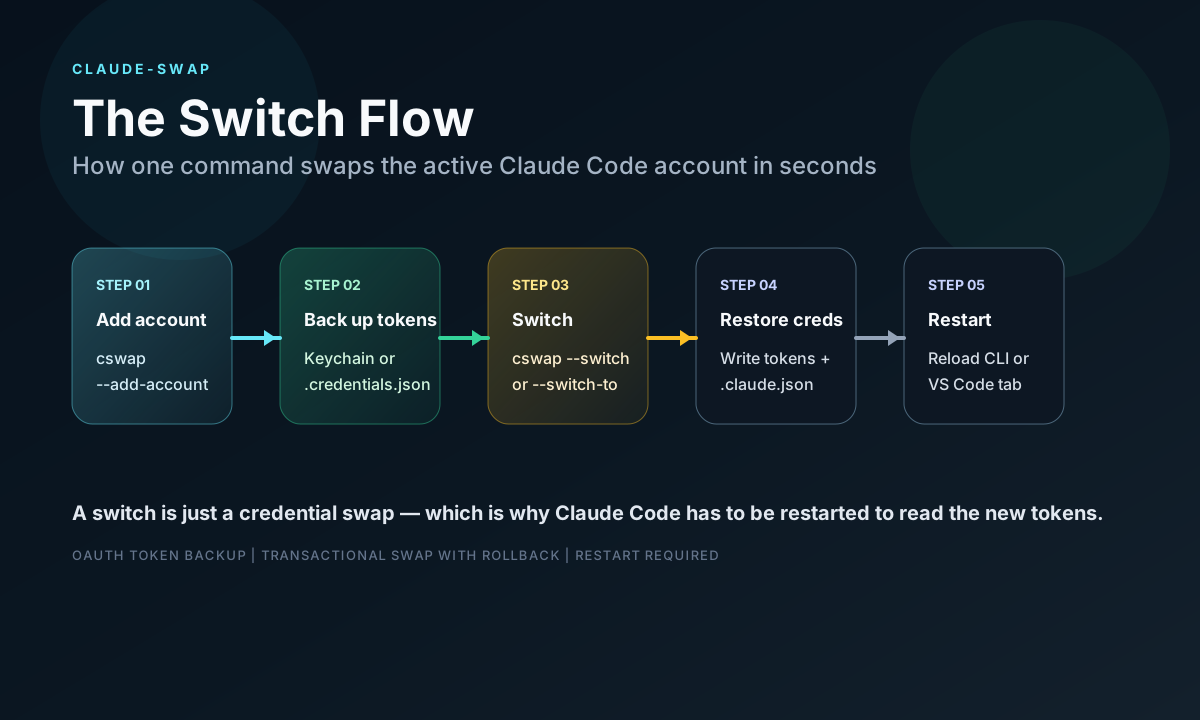
Where the credentials live
The live store is platform-specific, and claude-swap respects each platform’s conventions:
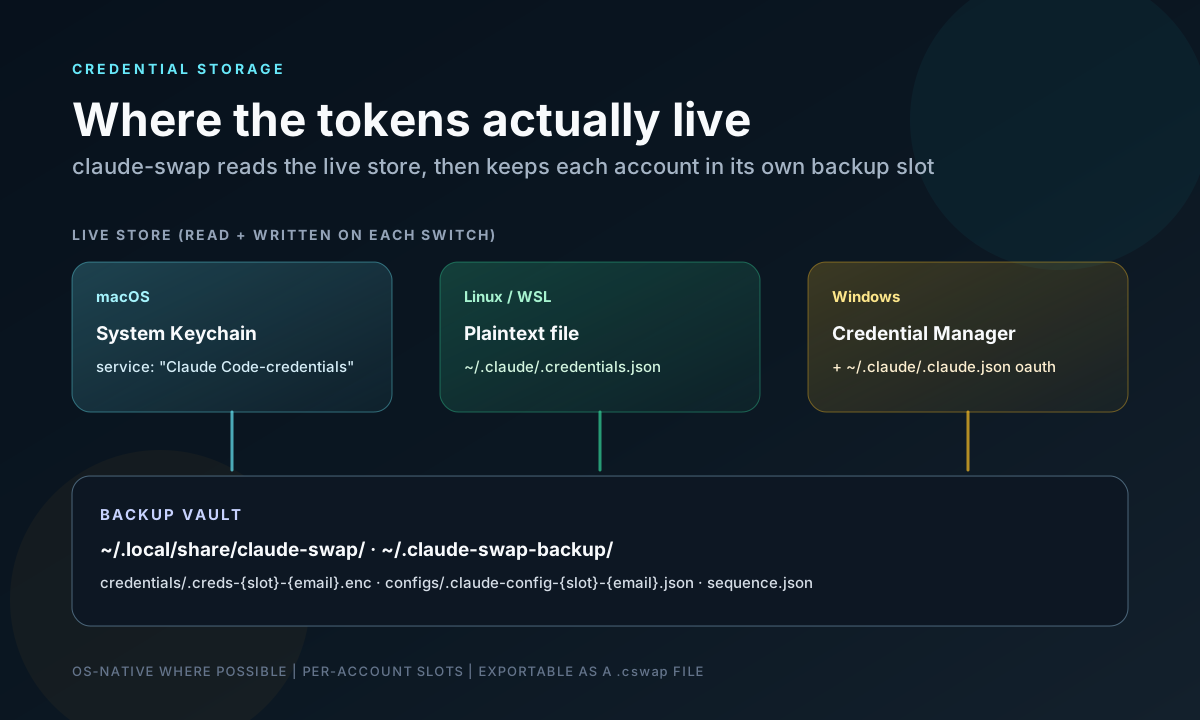
- macOS — the system Keychain, under the service name
Claude Code-credentials. - Linux / WSL — a plaintext file at
~/.claude/.credentials.json. - Windows — a protected credential store, plus the account section of
~/.claude/.claude.json.
That platform split is also why the switch feels different per OS: a file change is picked up immediately, a Keychain read is cached for a while.
claude-swap keeps its own backups in a vault directory — ~/.local/share/claude-swap/ on Linux and WSL (overridable with the XDG_DATA_HOME environment variable), ~/.claude-swap-backup/ on macOS and Windows — with one slot per account.
claude-swap backup vault
claude-swap/
├── credentials/           # per-account credential backups
├── sessions/              # profiles for session mode (cswap run)
├── settings.json          # tool preferences (cswap config)
└── autoswitch_state.json  # cooldown + quarantined accounts
The switch lifecycle
WHAT HAPPENS ON cswap switch
A switch is a locked credential swap, not a session change. Taking the same locks Claude Code uses is what keeps a half-finished switch from leaving you logged into nobody.
STEP 01
Back up the current account
Before touching anything, it snapshots the live credentials and config of whoever is active right now into that account’s slot.
STEP 02
Load the target account
It reads the target slot’s stored tokens and the saved account details for that slot.
STEP 03
Write into the live store
Holding the same credential locks Claude Code itself uses, it writes the target credentials back to the live store and patches the account section of ~/.claude/.claude.json.
STEP 04
Leave everything else alone
Only the account-specific login is swapped. Account-independent OAuth state, such as your MCP server logins, is preserved rather than overwritten by an older snapshot.
That locking is the part most “swap a config file” hacks get wrong. Because the swap holds Claude Code’s own credential locks, it can never interleave with a token refresh happening at the same moment — so a switch is safe to run while Claude Code is mid-task.
The one platform wrinkle: on macOS, Claude Code caches the Keychain read for about 30 seconds. A running session picks up the new account once that cache expires. On Linux and Windows the credentials live in a file that Claude Code re-reads on change, so the switch applies on your next message. Either way, restarting the CLI or reopening the VS Code extension tab makes it instant.
How To Use claude-swap
Installation
The recommended path is uv, but pipx works just as well:
# Recommended
uv tool install claude-swap

# Or with pipx
pipx install claude-swap

# From source
git clone https://github.com/realiti4/claude-swap
cd claude-swap
uv sync
Upgrades are equally boring (the good kind):
uv tool upgrade claude-swap      # or: pipx upgrade claude-swap
cswap upgrade # self-update, auto-detecting your installerRegister your accounts
You add accounts one at a time. Log into the account you want to capture first (via normal Claude Code login), then register it:
# Log into account A in Claude Code, then:
cswap add

# Switch the Claude Code login to account B, then:
cswap add
Each cswap add captures whoever is currently logged in. When a token later expires, log back in with that account and re-run cswap add — it updates the existing slot rather than creating a duplicate.
Switch, list, and check status
cswap switch                # rotate to the next account in sequence
cswap switch 2              # switch to a specific slot number...
cswap switch you@work.com   # ...by email...
cswap switch dev            # ...or by an alias set with: cswap alias 2 dev
cswap list                  # show accounts, 5h/7d usage, and reset times
cswap status                # show which account is active right now
cswap tui                   # interactive dashboard (or just: cswap)
Not sure which account to jump to? cswap switch --strategy best picks the one with the most quota left, and --strategy next-available skips anything currently rate-limited.
Let it switch for you before you hit a limit
cswap auto is the piece that closes the loop. It polls your usage and rotates to a fresher account when the active one nears its 5-hour or 7-day limit — so you find out you were near a wall rather than hitting one:
cswap auto                     # foreground loop, polls every 60s
cswap auto --threshold 80      # switch earlier than the default 90%
cswap auto --once              # single check-and-switch, for cron
cswap auto --dry-run           # log what it would do, never switch
A cooldown plus a hysteresis margin stops it flip-flopping between two accounts hovering at the threshold, and switches take Claude Code’s credential locks, so running it alongside an active session is safe.
Run two accounts at the same time
Session mode launches Claude Code as a specific account in the current terminal only — every other terminal and the VS Code extension stay on your default login:
cswap run 2                  # launch Claude Code as account 2, here only
cswap run 2 -- --resume      # anything after -- is forwarded to claude
cswap run 2 --share-history  # share chat history with this account too
cswap map 2 ~/work/client-app  # bind a directory: bare `cswap run` picks account 2 there
Each account keeps its own chat history by default, and sessions reuse your normal ~/.claude setup — settings, CLAUDE.md, skills, MCP servers.
Headless and CI: register by token
On a server with no browser, you can’t do interactive OAuth. claude-swap lets you register an account directly from a setup token or a managed API key:
cswap add-token sk-ant-oat01-...   # OAuth setup token from: claude setup-token
cswap add-token sk-ant-api03-...   # managed API key
cswap add-token - --slot 3         # read the token from stdin
Move accounts between machines
Export creates a portable .cswap file; import restores it on another machine. This is the answer to “I set all this up on my laptop, now I need it on the work desktop” — you move the registered logins instead of doing the browser OAuth dance once per account per machine:
cswap export backup.cswap             # all accounts
cswap export backup.cswap --account 2 # just one
cswap export backup.cswap --full      # include full config, for same-PC backups
cswap import backup.cswap             # skips accounts that already exist
cswap import backup.cswap --force     # overwrite existing accounts
Two things worth knowing. By default the export carries only each account’s own login — machine-shared MCP and plugin OAuth tokens stay on the source machine, which is usually what you want. And if the imported account is the one you’re already logged in as, activate the imported credentials explicitly with cswap switch N --force; a plain switch to the already-active account is a safe no-op and won’t touch the import.
Command Reference
Every claude-swap command is a subcommand of cswap, and the ten you actually need day to day are add, switch, list, status, auto, run, remove, export, import, and tui. The rest are conveniences you’ll reach for once and then forget about.
| Command | What it does | Typical use |
|---|---|---|
| cswap add | Register the currently logged-in account into a slot (re-run to refresh an expired one) | Setup |
| cswap switch | Rotate to the next account in sequence | Daily |
| cswap switch N|email|alias | Activate a specific account by slot number, email, or alias | Daily |
| cswap auto | Watch usage and switch automatically before a rate limit lands | Background |
| cswap run N | Launch Claude Code as that account in this terminal only, so two accounts run in parallel | Parallel work |
| cswap map N DIR | Bind a directory to an account so a bare cswap run there picks it | Per-repo setup |
| cswap list | Dashboard of every account with 5-hour and 7-day usage plus reset times | Daily |
| cswap status | Show which account is active right now | Daily |
| cswap tui / cswap watch | Full-screen interactive dashboard, keyboard-driven | Monitoring |
| cswap alias N NAME | Give an account a short name usable anywhere a slot number works | Setup |
| cswap disable / enable N | Hold an account out of rotation without removing it, then put it back | Occasional |
| cswap move N M | Relocate an account to a different slot number | Occasional |
| cswap remove N|email | Unregister an account | Cleanup |
| cswap add-token TOKEN | Register from a raw OAuth setup token or API key, no browser needed | Headless / CI |
| cswap export / import PATH | Back up or migrate accounts as a .cswap file | New machine |
| cswap config | Show or edit tool settings, with validation | Tuning |
| cswap upgrade | Update claude-swap to the latest release | Maintenance |
| cswap purge | Erase all claude-swap data | Uninstall |
Add --json to list, status, or switch when you’re scripting: each emits one machine-readable object on stdout, with human-readable notices kept on stderr.
How Do You Change Your Claude Account in VS Code or Cursor?
You change your Claude account in VS Code or Cursor from a terminal, not from the editor UI: run cswap switch (or cswap switch you@work.com), then close and reopen the Claude Code tab. There is no account picker inside the extension, and there doesn’t need to be — the extension and the CLI read the same credential store, so a switch made anywhere on the machine applies everywhere on it.
The reason this trips people up is that the extension looks like a self-contained app. It isn’t. Anthropic’s own docs are explicit that Claude Code settings in ~/.claude/settings.json are shared between the extension and the CLI, and the login sits in the same place. Change the login underneath and the extension follows.
The exact sequence:
SWITCHING ACCOUNTS INSIDE VS CODE OR CURSOR
Three steps, one of which is optional. The whole thing takes about five seconds once your accounts are registered.
STEP 01
Run the switch in any terminal
Use VS Code’s integrated terminal or a separate one — it makes no difference. Run cswap switch to rotate, or cswap switch 2 to jump to a specific account.
STEP 02
Reload the Claude Code tab
Close and reopen the extension tab. On Linux and Windows the switch would land on your next message anyway; on macOS this skips the roughly 30-second Keychain cache.
STEP 03
Confirm, if you want proof
Run cswap status in a terminal, or type /usage in the extension’s prompt box to see the signed-in account and its plan limits.
Cursor, Windsurf, and other VS Code forks work the same way. Anthropic ships the Claude Code extension for Cursor directly and notes it installs in other forks via the Open VSX registry; because every one of them uses the same on-disk login, cswap switch covers all of them at once. If your fork can’t install the extension at all, install the standalone CLI and run claude in its integrated terminal — that path is unaffected.
The one thing that does not work: expecting the extension’s own Logout command (in the Command Palette) to give you a switcher. It signs you out, and then you’re back to browser OAuth — which is the exact cost claude-swap exists to remove.
How Do You Log Out of Claude Code and Change Users?
To change users the built-in way, type /logout in Claude Code, then /login and authenticate as the other account in the browser — and that is the whole official story, because Claude Code has no concept of a second registered user. In the VS Code extension the equivalent is the Logout command in the Command Palette; the sign-in screen reappears afterwards.
That flow is fine once a week and miserable three times a day, which is the entire reason tools like claude-swap exist. The comparison is stark:
| What you want | Built-in way | With claude-swap |
|---|---|---|
| Change the logged-in user | /logout, then /login, then browser OAuth | cswap switch |
| Go back to the previous user | Full OAuth round-trip again | cswap switch again |
| See who is logged in | /usage in the CLI or extension | cswap status or cswap list |
| Sign out completely | /logout | /logout — claude-swap doesn’t replace this |
Worth being precise about what claude-swap does and doesn’t replace: it does not log you out. Your registered accounts all stay authenticated in its vault, and it changes which one Claude Code currently sees. If you genuinely want to end a session — a shared machine, an offboarding, a client handover — use /logout, and use cswap remove to unregister the account from claude-swap as well.
Can You Use Multiple Claude Accounts on One Machine?
Yes — nothing in Claude Code stops you having several Claude accounts on one machine; the limitation is that only one of them can be the active login at a time, which is precisely the gap claude-swap fills. With cswap run you can go a step further and have two accounts working in parallel in different terminals.
The part people are actually asking about is usually permission, not mechanics, so here is the honest read. Anthropic’s Consumer Terms are explicit about sharing: “You may not share your Account login information, Anthropic API key, or Account credentials with anyone else. You also may not make your Account available to anyone else.” They do not set out a cap on how many accounts one person may hold. So:
MULTIPLE ACCOUNTS: WHERE THE LINE SITS
CLEARLY FINE
Several accounts that are all yours
A personal subscription and a work or client-billed one, each paid for and used by you. Rotating between logins you own is ordinary account management.
CLEARLY NOT
Sharing one account with other people
Handing your credentials to a teammate, or pooling one seat across a group, is the thing the Consumer Terms prohibit by name. A switcher does not make it allowed.
READ YOUR PLAN
Stacking accounts purely to dodge limits
Terms change, and Team and Enterprise plans carry their own seat rules. If your goal is more capacity rather than cleaner separation, check the terms of the specific plans you hold.
PRACTICAL LIMIT
One active login per machine
Claude Code stores a single active login. claude-swap adds slots around it; cswap run adds per-terminal sessions. Neither creates extra quota — each account keeps its own limits and billing.
The mechanics are unremarkable: register each account once with cswap add, and from then on cswap list shows all of them side by side with their usage and reset times. Nothing is pooled or merged — you are just spared the browser round-trip when you move between logins you already pay for.
Does Claude Desktop Share Accounts With Claude Code?
No — the Claude Desktop app and Claude Code keep separate logins, and claude-swap does not touch Claude Desktop at all. claude-swap is scoped to Claude Code’s credential store: the CLI and the VS Code extension. The desktop app signs into claude.ai with its own session, so switching accounts in one has no effect on the other.
That means there is no claude-swap-shaped answer for “Claude Desktop account switcher.” What you actually have available:
SWITCHING ACCOUNTS IN CLAUDE DESKTOP
Track progress as you work through the list
0%
0/4 done
If you use both surfaces heavily, the practical setup is to leave Claude Desktop signed into whichever account you treat as primary and let claude-swap rotate Claude Code underneath it. They will drift out of sync, and for most workflows that is harmless — the desktop app is for conversation, Claude Code is where the rate limits bite.
When To Use It (and When Not To)
DOES CLAUDE-SWAP FIT YOUR WORKFLOW?
The tool is a great fit for a specific kind of pain. Match your situation to one of these before you install it.
Use this to skip to what matters
POWER USERS
You hit limits mid-session, daily
You run long Claude Code sessions and routinely tap out one account before the work is done.
Focus on
OutcomeYou rotate accounts in seconds instead of losing minutes to OAuth.
CONSULTANTS + TEAMS
You juggle personal vs client billing
Different accounts map to different billing buckets and you switch contexts often.
Focus on
OutcomeYou stop mixing up which account is billing which project.
PLATFORM + CI
You provision headless machines
You set up Claude Code on servers or fresh laptops without a browser handy.
Focus on
OutcomeYou script account setup instead of doing it by hand each time.
What claude-swap Still Misses
No hype here — this is a small, focused tool, and its gaps are real. Two of them closed during 2026: auto-rotation now exists as cswap auto, and a restart after switching is usually no longer required. What’s left is worth weighing honestly before you adopt it.
THE GAPS WORTH KNOWING
CLAUDE CODE ONLY
No Claude Desktop or claude.ai support
It manages the Claude Code credential store — CLI and VS Code extension. The desktop app and the website have their own sessions and are out of scope.
NOT INSTANT ON MACOS
The Keychain cache adds a short delay
On macOS a running Claude Code session picks up a switch once its roughly 30-second credential cache expires, unless you restart or reopen the tab to force it.
DEAD TOKENS NEED YOU
A failed refresh token means logging back in
Auto-switch quarantines an account whose refresh token has died and reports it, but recovering means logging into that account again and re-running cswap add, or restoring it from an export.
SINGLE-USER SCOPE
Not a team credential manager
It manages your accounts on your machine. It is not a shared vault, SSO bridge, or org-wide seat manager, and sharing an account with someone else breaks Anthropic’s terms regardless of tooling.
COUPLED TO INTERNALS
Tied to Claude Code’s storage format
It depends on where and how Claude Code stores credentials today. An Anthropic change to that layout could break swaps until the tool catches up.
SECURITY SURFACE
It centralizes your tokens
On Linux and WSL the live store is a plaintext file, and exports are plaintext JSON by default. Convenience comes with a bigger blast radius if your machine is compromised.
💡 Key insight: The remaining gaps are all about scope, not capability. claude-swap now switches, monitors, and even auto-rotates competently — inside Claude Code. Everything it can’t do is a thing that lives somewhere else: the desktop app, the browser, another person’s machine.
Best Practices
GET THE MOST OUT OF CLAUDE-SWAP
Track progress as you work through the list
0%
0/8 done
How Does claude-swap Compare To ccswitch And The Other Account Switchers?
claude-swap is the most feature-complete of the community Claude Code account switchers — it’s the one with usage-aware auto-rotation, parallel session mode, and a live dashboard — but every tool in this space, including the alternatives, does the same core trick: back up each account’s OAuth credentials and swap the active set. Which one suits you comes down to how much you want beyond that swap.
First, the approaches themselves:
| Approach | Switch speed | Keeps you logged in? | Best for |
|---|---|---|---|
| Native /logout + re-login | Slow (browser OAuth) | No — full re-auth | Occasional switches |
| claude-swap | Seconds (one command) | Yes — all accounts stay registered | Frequent switching |
| Separate OS users / profiles | Slow (context switch) | Yes, but isolated | Hard separation, rare switching |
Other community account switchers
If you arrived here searching for a tool by a different name, you probably want one of these. They are separate projects by separate authors, all solving the same problem with different surface areas:
| Tool | Shape | Notable difference |
|---|---|---|
| claude-swap (realiti4) | Python CLI plus TUI, cross-platform | Usage dashboard, auto-switch on approaching limits, parallel session mode, optional macOS menu bar |
| ccswitch (vyshnavsdeepak) | CLI, keychain-backed | Snapshots credentials to the system keychain and swaps in one command; handles the setup-token path |
| cc-account-switcher (ming86) | Lightweight shell-style CLI | Minimal add / remove / list / switch, no usage tracking |
| CCSwitcher (XueshiQiao) | macOS menu bar app | Point-and-click switching from the menu bar rather than a terminal; macOS only |
Their names collide badly in search — “cc switch”, “ccswitch”, “cc-account-switcher” and “cc-switch” are four different projects, and at least one cc-switch is a model and provider switcher rather than an account switcher. Check the repository before you install: if it talks about API endpoints and providers, it is not solving the multi-account subscription problem.
I’d pick claude-swap when you want usage visibility and automatic rotation, a keychain-only CLI when you want the smallest possible dependency, and the menu bar app when you never want to open a terminal to switch. None of them is an Anthropic product, and all of them depend on Claude Code’s internal credential layout staying put.
FAQ
Questions readers usually have
The recurring questions are about what it actually does, whether it's safe, and how it differs from just logging out.
Final Take
claude-swap is the kind of tool that shouldn’t need to exist — and that’s exactly why it’s good. Anthropic gives you a credential store and a login flow; claude-swap notices that “switching accounts” is really just “swap two files and a keychain entry,” and turns a 60-second browser ritual into one command.
It’s not magic. It only covers Claude Code, it centralizes real OAuth tokens on your machine, and it lives or dies by an internal credential layout Anthropic could change tomorrow — so it’s a personal-productivity tool, not an enterprise credential platform. Know those edges and they won’t surprise you. The two complaints in the original version of this post, that it wouldn’t rotate on its own and that every swap needed a restart, have both since been fixed upstream.
But if you live in Claude Code and bounce between accounts more than once a day, the math is obvious: pay the OAuth cost once per account, then never pay it again. For a free, MIT-licensed CLI, that’s a remarkably good trade.
If you found this useful, read how Anthropic Code Review fits into Claude Code next — it’s the clearest signal of where the rest of the Claude Code workflow is heading, beyond the account you happen to be logged into. The install-first page is claude-swap; the rest of this cluster is Claude Account Management.
Sources
- claude-swap on GitHub — the project itself, by realiti4
- Anthropic: Claude Code
- Claude Code Docs
- Use Claude Code in VS Code — extension setup, Cursor and VS Code forks, the Logout command
- Anthropic Consumer Terms of Service — account sharing clause
- uv — Python package and project manager
- ccswitch, cc-account-switcher, CCSwitcher — alternative community switchers
Written for umesh-malik.com — no-fluff technical writing on AI, Web Dev, and Engineering.
Google Search · Preferred sources
Prefer this site on Google
If you already read this writing, add umesh-malik.com as a Preferred Source. Google can then highlight it with a preferred badge in Top Stories, AI Overviews, and AI Mode — for you, not as a site-wide ranking boost.
Related Articles

AI Coding Agents & DX
Can You Use Claude Code and Codex for Free? Honest 2026 Guide
The honest answer to using Claude Code and Codex for free in 2026: what's truly $0, what isn't, the best free AI coding CLIs, and how to cut your bill.
AI Coding Agents & DX
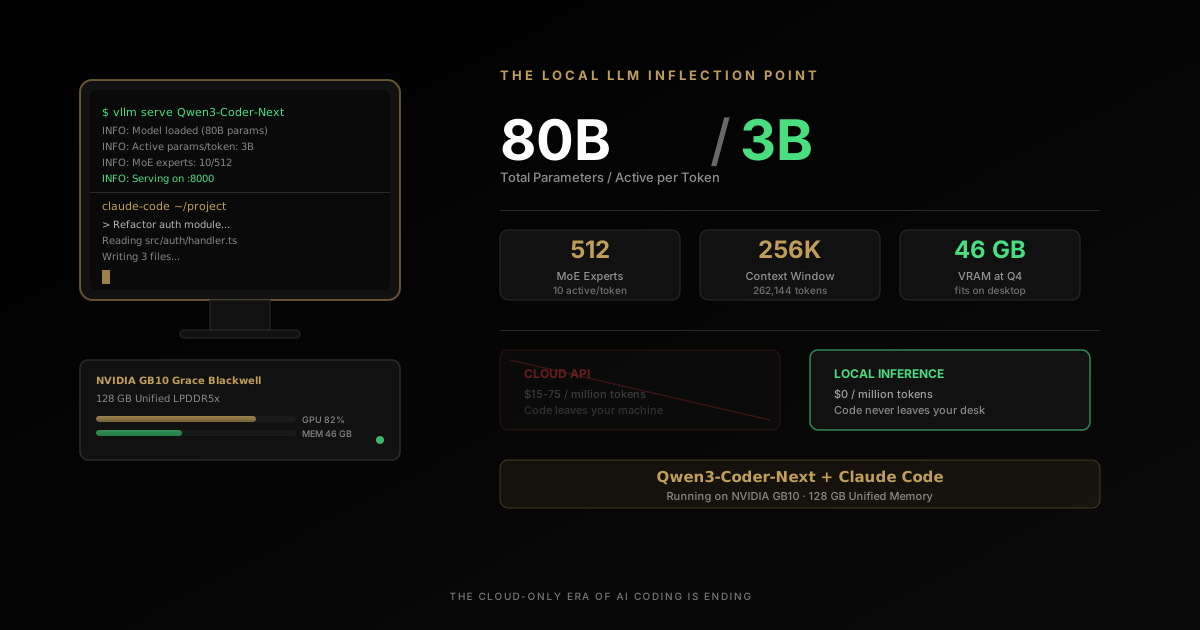
Qwen3-Coder: Run an 80B-Parameter LLM on Your Desktop
Qwen3-Coder runs 80B parameters on a desktop with only 3B active per token — and plugs into Claude Code. Why the cloud-only era of AI coding is ending.
AI Coding Agents & DX
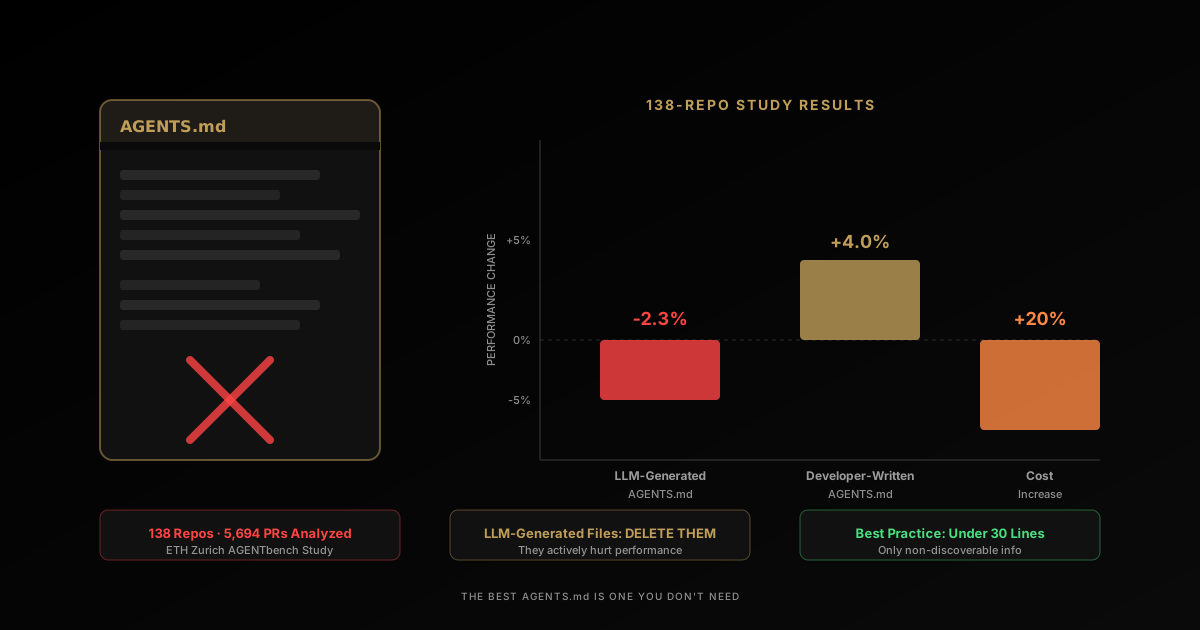
AGENTS.md Files Don't Work the Way You Think — A 138-Repo Study
A 138-repo study: AGENTS.md files hurt performance by 2-3% and raised costs 20%+. What the research found — and what actually works instead.
Keep reading
Get new posts on AI, Claude Code & LLMs
New deep-dives on AI engineering, Claude Code, and developer tooling — follow along however you prefer.
About the Author

Software engineer writing about AI, Claude Code, LLMs, OpenAI, Anthropic, and developer tooling. 5+ years building production systems at Expedia Group, Tekion, and BYJU'S.