ChatGPT Search Optimization After the Site-Scoping Shift
ChatGPT search optimization changed when 17% of queries started scoping to specific sites. What the GPT-5.6 shift means and how to get cited.

TL;DR ChatGPT search optimization changed on August 8, 2026 when site-scoped queries jumped from 0.3% to 17% after the GPT-5.6 Sol rollout. The shift means ChatGPT now actively chooses which domains to search rather than trusting whatever the search engine returns. If your content is not the primary source for its topic, ChatGPT increasingly bypasses you by scoping to the domain that is.
What is ChatGPT Search site scoping?
Site scoping is when ChatGPT Search internally rewrites a query to include a site: operator before sending it to the underlying search engine. Instead of searching "how to deploy cloudflare workers", it searches site:developers.cloudflare.com how to deploy cloudflare workers. The result: ChatGPT decides which domain to trust before the search happens, not after.
This is not new behavior — ChatGPT has always had the ability to scope searches. What changed is how often it does so. Promptwatch, a GEO analytics company that tracks AI search behavior across ChatGPT, Claude, and Gemini, observed that site-scoped queries jumped from 0.3–0.5% of all ChatGPT Search fanout to 16–17% on August 8 — a 35× increase in one day.
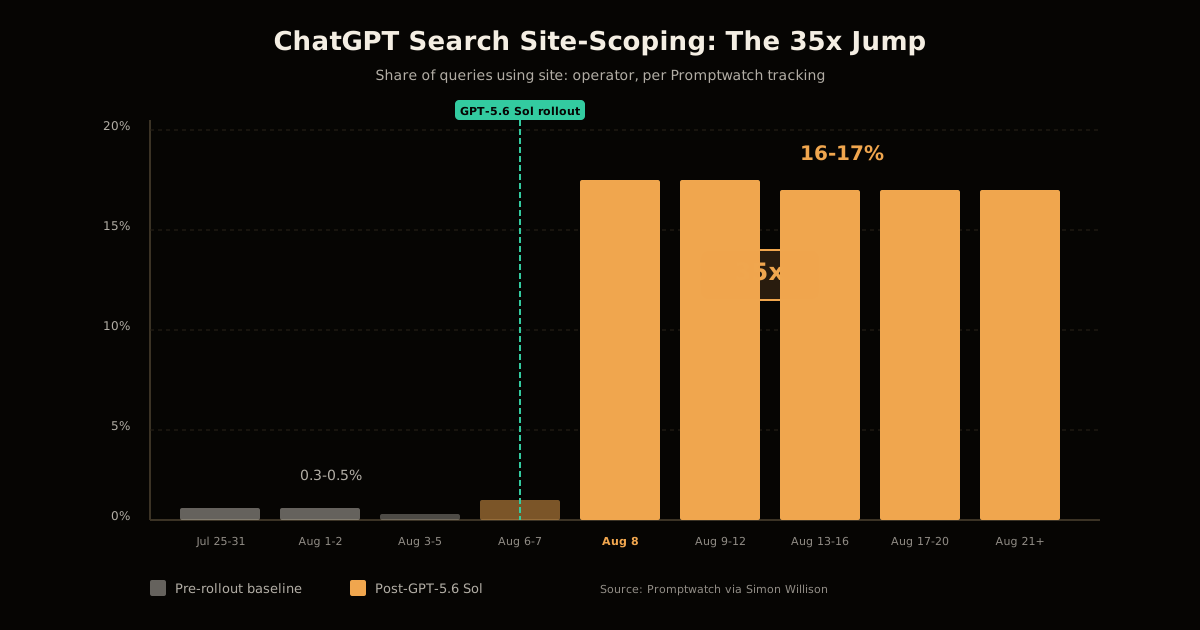
The timing matches OpenAI’s August 6 announcement:
For Plus and Pro users, we’re updating GPT‑5.6 Sol in Chat to be more reliable with facts and provide more focused answers.
“More reliable with facts” appears to mean “we now route more queries to domains we’ve decided are authoritative.”
How does the site-scoping change affect your content?
The old model: ChatGPT sends a query to the search engine, gets back a ranked list, and cites whatever looks relevant. Your job was to rank well — same as traditional SEO.
The new model: ChatGPT first decides whether to scope the query to a specific domain. If it does, only that domain’s content is even considered. If you are not the domain ChatGPT scopes to, you are not in the running.
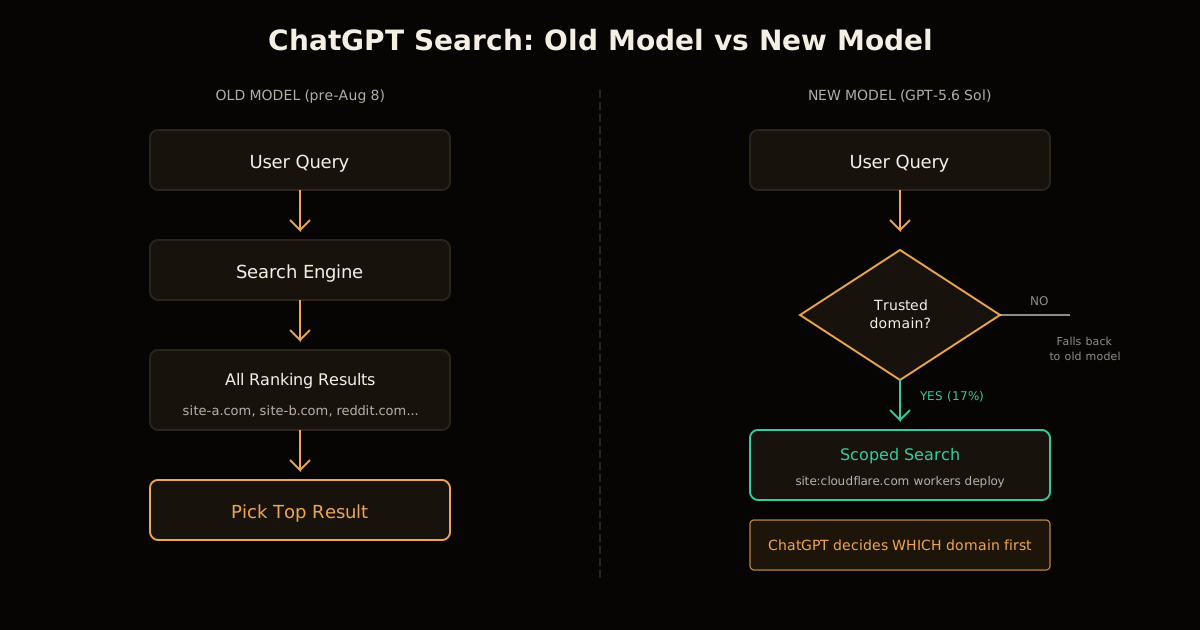
This shifts the competition. Under the old model, you competed against every page that ranked for the query. Under the new model, you compete to be the domain ChatGPT decides to scope to. Once that decision is made, ranking well on a different domain does not help.
The implication for content strategy: becoming the primary source matters more than aggregating or summarizing other sources. ChatGPT increasingly scopes to the origin, not to sites that restate what the origin said.
What happened to Reddit?
Promptwatch’s follow-up on August 18 noted that Reddit’s share of ChatGPT Search citations appears to have dropped after the GPT-5.6 rollout. Simon Willison could not confirm a system-prompt change discouraging Reddit sourcing, but the behavioral shift is visible in the data.
This is not surprising. Reddit excels at discussion, opinion, and edge-case troubleshooting — the kind of content that supplements primary sources but rarely is the primary source. When ChatGPT decides it wants facts rather than discussion, scoping away from Reddit is a natural move.
Reddit is not dead for GEO. It remains valuable for:
- Topics where no authoritative primary source exists
- Recent events the official docs have not caught up to
- Niche product comparisons with real user experience
But if an authoritative primary source does exist for the query, ChatGPT now actively routes there. Aggregation and discussion forums are second-tier.
What this means for traditional SEO
Site scoping does not replace traditional SEO — it runs alongside it. ChatGPT still relies on the underlying search engine to find content once it decides where to look. If you are the domain ChatGPT scopes to, you still need your pages to rank within that domain’s results.
| Factor | Traditional SEO | ChatGPT Search (GEO) |
|---|---|---|
| What decides visibility | Search engine ranking | ChatGPT’s domain-selection + ranking within that domain |
| Key signal | Backlinks, on-page optimization | Being the primary/original source for the topic |
| Content structure | Optimized for snippets and featured results | Optimized for extraction — TL;DR, tables, numbered steps |
| Competition | Every page ranking for the query | Every domain that could be scoped to |
| Failure mode | Ranking page 2 or lower | Not being in the set ChatGPT considers at all |
The strategic question is no longer just “how do I rank for this query?” but “how do I become the domain ChatGPT routes this query to?”
ChatGPT search optimization: what actually works now
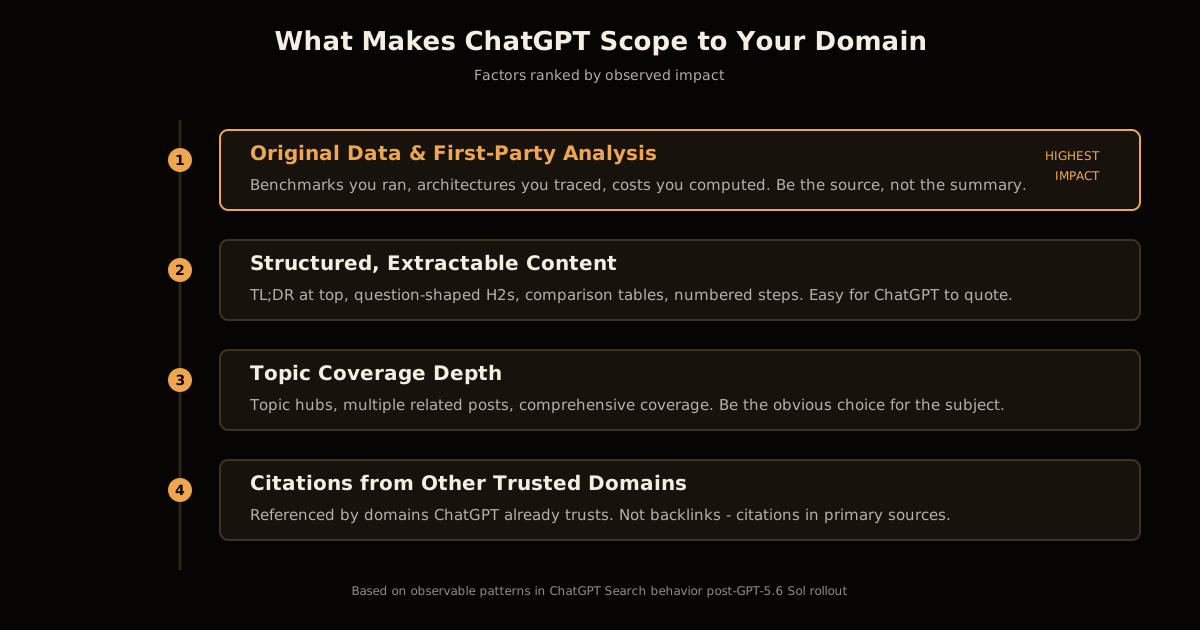
OpenAI has not published the criteria ChatGPT uses to decide which domains are authoritative for which topics. But the observable pattern suggests several factors:
1. Be the original source.
If you publish original data — benchmarks you ran, architectures you traced, costs you computed — you are harder to bypass. ChatGPT can scope to the site that has the data rather than the site that wrote about the data. The ads-for-agents teardown on this site gets cited precisely because it is first-party analysis, not a summary of someone else’s findings.
2. Structure content for extraction.
ChatGPT needs to pull quotable passages. That requires:
- A 2–3 sentence TL;DR at the top (what AI Overviews and ChatGPT lift verbatim)
- Question-shaped H2s that match how people phrase queries
- Comparison tables (ChatGPT extracts these heavily)
- Numbered procedures for how-to content
If your content is a wall of prose, ChatGPT has to work harder to find the extractable answer — and may scope to a domain that structures it better.
3. Cover the topic completely.
Site scoping suggests ChatGPT builds a mental map of “which domain is authoritative for which topic.” You want to be the obvious choice. That means covering the topic thoroughly, not just one angle. A single blog post is less likely to be scoped to than a domain with a topic hub, multiple related posts, and depth across the subject.
4. Get cited by other primary sources.
ChatGPT appears to weight domains that are referenced by other authoritative domains. If Cloudflare’s docs link to your MCP server guide, ChatGPT notices. This is not traditional backlink SEO — it is citation from sources ChatGPT already trusts.
How do you know if ChatGPT is scoping to your domain?
You mostly do not — OpenAI does not expose this in any dashboard. Promptwatch and similar GEO analytics tools infer it by tracking what sources appear in ChatGPT responses over time. If your domain suddenly appears more or less frequently in ChatGPT citations for queries you cover, that is a signal.
The proxy metrics that matter:
- Citation frequency in ChatGPT responses (requires tracking tools or manual sampling)
- Query overlap between your content and ChatGPT’s answers (are you saying what it says?)
- Referral traffic from sources that cite you (a rough proxy for domain authority)
Traditional SEO metrics like ranking position are still relevant but no longer sufficient. A page can rank #1 on Google and still not appear in ChatGPT’s answer if ChatGPT scopes to a different domain.
The bigger picture: search is becoming deliberate
The site-scoping shift is one data point in a longer trend. AI search systems are moving from “search everything and pick the best result” to “decide what kind of source I want, then search within that category.” Google’s AI Overviews do a version of this. Perplexity does a version of this. ChatGPT is now doing it more explicitly.
This changes the optimization game. In traditional SEO, you optimize for the search algorithm. In GEO, you optimize to be the kind of source the AI decides to trust. The former is technical; the latter is reputational.
The GEO playbook I published earlier covers the structural side — question headings, TL;DRs, comparison tables. Site scoping adds an authority layer on top: you also need to be the domain the AI routes to, not just the page that extracts well.
For anyone building content in 2026, the implication is clear: aggregation and summarization are losing ground. Original analysis, first-party data, and genuine expertise are gaining it. ChatGPT is learning to tell the difference.
FAQ
What changed in ChatGPT Search on August 8, 2026? ChatGPT Search began using the site: operator in roughly 17% of its internal search queries, up from 0.3–0.5% the week before. This means ChatGPT now actively scopes a significant fraction of its searches to specific domains rather than trusting whatever the search engine returns.
How does ChatGPT decide which sites to scope to? OpenAI has not published the selection criteria. The observable pattern suggests ChatGPT evaluates query intent and routes factual/technical queries to sites it has learned to trust for that topic. The model appears to have a mental map of domain expertise.
Does this mean Reddit is deprioritized? Reddit’s share of ChatGPT Search citations dropped noticeably after the GPT-5.6 rollout. ChatGPT increasingly favors primary sources over discussion threads for factual queries. Reddit remains valuable for niche topics where primary documentation does not exist.
How do I optimize for this? Become the primary source. Publish original data, structure content for extraction (TL;DR, tables, numbered steps), and cover topics thoroughly. The goal is to be the domain ChatGPT scopes to, not just a page that ranks well.
Is this the same as traditional SEO? Partly. Traditional SEO gets you into the index; GEO gets you cited in the answer. Both need good content, but GEO rewards structure and authority more heavily than ranking signals like backlinks.
Sources
- Simon Willison — ChatGPT search now uses the site:operator at scale (August 20, 2026)
- OpenAI — GPT-5.6 Sol Announcement (August 6, 2026)
- Promptwatch — GEO analytics tracking (referenced via Simon Willison’s post)
Frequently asked questions
Google Search · Preferred sources
Prefer this site on Google
If you already read this writing, add umesh-malik.com as a Preferred Source. Google can then highlight it with a preferred badge in Top Stories, AI Overviews, and AI Mode — for you, not as a site-wide ranking boost.
Related Articles

LLM Engineering
How to Stop an LLM Saying As a Language Model: It's the Template
How to stop an LLM saying as a language model: it's the chat template, not the weights. Disclaimers drop 17 points without one — the fix, and its limits.

LLM Engineering
How to Fix Multi-Agent LLM Latency: Text Handoffs Cost 2.5x
Multi-agent LLM latency isn't random: an ICLR 2026 paper measured the cause — text handoffs cost 2.5x more time and 3-5% less accuracy than skipping text.

LLM Engineering
How to Migrate a Large System Prompt to Ollama Without Breaking It
Migrate a large system prompt to Ollama and it can burn 14% of a 65K context window before the first turn. What breaks, why, and the fix that worked.
Keep reading
Get new posts on AI, Claude Code & LLMs
New deep-dives on AI engineering, Claude Code, and developer tooling — follow along however you prefer.
About the Author

Software engineer writing about AI, Claude Code, LLMs, OpenAI, Anthropic, and developer tooling. 5+ years building production systems at Expedia Group, Tekion, and BYJU'S.