
LLM Engineering •
How to Audit an LLM Judge: Right Verdict, Wrong Reason
How to audit an LLM judge in six steps: catch right-verdict, wrong-reason errors and set a mean-minus-2σ drift floor, using Netflix's rubric loop.
8 min read
Read more →Topic Hub
LLM Engineering is the discipline of shipping production systems built on large language models — model choice, RAG, fine-tuning, evals, and inference. These articles are the field notes from building those systems, not a recap of vendor docs.
How to audit an LLM judge in six steps: catch right-verdict, wrong-reason errors and set a mean-minus-2σ drift floor, using Netflix's rubric loop.

How to ground AI agent findings in evidence: validate every citation in code. Cloudflare's 3-state pattern plus a TypeScript checker you can copy.

How to stop an LLM saying as a language model: it's the chat template, not the weights. Disclaimers drop 17 points without one — the fix, and its limits.

How to build an autonomous cryptanalysis agent: the AI that broke a 1941 Enigma cipher unsolved since 2005, using a crib it found itself.

Multi-agent LLM latency isn't random: an ICLR 2026 paper measured the cause — text handoffs cost 2.5x more time and 3-5% less accuracy than skipping text.

Migrate a large system prompt to Ollama and it can burn 14% of a 65K context window before the first turn. What breaks, why, and the fix that worked.

Compare LLM architectures fast: GQA cuts KV cache 8x on Llama 3 70B, MLA cuts it 93.3% on DeepSeek-V2. One PyTorch repo shows why, file by file.

Debugging OpenRouter in production means auditing providers, not models: the same weights score 90% vs 58% GPQA, and pinned fallbacks cascade-fail in 14 days.

Loop transformer blocks or add more layers? Reusing weights cuts training compute 6.8-18% at equal loss, but forward passes and KV cache never shrink.

Run Kimi K3 locally on a MacBook by streaming 1.45TB of experts from four SSDs — the 1 tok/s number, and why doubling drives doesn't double speed.

How to build an AI agent knowledge base: the wiki-plus-recipes pattern that cut per-turn tokens 80% and turned days of expert review into minutes.

The OpenAI Python HTTPX2 migration breaks certifi TLS in containers and proxies. The full checklist, OS trust store fix, and legacy escape hatch.

How to harden vLLM inference against token exploits. CVE-2025-9141 let models run code via eval(). Separate GPU hosts from parsers.

ChatGPT search optimization changed when 17% of queries started scoping to specific sites. What the GPT-5.6 shift means and how to get cited.

Agent context compaction drops every block before the summary at 150K tokens. What survives, what instructions silently replaces, and the usage field that lies.

Here's how to test an LLM's knowledge cutoff with three reproducible probes — the method showing Opus 5 claims May 2026 but answers like January 2026.

vLLM throughput tuning starts with KV cache blocks, not a bigger GPU. The four flags that decide your tokens/sec, and the one that quietly backfires.

Run agent tool calls in parallel by swapping the loop for a DAG planner: ten round trips become two levels, plus the cap, budget and critic on top.

Reinforcement fine-tuning let a 4B open model match GPT-5.6 Sol on retrieval at 100x lower cost. How RFT works, and when it beats prompting a frontier LLM.

Agent harness design decided a benchmark: OpenAI's ARC-AGI-3 score went 13.3% → 38.3% with zero model changes. What that means for your agent loop.

LLM abuse detection failed at the message level and worked at the account level. OpenAI's Cambodia scam ban shows which signal actually catches misuse.

An LLM eval framework turns vibes into scores. How smevals structures tasks, configs, runners and graders — and how to ship your first eval today.

Run 70B LLM on 4GB GPU hardware with AirLLM's layer-by-layer inference. The VRAM math is real — you just pay for it in disk bandwidth. The honest tradeoff.

Build a RAG chatbot in Next.js with the AI SDK: embed the query, search pgvector, stream a grounded answer with citations, and stop hallucinations.

Vercel AI SDK in production: streaming, tool-calling, aborting generations, error retry UX, rate limiting, and cost control — the layer every tutorial skips.

Only 23% of autonomous AI agents reach production in 2026. The demo-to-production gap, why agents fail, and the playbook the winners actually use.

Build a RAG pipeline from scratch: chunking, embeddings, retrieval, reranking, grounded generation, and the production patterns that decide whether it works.

How to build an MCP server, step by step: JSON-RPC 2.0, the Streamable HTTP transport, typed tools, and agent discovery — from a real one I shipped.
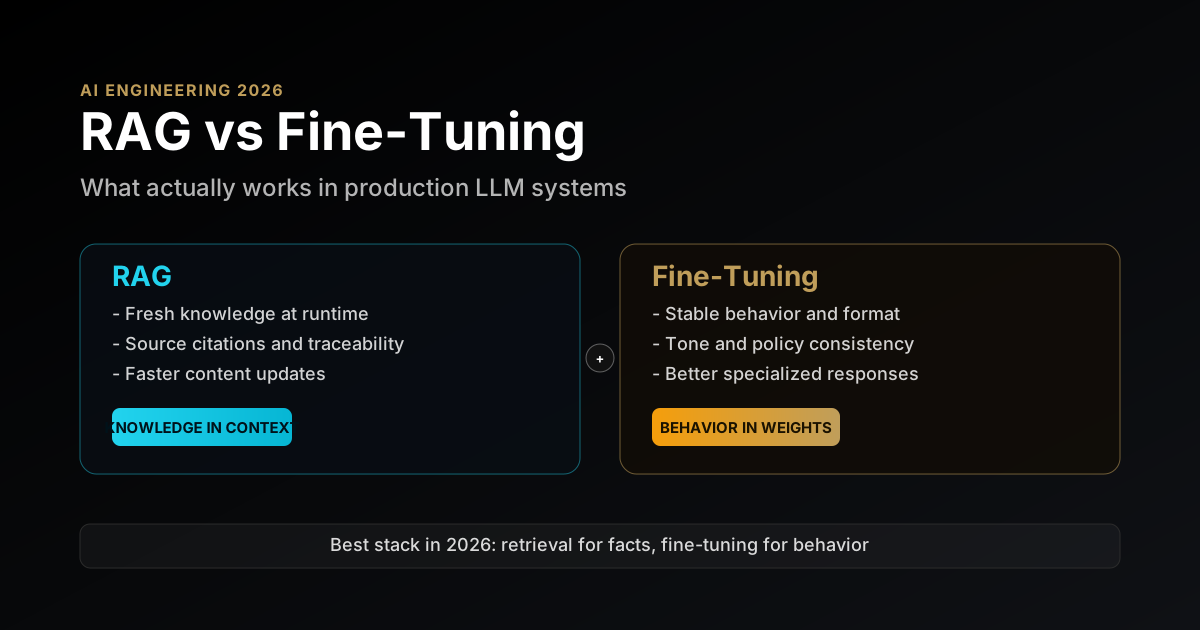
RAG vs fine-tuning for LLMs in 2026: a practical decision framework covering architecture tradeoffs, cost, latency, and when to use each in production.

Ads for AI agents are live. TIME serves crawlers a 42 KB markdown site with sponsored blocks; humans and Googlebot get 1.2 MB of HTML. I measured all of it.

How to build enterprise-grade AI agents for free in 2026: a hands-on MaxKB + local LLM guide to RAG precision, security, and $0 API cost.

DeepSeek V4 Flash 0731 benchmarks: same 284B/13B architecture as the preview, re-post-trained only — and it beats the 1.6T V4-Pro Preview on nine agent tests.

Kimi K3 beats Claude Fable 5 on cost by a wide margin and loses on agentic tasks. The benchmarks that decide it, and how to run K3 where it actually wins.

GPT-5.6 Sol vs Terra vs Luna compared on price, coding, latency, and cost per task — plus a routing strategy that cuts your bill without wrecking quality.

GPT-5.6 API pricing ($1-$30/1M), the Ultra and Max thinking modes, and a 1.05M context window that is shared — with the fine print that breaks agent loops.
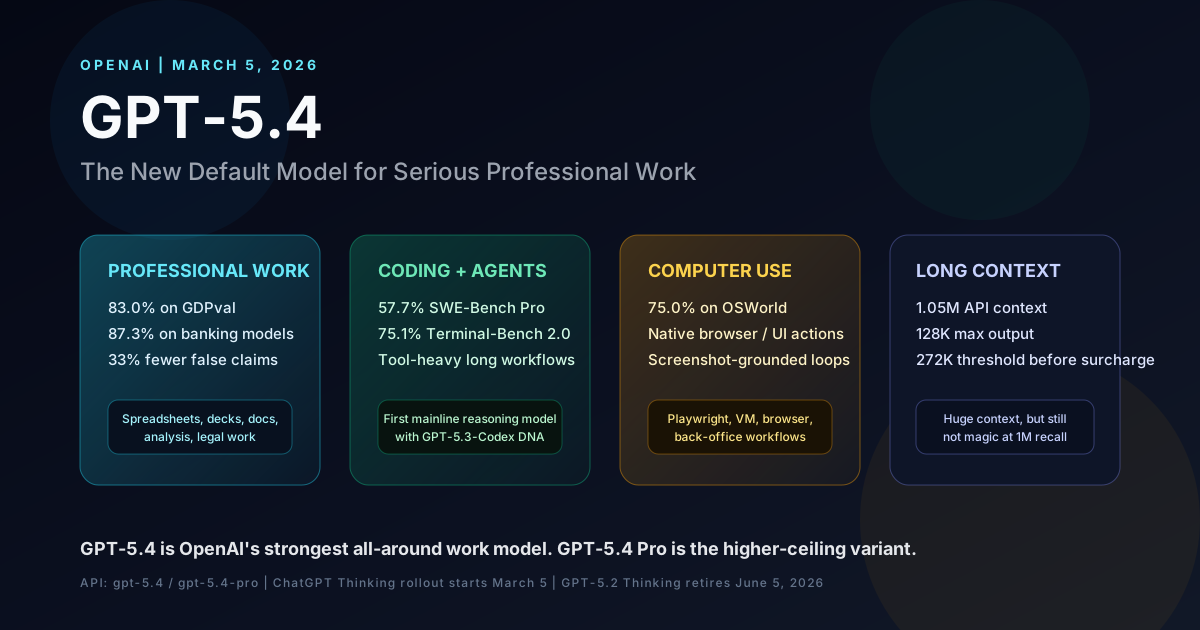
GPT-5.4's native computer use and MCP tool calls are the real upgrade for agents. What holds up in a loop, what the 1M context costs, and how Pro compares.
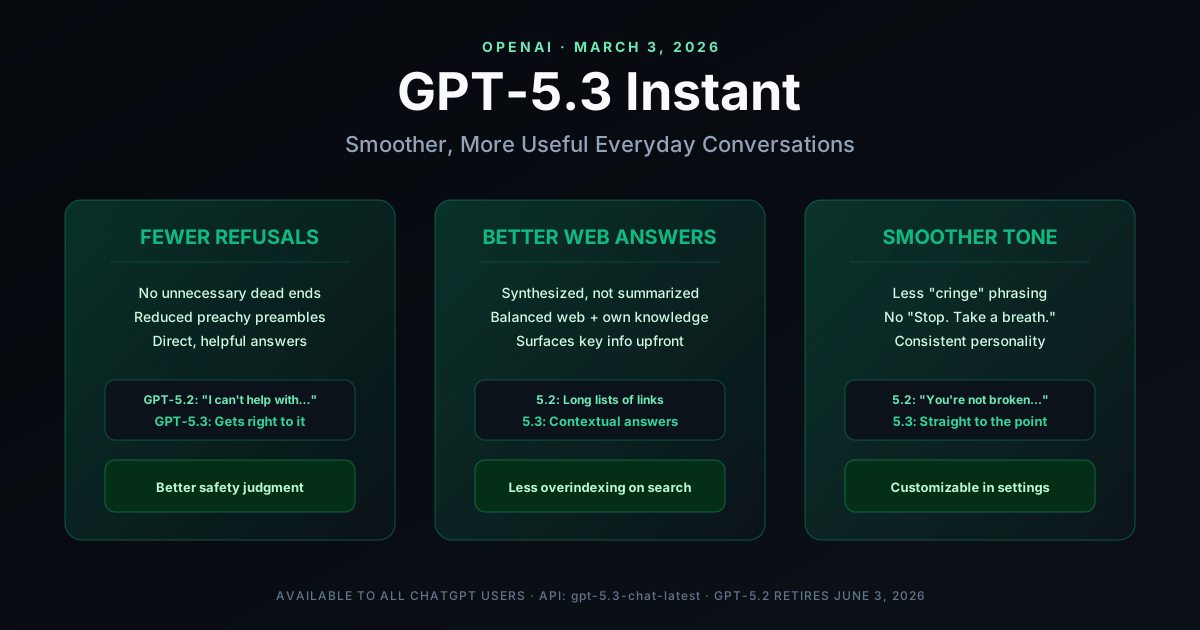
GPT-5.3 Instant brings 26.8% fewer hallucinations, fewer needless refusals, and better web-sourced answers — what changed and why it matters for devs.
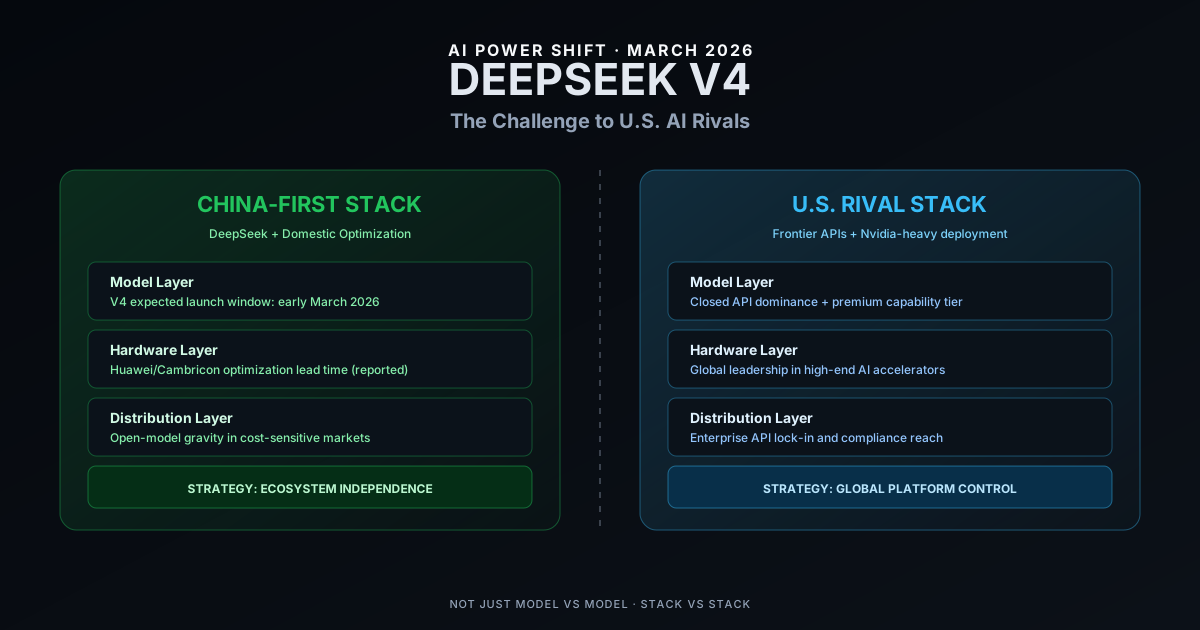
DeepSeek V4 is expected in early March 2026. Here is what is confirmed, what remains unverified, and how it challenges U.S. AI rivals.
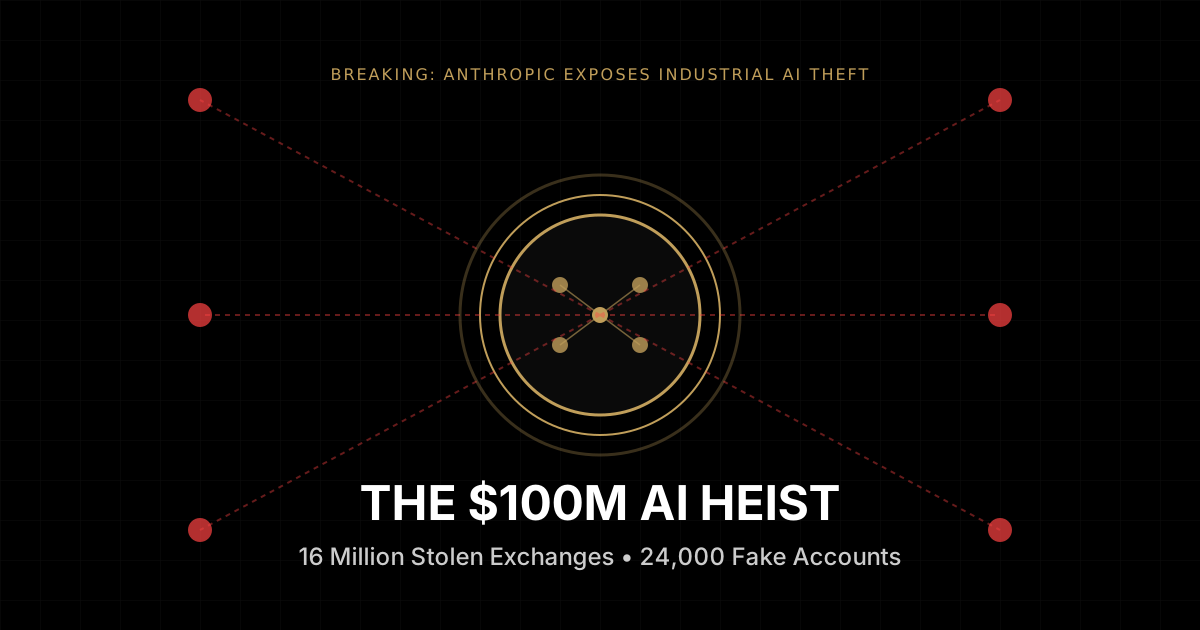
Anthropic exposes an AI model distillation attack by DeepSeek, Moonshot, and MiniMax: 16 million exchanges, 24,000 fake accounts. The forensic breakdown.
LLM Engineering is the practice of building production systems with large language models. It covers model selection, prompt design, RAG architecture, fine-tuning strategies, evaluation pipelines, and inference optimization — the full technical stack between a raw model and a working AI product.
RAG (Retrieval-Augmented Generation) fetches relevant context at inference time from an external knowledge base, making it ideal for dynamic or frequently-updated information. Fine-tuning adjusts model weights for specific tasks or communication styles and is better for consistent behavior and lower-latency responses. Most production systems combine both: fine-tuning for style and RAG for knowledge.
GPT-5.3 introduced significantly fewer refusals and better instruction following, reducing prompt engineering overhead. GPT-5.4 added expanded context windows and improved agentic tool use, making it easier to build reliable multi-step pipelines without complex fallback logic.
Local LLMs make sense for private codebases, high-volume batch tasks where API costs add up, offline workflows, and experimentation without usage limits. Models like Qwen3-Coder are viable for coding assistance on modern hardware. The tradeoff is quality: frontier models still outperform local alternatives on complex reasoning tasks.
Google Search · Preferred sources
If you already read this writing, add umesh-malik.com as a Preferred Source. Google can then highlight it with a preferred badge in Top Stories, AI Overviews, and AI Mode — for you, not as a site-wide ranking boost.