How to Audit an LLM Judge: Right Verdict, Wrong Reason
How to audit an LLM judge in six steps: catch right-verdict, wrong-reason errors and set a mean-minus-2σ drift floor, using Netflix's rubric loop.

TL;DR How to audit an LLM judge: compare its written rationale to a human’s, not just its PASS/FAIL label, and require its metrics to stay within two standard deviations of your human raters each week. Netflix’s judge lifecycle shows why: a label-only tuning loop degraded one criterion that a reasoning-aware loop kept stable. Below is the six-step audit, a drift-floor calculation with real arithmetic, and about 25 lines of TypeScript.
An LLM judge is a second model that scores a first model’s output as a proxy for human raters. It earns trust only while its verdicts, and its reasons, keep matching what humans would say.
What Is an LLM Judge, and Why Does It Need an Audit?
Any team generating text at scale cannot read all of it. A judge is the cheap fix: it labels each output PASS or FAIL and explains why. Netflix opens its LLM-as-a-Judge lifecycle post with the catch: if the judge drifts and starts approving bad output, nothing downstream flags it.
Their running example is a recommendation explanation, a one-line reason shown under a title (“a funny, heartfelt holiday romance, much like My Secret Santa”). A generator wrote hundreds of thousands of these per week, and a judge gated them. Their rule is the one to steal: an LLM judge must never operate alone. Humans define “good”, label the benchmark, watch the live judge, and approve every change.
If you already run evals, this is the layer above them. A framework like the one in my LLM eval framework walkthrough grades your prompts and models. This post grades the grader.
What Is a Right-Verdict, Wrong-Reason Error?
It is the failure that agreement metrics cannot see. The judge says FAIL, the human says FAIL, the dashboard shows alignment, and the judge’s stated reason is still wrong or only half right.
Netflix’s example: a member watched a family-fantasy musical with an ensemble cast. The system recommended an adventure film that matched on “family fantasy with a young heroine” but shared neither the songs nor the cast. FAIL was correct. The judge’s rationale sounded reasonable but missed what the human flagged. Label agreement scores that as a win.
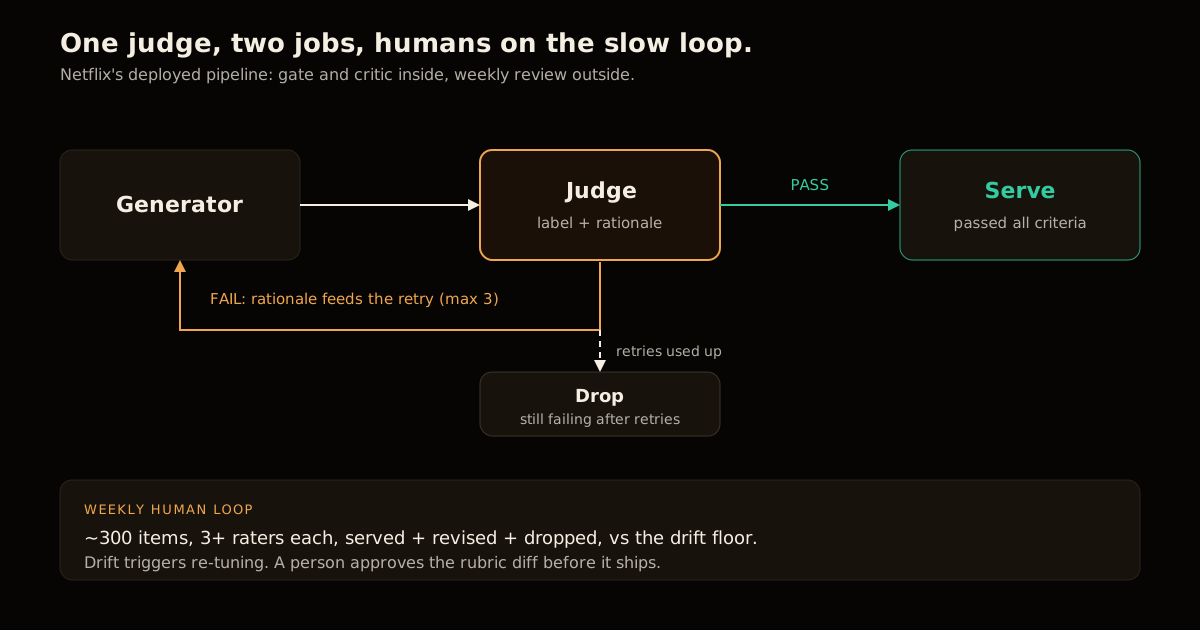
It matters because the rationale is not decoration. In their pipeline the failure reason is appended to the generator’s prompt so it can retry. A wrong reason steers the retry toward the wrong fix.
| Judge label | Human label | Reasons match? | Label-agreement metric | Needs a rubric fix? |
|---|---|---|---|---|
| PASS | PASS | not checked | counts as agreement | no |
| FAIL | PASS | n/a | counts as error | yes |
| PASS | FAIL | n/a | counts as error | yes, and urgent |
| FAIL | FAIL | yes | counts as agreement | no |
| FAIL | FAIL | no | counts as agreement | yes, hidden |
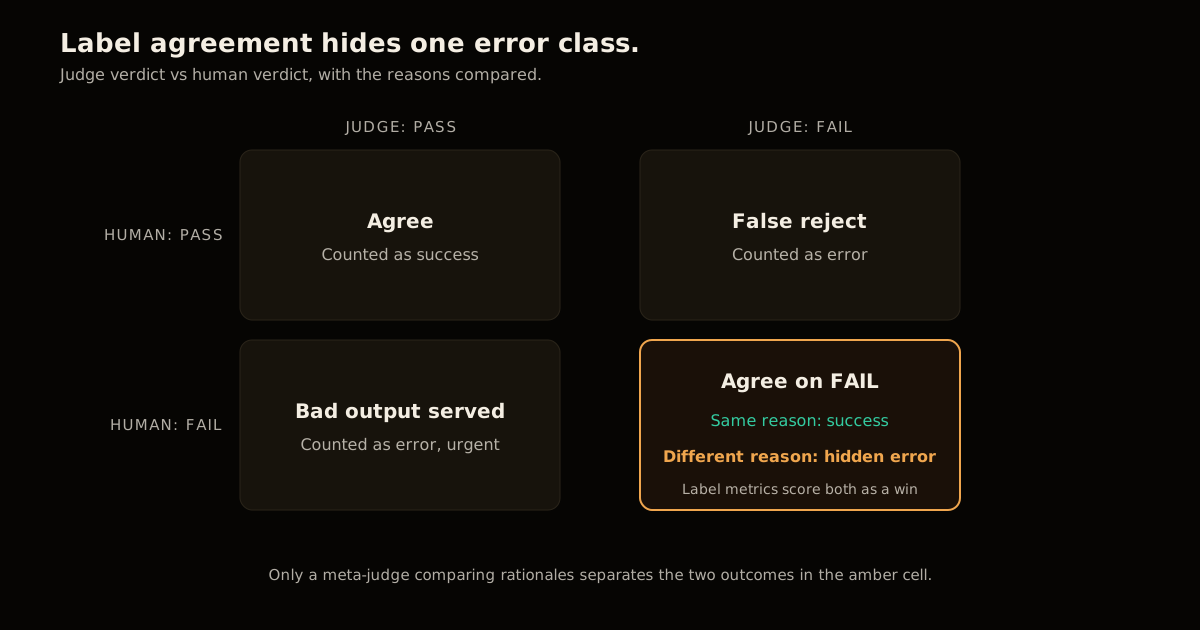
Their ablation makes the cost concrete. Netflix compared the reasoning-aware loop (RART, Reasoning-Aligned Rubric Tuning) against an otherwise identical label-only loop. On two of three must-have criteria the two tied, because the starting rubric was already near ceiling.
On the third, the label-only loop rewrote the rubric into degenerate forms, and specificity and reasoning agreement fell with each iteration, ending below where they started. RART stayed stable and improved both. The paper’s numbers live in the original; the direction is what I would carry over.
How to Audit an LLM Judge: A 6-Step Procedure
This is my condensed version of the lifecycle. Netflix describes the pieces; the checklist and code are my own illustration, not their source.
Write rationales, not just labels, in your benchmark. Every human FAIL needs a one-line reason. Netflix calls this “a small bookkeeping detail” that is critical, because you cannot correct a judge’s reasoning if nobody wrote down the human’s.
Mix three data sources. Hand-written adversarial cases, LLM-synthesized boundary cases that humans then rate, and real samples from production output.
Make the judge emit label plus rationale. A bare score gives you nothing to audit.
Measure three metrics per criterion. Specificity (fail-recall: how often it rejects bad output), recall (pass-recall), and reasoning agreement (on cases both reject, how often the reasons match). Run one judge per criterion, since one can be healthy while another slips.
Check reasons with a meta-judge. A second model compares the judge’s rationale to the human’s on agreed-FAIL cases. Netflix validated its meta-judge against trained raters first, and it matched their verdicts on nearly all of a sample.
Feed both error classes back into the rubric. The focus set is label mismatches plus right-label-wrong-reason cases.
Here is that focus-set logic as code. sameReason is your meta-judge call.
type Row = {
  id: string;
  judge: { label: "PASS" | "FAIL"; rationale: string };
  human: { label: "PASS" | "FAIL"; rationale: string };
};

export function buildFocusSet(
  rows: Row[],
  sameReason: (judge: string, human: string) => boolean,
) {
  const focus: { id: string; kind: string }[] = [];
  for (const r of rows) {
    if (r.judge.label !== r.human.label) {
      focus.push({ id: r.id, kind: "label_mismatch" });
    } else if (r.human.label === "FAIL" && !sameReason(r.judge.rationale, r.human.rationale)) {
      focus.push({ id: r.id, kind: "right_label_wrong_reason" });
    }
  }
  return focus;
}
I ran this against three toy rows (one match, one label error, one agreed-FAIL with differing reasons) and it returned exactly the two rows that need attention. Only agreed-FAIL rows go to the meta-judge, which keeps its cost proportional to your failure rate, not your traffic.
How Do You Set a Drift Threshold That Isn’t Arbitrary?
Do not pick a fixed number like “95% agreement”. A hard week produces disagreement among humans too, and a fixed bar flags the judge for difficulty the people felt as well.
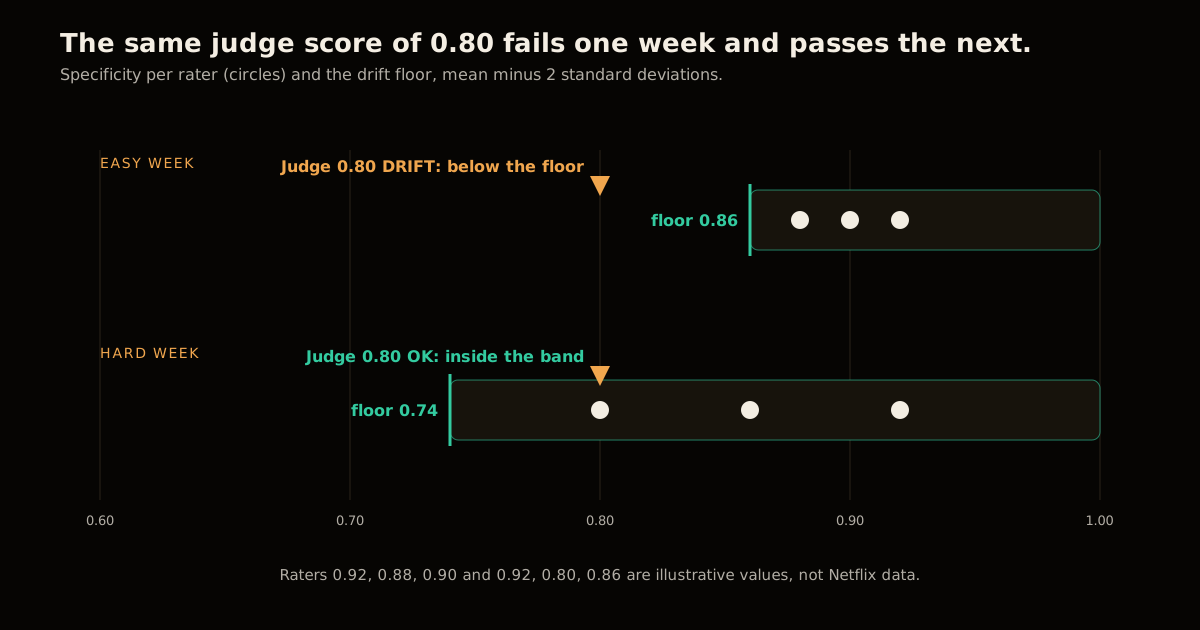
Netflix’s yardstick is the raters’ own spread. Each week, score the judge and every rater against the same panel-majority label. For one criterion and one metric M, the judge must satisfy: judge M at least mean(rater M) minus 2 times the standard deviation of rater M. Falling below on any criterion-metric pair is a drift event. (The post does not say whether it uses sample or population standard deviation. My code uses sample.)
const mean = (v: number[]) => v.reduce((a, b) => a + b, 0) / v.length;
const sd = (v: number[]) => {
  const m = mean(v);
  return Math.sqrt(v.reduce((a, b) => a + (b - m) ** 2, 0) / (v.length - 1));
};

export function driftCheck(judge: number, raters: number[]) {
  const floor = mean(raters) - 2 * sd(raters);
  return { floor, drift: judge < floor };
}
Worked example with my own illustrative numbers, specificity on a three-rater panel:
| Week | Rater scores | Mean | Std dev | Floor | Judge at 0.80 |
|---|---|---|---|---|---|
| Easy | 0.92, 0.88, 0.90 | 0.90 | 0.02 | 0.86 | Drift |
| Hard | 0.92, 0.80, 0.86 | 0.86 | 0.06 | 0.74 | Within band |
The same judge score of 0.80 triggers re-tuning in the easy week and not in the hard one. That is the intent: when humans agree tightly the judge is held tightly, and when the task itself is ambiguous the band widens. The tradeoff is that a noisy panel hides a real judge regression, so keep the rater count at three or more and track panel variance as its own number.
What does the sampling cost? Netflix pulled roughly 300 explanations per week, stratified across served, revised and dropped outputs and weighted toward newer catalog items, with at least three raters each. That is at least 900 human labels a week, about 3,600 a month, held on a fixed stratification so weeks compare. Budget for that before you promise “continuous monitoring”.
Should a Failed Output Be Retried, Served, or Dropped?
Netflix reuses the aligned judge in two roles: a gate that blocks failing output, and a critic whose rationale goes back to the generator for another attempt. Retries are capped. Their test used a budget of 3 retries with their strongest generator, and anything still failing was dropped, not served.
The arithmetic is worth knowing: a 3-retry cap means at most 4 generator calls and 4 judge calls per item, so your worst-case cost is 4x the happy path. They also observed that revision amplifies a capable generator and does not rescue a weak one, so spend on the generator before you raise the cap.
Dropping is the point. A bad output is a trust hazard, while a missing one only forgoes an opportunity. If the cost of a wrong answer exceeds the cost of silence, the default on doubt is nothing. I made the same argument for agents that must report “could not assess” in grounding AI agent findings in evidence, and it connects to deciding when to give AI agents autonomy.
One more caution. Netflix is explicit that offline agreement with raters was necessary but never sufficient: only an online A/B test, about a month on the mobile app, showed the explanations helped members. A well-aligned judge proves compliance with your rubric, not that the rubric is right.
What Does Human Review Catch That Metrics Can’t?
Drift detection keeps the judge aligned with the current rubric. Continuous human review keeps the rubric aligned with what works. Netflix’s reviewers surfaced problems no agreement metric showed:
- accurate attributes that still overstate how similar two titles are;
- a single vague adjective (“exciting”) that technically satisfies the rubric while saying nothing;
- a reference title the member would never consider comparable;
- explanations that pass every criterion but read like “word soup”.
When a pattern recurred they changed the guidelines, which seed both the rater instructions and the judge rubric, so one edit updates both. Sometimes they added a product rule outside the judge instead, such as blocking certain title types from being used as references. Any re-tuned rubric goes live only after a person reads the diff, and the previous rubric stays available for rollback.
The same discipline applies to the benchmarks you read about: verify AI agent benchmark claims before you trust them, and keep agent tool instructions testable. More patterns live in the LLM engineering hub.
FAQ
What is an LLM judge? A second model that labels or scores a first model’s output, usually PASS or FAIL plus a rationale, standing in for human raters at scale.
What is a right-verdict, wrong-reason error? Judge and human agree on the label but not the reason. Label metrics count it as success, and the wrong rationale misleads any generator retrying from it.
How many human labels do I need each week? Netflix used about 300 items and at least three raters, roughly 900 labels. Keep the stratification fixed so weeks are comparable.
How do I know a judge has drifted? When it falls more than two standard deviations below the average rater on any criterion and metric for that week.
Should a rubric update automatically after drift? No. A person approves every change, and the previous rubric stays available for rollback.
Sources
- The Lifecycle of LLM-as-a-Judge: Building, Aligning, and Monitoring at scale: Netflix Technology Blog, October 14, 2026. Primary source for the lifecycle, RART, the ablation, the 3-retry budget, the 300-sample weekly review and the two-standard-deviation rule. The code, checklist and worked example numbers are my own illustration.
- Judging LLM-as-a-Judge with MT-Bench and Chatbot Arena: Zheng et al., the foundational paper on using strong LLMs as judges and their known biases.
- OWASP Top 10 for LLM Applications: background on overreliance, the risk of acting on unaudited model output.
Frequently asked questions
Google Search · Preferred sources
Prefer this site on Google
If you already read this writing, add umesh-malik.com as a Preferred Source. Google can then highlight it with a preferred badge in Top Stories, AI Overviews, and AI Mode — for you, not as a site-wide ranking boost.
Related Articles

LLM Engineering
How to Stop an LLM Saying As a Language Model: It's the Template
How to stop an LLM saying as a language model: it's the chat template, not the weights. Disclaimers drop 17 points without one — the fix, and its limits.

LLM Engineering
How to Fix Multi-Agent LLM Latency: Text Handoffs Cost 2.5x
Multi-agent LLM latency isn't random: an ICLR 2026 paper measured the cause — text handoffs cost 2.5x more time and 3-5% less accuracy than skipping text.

LLM Engineering
How to Migrate a Large System Prompt to Ollama Without Breaking It
Migrate a large system prompt to Ollama and it can burn 14% of a 65K context window before the first turn. What breaks, why, and the fix that worked.
Keep reading
Get new posts on AI, Claude Code & LLMs
New deep-dives on AI engineering, Claude Code, and developer tooling — follow along however you prefer.
About the Author

Software engineer writing about AI, Claude Code, LLMs, OpenAI, Anthropic, and developer tooling. 5+ years building production systems at Expedia Group, Tekion, and BYJU'S.