Fix the PCIe Bottleneck in AI Training: How Built-in NICs Work
Fix the PCIe bottleneck in AI training with built-in NICs. Meta's MTIA 300 reclaims 1.2 TB/s by eliminating host CPU mediation.

TL;DR The PCIe bottleneck in AI training is where distributed training throughput goes to die—data traveling GPU → PCIe → CPU → NIC loses bandwidth at every hop. Meta’s MTIA 300 eliminates it entirely by putting twelve 800 Gbps RDMA NICs directly on the chip package—1.2 TB/s of bandwidth that never touches the host CPU. The pattern it demonstrates (built-in NICs, dedicated message engines, near-memory compute for collectives) is the template for fixing this bottleneck in serious training infrastructure.
What is the PCIe bottleneck in AI training?
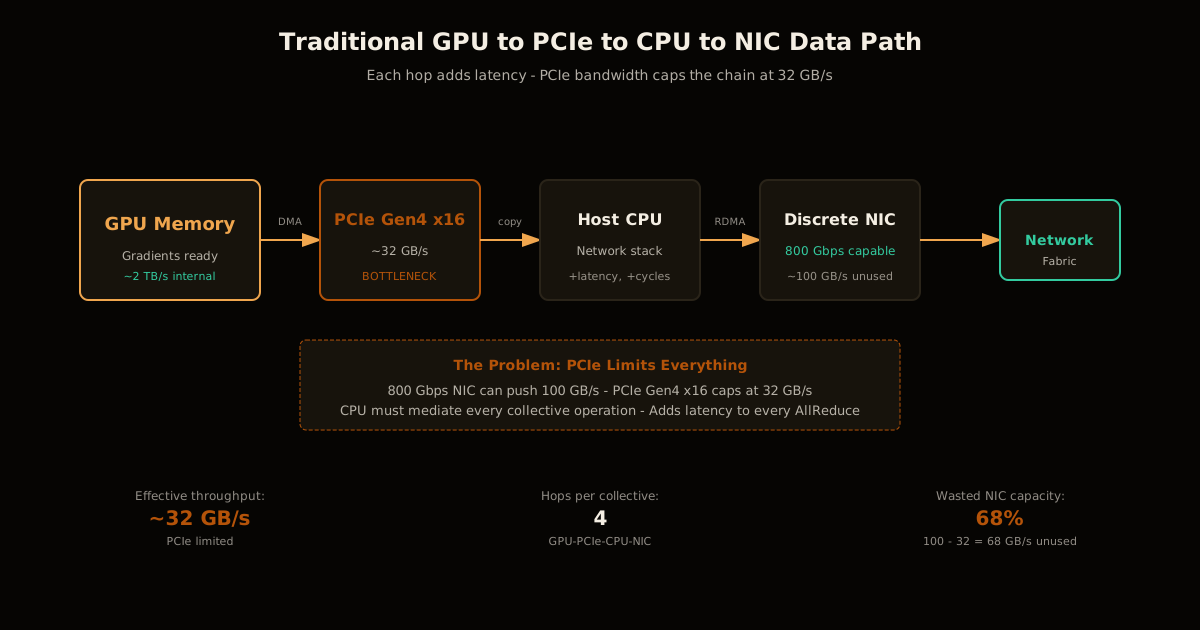
The PCIe bottleneck in AI training is the overhead of routing collective communication through the host CPU instead of directly between accelerator and network. In a traditional GPU cluster, when you need to synchronize gradients across nodes, data travels from GPU memory → across PCIe → to host memory → through the CPU’s network stack → out through a separate NIC → across the fabric → and the reverse path on the receiving side. Every hop adds latency. Every hop burns CPU cycles. And PCIe bandwidth caps the whole chain at whatever the bus can sustain.
This matters because collective operations—AllReduce, AllGather, ReduceScatter—are not rare events in distributed training. They happen after every batch. In recommendation model training, where the compute-to-communication ratio is low, the network can easily become the limiting factor. A GPU capable of teraflops sits idle waiting for gradients to arrive.
The numbers make it concrete. A typical GPU-to-NIC path through PCIe Gen4 x16 tops out around 32 GB/s per direction. An 800 Gbps RDMA NIC can push 100 GB/s. The PCIe bus, not the network, is the constraint—and there is a CPU in the middle doing work you would rather it did not have to do.
How built-in NICs eliminate host-device overhead
MTIA 300 removes the PCIe-CPU-NIC chain by placing the network interface on the accelerator package itself. Two network chiplets, each containing six custom 800 Gbps RDMA NICs, sit directly on the chip. Data flows from on-chip memory to the network without ever crossing a PCIe bus or involving the host CPU.
The ISCA 2026 paper puts the aggregate at 1.2 TB/s of I/O bandwidth—more than 37× what a single PCIe Gen4 x16 link provides. But bandwidth is only half the story. The other half is latency: every collective operation that previously required CPU mediation now executes entirely on the accelerator side, with the host only involved at setup time.
| Architecture | Data path for AllReduce | Peak bandwidth | Host CPU involvement |
|---|---|---|---|
| GPU + discrete NIC | GPU → PCIe → CPU → NIC → fabric | ~32 GB/s (PCIe limited) | Every operation |
| MTIA 300 built-in NIC | Accelerator → NIC chiplet → fabric | 1.2 TB/s | Setup only |
This is not incremental improvement. It is a different architecture with different constraints. The trade you make is that the NICs are now part of the accelerator’s silicon budget and power envelope—you cannot upgrade them independently, and failures affect the whole chip. What you gain is that the network becomes a first-class citizen of the memory hierarchy rather than an afterthought bolted on through a bus.
The collective offloading pattern: dedicated message engines
Built-in NICs solve the bandwidth and latency problem. Dedicated message engines solve the compute-interference problem. In GPU-based collective libraries like NCCL, the same streaming multiprocessors that run your training kernels also run the communication code. When a collective is in flight, compute stalls or at least competes for resources.
MTIA 300 separates these concerns completely. Alongside its 12×6 grid of processing elements for training compute, the chip includes 16 dedicated message engines (MEs) that handle all collective communication. Each ME contains:
- A small CPU core for control flow
- A register file for state
- Access to the on-chip interconnect for reading/writing to memory and NICs
The HCCL paper describes how this works in practice. The host-side library compiles a collective operation (say, an AllReduce across 64 nodes) into a set of subgraphs—directed acyclic graphs of send, receive, reduce, and synchronization primitives. These subgraphs are dispatched to the message engines, which execute them autonomously. The compute grid is free to run the next forward pass while gradients from the previous one are still in flight.
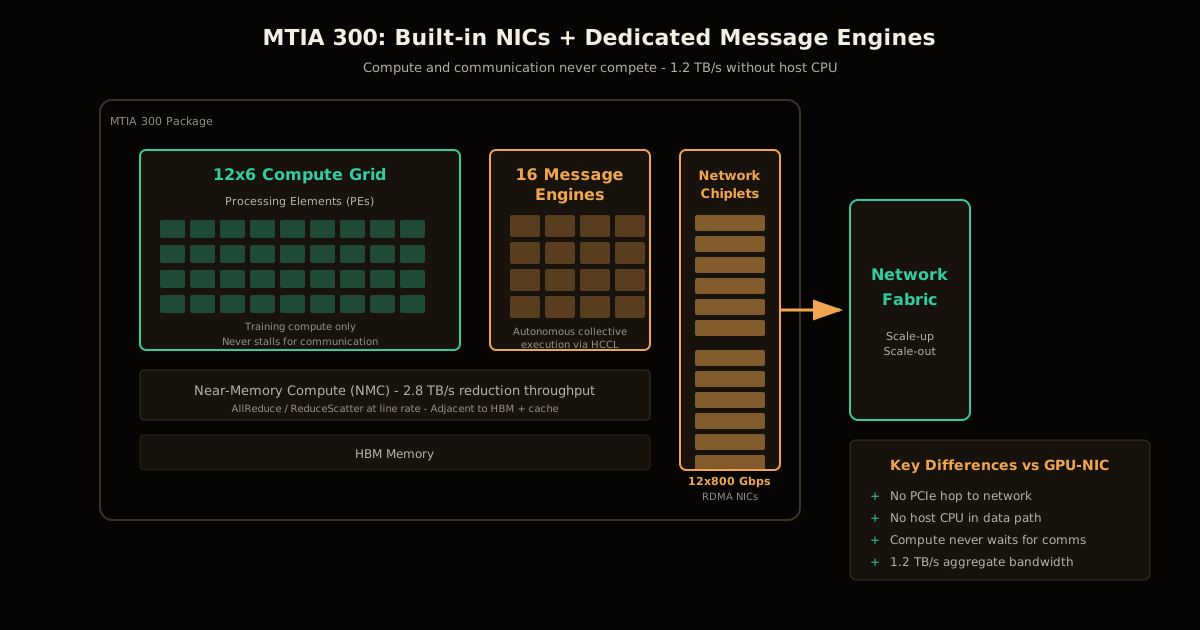
The message engines are not general-purpose. They are built for the communication patterns that dominate training: point-to-point RDMA, ring-based collectives, and tree-based reductions. What they lack in flexibility they make up in throughput: the 16 MEs together deliver throughput comparable to the compute engines while using only one-third of the chip area.
How near-memory compute accelerates reductions
AllReduce is not just a data movement operation—it involves arithmetic. Gradients from multiple sources must be summed (or averaged) before broadcast. In traditional architectures, either the GPU does this reduction (stealing compute cycles) or the CPU does it (adding latency). MTIA 300 does it at the memory interface.
Near-memory compute (NMC) units sit at the chip edges, next to HBM and the on-chip cache. They contain specialized hardware for the arithmetic operations that dominate collectives: addition, max, and bitwise operations at the data types training uses (FP32, BF16, FP8). The MTIA 300 paper reports that these NMC units collectively deliver more than 2.8 TB/s of reduction throughput—more than double the I/O bandwidth.
That ratio matters. It means the chip can execute AllReduce and ReduceScatter at line rate without the message engines or compute grid becoming the bottleneck. Data arrives from the network, gets reduced as it flows through the memory hierarchy, and is available to the next training iteration without ever occupying the main compute resources.
| Operation | Traditional GPU path | MTIA 300 path |
|---|---|---|
| Receive gradient shards | NIC → PCIe → host → PCIe → GPU memory | NIC chiplet → on-chip interconnect |
| Reduce | GPU kernel (SM cycles) | NMC unit (dedicated hardware) |
| Broadcast result | GPU → PCIe → host → NIC | On-chip → NIC chiplet |
When does this pattern matter most?
Not all training workloads are communication-bound. Large language model training with big batches and long sequences spends most of its time in matmuls—the compute-to-communication ratio is high enough that even a slow network can be hidden behind pipelining. But three categories of workloads expose the PCIe bottleneck brutally:
1. Deep Learning Recommendation Models (DLRMs). These have modest FLOPS requirements but enormous embedding tables that must be synchronized across nodes. The Meta engineering post notes that DLRM training “requires modest FLOPS but large memory, high network bandwidth, and frequent collective communication.” MTIA 300 was optimized for this workload first.
2. Data-parallel training at extreme scale. When you scale to thousands of GPUs, even a small overhead per collective compounds. A 100-microsecond PCIe penalty on each AllReduce, multiplied by thousands of iterations per epoch, becomes hours of wall-clock time. This is why hyperscalers invest in custom silicon for communication.
3. Hybrid parallelism with frequent synchronization. Pipeline parallelism and tensor parallelism require coordination at layer boundaries. The more fine-grained the parallelism, the more often you hit the network, and the more the PCIe overhead matters.
If your training fits on one node, or if your batch sizes are large enough to amortize communication, the GPU-NIC architecture is fine. The built-in NIC pattern pays off when communication is frequent, latency-sensitive, or bandwidth-hungry. The same principle applies to tuning vLLM’s throughput flags—the bottleneck is not always where you expect, and measuring before optimizing saves wasted effort.
What you can apply without custom silicon
MTIA 300 is not available for purchase. But the patterns it demonstrates are:
1. Use GPUDirect RDMA where available. NVIDIA’s GPUDirect allows NICs to DMA directly to/from GPU memory, bypassing the host CPU for data movement. It does not eliminate the PCIe hop to the NIC, but it removes the CPU from the data path. This is the closest commodity equivalent to built-in NICs.
2. Co-locate NICs and GPUs on the same PCIe switch. If both devices hang off the same switch, data does not need to traverse the root complex. Topology matters: the NCCL documentation has guidance on which paths enable peer-to-peer transfers.
3. Size your network for the actual collective patterns. AllReduce on a ring topology has different bandwidth requirements than a tree. Measure your collective times with NCCL’s built-in profiling before assuming the network is not the problem. The diagnostic discipline is the same one that applies to understanding context limits in agent loops—you cannot fix what you have not measured.
4. Consider accelerator-native networking when scaling up. Cloud providers increasingly offer instances with integrated high-bandwidth networking (AWS EFA, Google’s GPUDirect TCPX, Azure’s InfiniBand). These are not built-in NICs, but they reduce the host CPU’s role in collective communication. The infrastructure patterns that matter for bare-metal Kubernetes apply here—where your packets actually flow determines your ceiling.
The trade-offs of integrated NICs
Built-in NICs are not free. The silicon area they occupy could have been more compute or more memory bandwidth. The power they consume comes out of the same package TDP. And they lock you into a specific network generation—you cannot swap in a faster NIC when 1600 Gbps becomes available.
| Consideration | Built-in NIC (MTIA 300) | Discrete NIC |
|---|---|---|
| Peak bandwidth | 1.2 TB/s (fixed at tape-out) | Upgradable per generation |
| Host involvement | Setup only | Every operation |
| Silicon cost | Competes with compute area | Separate budget |
| Failure domain | Chip-level | Card-level |
| Flexibility | Single network protocol | Swappable |
Meta’s decision to integrate NICs makes sense for their scale: they run enough of these chips that the per-chip efficiency gain outweighs the flexibility cost, and they control the entire software stack from HCCL down to the NIC firmware. For smaller deployments, the ability to mix and match accelerators and network hardware may matter more.
The architectural lesson is not “build your own chip with NICs.” It is that communication deserves the same design attention as compute. The GPU-CPU-NIC chain was expedient when training fit on one machine. At scale, it becomes the constraint that all the tensor cores in the world cannot overcome.
What to check in your own training infrastructure
Before concluding that your training is compute-bound, measure the communication:
Profile collective times. NCCL logs timing for each operation when you set
NCCL_DEBUG=INFO. If AllReduce takes longer than the backward pass, communication is your bottleneck.Check your PCIe topology.
nvidia-smi topo -mshows which devices share switches. Cross-socket traffic is slower than intra-socket; cross-node is slower still. Know which paths your collectives actually take.Measure host CPU utilization during training. If the CPU is pegged during communication phases, you are paying the host-mediation tax. GPUDirect RDMA should reduce this; if it does not, something is misconfigured.
Test with synthetic collectives. NCCL’s
nccl-testssuite lets you measure AllReduce bandwidth in isolation. Compare the result to your NIC’s rated bandwidth—the gap is your overhead.
The pattern that MTIA 300 represents—NICs on the chip, dedicated processors for communication, reduction at the memory interface—is the direction training infrastructure is heading. Understanding why it works is the first step to getting more from the infrastructure you already have.
Frequently asked questions
What is the PCIe bottleneck in AI training?
The PCIe bottleneck occurs when data must travel from the accelerator through the PCIe bus to the host CPU, then out through the NIC to other nodes. This path adds latency, consumes CPU cycles, and limits bandwidth to whatever PCIe can sustain—typically far below what the accelerator and network could otherwise achieve.
How does MTIA 300 eliminate PCIe overhead?
MTIA 300 integrates twelve 800 Gbps RDMA NICs directly onto the chip package via two network chiplets. Data never crosses a PCIe bus to reach the network—it flows straight from the accelerator’s memory hierarchy to the NIC at 1.2 TB/s aggregate bandwidth, removing the host CPU from the data path entirely.
What are dedicated message engines for collective offloading?
Message engines are specialized processors that handle collective communication independently from the compute grid. HCCL compiles collective operations into subgraphs that these engines execute autonomously—the main compute grid never stalls waiting for communication to complete.
Does this pattern apply only to custom AI chips?
The principles apply to any distributed training architecture. Minimizing host involvement, co-designing software with hardware capabilities, and placing network interfaces close to memory all reduce overhead regardless of the specific chip.
How much bandwidth does built-in NIC architecture provide?
MTIA 300’s two network chiplets deliver 1.2 TB/s of total I/O bandwidth. The near-memory compute units add another 2.8 TB/s of reduction throughput, enabling line-rate execution of AllReduce and ReduceScatter collectives.
When does PCIe overhead matter most in training?
PCIe overhead dominates when collective communication is frequent relative to compute. DLRMs, extreme-scale data parallelism, and fine-grained hybrid parallelism all expose this bottleneck. If your training fits on one node with large batches, the overhead may be negligible.
Sources
- MTIA 300: Meta’s First Training Chip with Built-in NICs and Communication-Offloading Engines — Meta Engineering blog post announcing the chip and its communication architecture.
- MTIA 300: Meta’s First Training Chip Featuring Built-in NICs and Collective Offloading Engines — ISCA 2026 paper with detailed silicon architecture, message engine design, and performance evaluation.
- HCCL: Collective Communication for Meta Training and Inference Accelerators — SC26 paper describing the communication library co-designed with MTIA hardware.
- Four MTIA Chips in Two Years: Scaling AI Experiences for Billions — Meta AI blog on the MTIA chip family roadmap and workload coverage.
Frequently asked questions
Google Search · Preferred sources
Prefer this site on Google
If you already read this writing, add umesh-malik.com as a Preferred Source. Google can then highlight it with a preferred badge in Top Stories, AI Overviews, and AI Mode — for you, not as a site-wide ranking boost.
Related Articles

AI Engineering
How DNA wires a brain: 300M bits for 100 trillion connections
How DNA wires a brain: a ~10B-bit genome must wire 100 trillion connections. The scheme that closes the gap in 300M bits, and why two simpler plans fail first.

AI Engineering
Set up AI Gateway for Workers AI: one argument, every call logged
AI Gateway for Workers AI is now one argument on env.AI.run. What it logs instantly, why caching stays off until you ask, and the 60-second TTL floor.

AI Engineering
Production-Grade AI Agents: The Vibe-to-Live Gap
Production-grade AI agents need more than a working demo. 353,000 signed up to learn agents; 6,000 shipped a capstone. Here's exactly what closes the gap.
Keep reading
Get new posts on AI, Claude Code & LLMs
New deep-dives on AI engineering, Claude Code, and developer tooling — follow along however you prefer.
About the Author

Software engineer writing about AI, Claude Code, LLMs, OpenAI, Anthropic, and developer tooling. 5+ years building production systems at Expedia Group, Tekion, and BYJU'S.