GPT-5.6 Sol vs Terra vs Luna: The Routing Strategy That Cuts Cost
GPT-5.6 Sol vs Terra vs Luna compared on price, coding, latency, and cost per task — plus a routing strategy that cuts your bill without wrecking quality.

GPT-5.6 Sol vs Terra vs Luna is the wrong way to frame the choice — the real question is not which model is best, but which one to use for this request. OpenAI shipping GPT-5.6 as three models is not a marketing gimmick. It is a routing problem handed to you.
The old question was “should I pay for the pro model?” The new question is sharper: for this specific request, what is the cheapest tier that still gets it right? Get that wrong in the expensive direction and you burn money sending trivial requests to the flagship. Get it wrong in the cheap direction and you ship quality failures to users. This post is about getting it right.
The short answer: make Terra your default, escalate to Sol only when the task is genuinely hard, and push high-volume work to Luna. That single rule will beat both “always use the best model” and “always use the cheapest” on cost-per-successful-task — which is the only metric that actually matters.
THE PRICE SPREAD (PER 1M TOKENS)
$5 / $30
Sol
flagship, input / output
$2.50 / $15
Terra
2× cheaper than Sol
$1 / $6
Luna
5× cheaper than Sol
1.05M
Context
same on all three
PICK YOUR ANGLE
This is a decision post. Jump to the part that matches how you actually pay for models.
Use this to skip to what matters
COST OWNERS
You care about the bill
Go straight to the pricing math and the cost-per-task section.
Focus on
OutcomeYou will have a concrete routing rule that lowers spend without a quality cliff.
BUILDERS
You care about quality
Focus on the coding comparison and the escalation logic.
Focus on
OutcomeYou will know exactly when a request deserves Sol and when Terra is enough.
DECIDERS
You just want the answer
Read the TL;DR and the decision table and move on.
Focus on
OutcomeYou will leave with a default and two escalation paths in under three minutes.
TL;DR
- Default to Terra. It is half the price of Sol, keeps the full 1.05M context, and is strong enough for most production work.
- Escalate to Sol for hard, agentic, or high-stakes tasks — coding agents, deep research, security review. Sol scores 80 on the Artificial Analysis Coding Agent Index and uses far fewer tokens to finish, which partly offsets its higher price.
- Drop to Luna for high-volume, latency-sensitive, or cost-capped paths. At $1 / $6 it is 5× cheaper than Sol and still beats the last generation’s flagship.
- Sol’s per-token price is 2× Terra and 5× Luna, but Sol’s token efficiency means the effective gap on a completed task is smaller than the sticker price suggests.
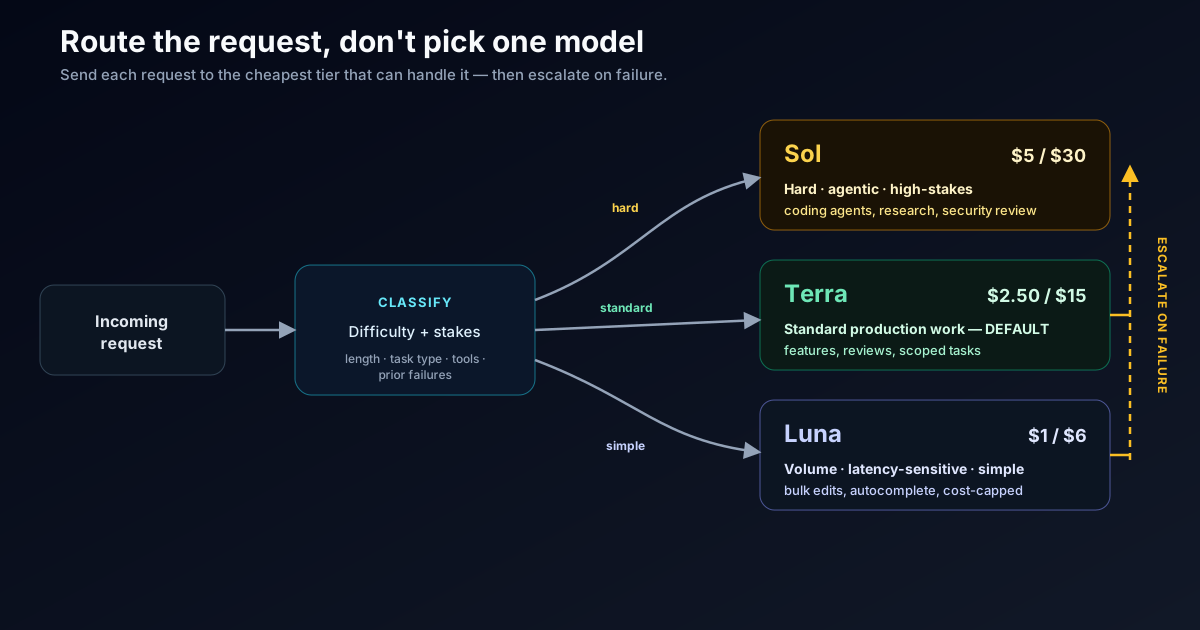
- The winning pattern is difficulty-based routing: classify the request, send it to the cheapest capable tier, and escalate on failure or low confidence.
- Because all three share one API surface and context window, mixing tiers in a single app is trivial — it is a model-string change, not a rewrite.
The Pricing Math (Do This First)
Everything downstream depends on the raw numbers, so start here.
GPT-5.6 TIER PRICING
Sol
FlagshipThe deal
$5.00 input / $30.00 output per 1M tokens
What you get
The premium tier. You pay it for the hardest coding, agent, research, and security work — not for routine requests.
Terra
Best defaultThe deal
$2.50 input / $15.00 output per 1M tokens
What you get
Exactly half of Sol on both input and output. Strong enough for most production traffic. Start here.
Luna
CheapestThe deal
$1.00 input / $6.00 output per 1M tokens
What you get
5× cheaper than Sol. Built for volume, low latency, and cost-capped paths — and it still beats last-gen flagships.
Shared across all three
No catchThe deal
1.05M context · 128K max output · Feb 16 2026 cutoff
What you get
The cheap tier does not get a smaller brain for context. You trade reasoning depth for price — not memory.
Two things jump out.
First, the gaps are clean multiples: Terra is exactly 2× cheaper than Sol, and Luna is 5× cheaper. That makes routing decisions easy to reason about — moving a request from Sol to Terra literally halves its token cost.
Second, and this is the part people miss: Sol uses fewer tokens to finish the same task. OpenAI cites roughly 54% better token efficiency on coding work, with Sol using less than half the output tokens of a comparable frontier model. So the effective cost gap between Sol and Terra on a completed task is smaller than the 2× per-token headline — sometimes much smaller on long agentic runs where Sol simply finishes in fewer steps.
💡 Key insight: Compare models on cost per successful task, not cost per token. A pricier model that finishes in half the tokens and half the retries can be cheaper in practice.
Cost Per Task, Not Cost Per Token
Here is the trap. A naive cost model says “Sol is 2× Terra, so always prefer Terra.” But real workloads have retries, failures, and multi-step loops, and those wreck the naive math.
Consider an agentic coding task:
- On Luna, it might take 4 attempts and still fail once, burning tokens on dead ends.
- On Terra, it succeeds in 2 attempts.
- On Sol, it succeeds first try, in half the tokens, with ultra thinking.
Suddenly “the expensive model” can be the cheapest path to a shipped result, because you paid once instead of three times. This is why routing beats a fixed choice: the right tier depends on how hard the request is, and you often do not know until you try.
Coding: When Sol Actually Earns Its Price
Coding is where the tiers separate most clearly.
| Signal | Sol | Terra | Luna |
|---|---|---|---|
| Coding Agent Index (Artificial Analysis) | 80 — best in family | Just above last-gen frontier | Beats last-gen flagship |
| Long-horizon agent tasks | 91.9% Terminal-Bench (ultra) | Solid for scoped tasks | Best for short, well-defined edits |
| Token efficiency to finish | Highest — fewest tokens per task | Good | Fast per step, may loop more |
| Best coding fit | Whole-repo, agentic, security | Everyday feature work, reviews | Autocomplete-style, bulk edits |
The practical read:
- Use Sol when the coding task is open-ended and agentic — “understand this repo, plan the change, edit across files, run the tests, fix what breaks.” That is where its long-horizon strength and token efficiency compound.
- Use Terra for scoped, everyday engineering — a well-defined feature, a code review, a bug with a clear repro. It is the right default for most day-to-day work.
- Use Luna for short, mechanical edits and high-volume operations — bulk refactors with a clear pattern, autocomplete-style suggestions, or anything where speed and price dominate.
If you want to see the agentic-coding loop that Sol is optimized for, my walkthrough of building UIs with Codex and Figma and the field notes on Claude Code auto mode in production both show what “the model keeps going without a babysitter” actually looks like in practice.
The Routing Strategy
This is the part worth stealing. Do not pick one model — pick a router.
DIFFICULTY-BASED ROUTING
Send each request to the cheapest tier that can plausibly handle it, then escalate. This beats any single-model choice on cost per successful task.
STEP 1
Classify the request
Score incoming requests by difficulty and stakes before you call a model.
- Cheap signals: input length, task type, tool count, prior failures
- A small classifier or even heuristics are enough to start
- High stakes (money, security, irreversible actions) bias upward
STEP 2
Route to the cheapest capable tier
Default trivial and high-volume work to Luna, everyday work to Terra, and only hard work to Sol.
- Volume + latency-sensitive → Luna
- Standard production work → Terra
- Agentic, ambiguous, or high-stakes → Sol
STEP 3
Escalate on failure or low confidence
If the cheap tier fails validation, returns low confidence, or loops, retry one tier up.
- Validate outputs (tests, schema, self-check) before accepting
- On failure, escalate Luna → Terra → Sol
- Cap escalations so a bad request cannot spiral
STEP 4
Measure cost per successful task
Track the metric that matters and let it tune your routing thresholds over time.
- Log tier, tokens, retries, and success per request type
- Move thresholds where the data says, not where intuition says
- Re-check after every model or prompt change
Because all three models share the same API surface, implementing this is genuinely a model-string swap:
import OpenAI from 'openai';

const client = new OpenAI();

// A crude but effective starting router.
function pickModel(req: { difficulty: number; highStakes: boolean }) {
  if (req.highStakes || req.difficulty >= 0.8) return 'gpt-5.6-sol';
  if (req.difficulty >= 0.4) return 'gpt-5.6-terra';
  return 'gpt-5.6-luna';
}

async function run(input: string, req: { difficulty: number; highStakes: boolean }) {
  let model = pickModel(req);
  let res = await client.responses.create({ model, input });

  // Escalate one tier if the cheap answer fails your validator.
  if (!isValid(res.output_text) && model !== 'gpt-5.6-sol') {
    model = model === 'gpt-5.6-luna' ? 'gpt-5.6-terra' : 'gpt-5.6-sol';
    res = await client.responses.create({ model, input });
  }
  return res.output_text;
}GPT-5.6 Sol vs Terra vs Luna: The Decisions, Made Explicit
THE CALLS THAT MATTER
If you only make these three decisions deliberately, you will get most of the value from the GPT-5.6 lineup.
- Default
THE QUESTION 01
What is the default tier?
THE CALL
Terra.
WHY IT WAS MINE TO MAKE
Half the price of Sol, full context window, strong enough for most production work. Defaults should be boring and cheap.
- Escalation
THE QUESTION 02
When do we pay for Sol?
THE CALL
Hard, agentic, or high-stakes only.
WHY IT WAS MINE TO MAKE
Sol’s token efficiency and long-horizon strength pay off on genuinely difficult tasks — and its cost is wasted on easy ones.
- Volume
THE QUESTION 03
What goes to Luna?
THE CALL
Volume and latency-sensitive paths.
WHY IT WAS MINE TO MAKE
5× cheaper than Sol and still beats last-gen flagships. Perfect for bulk, mechanical, or speed-critical work.
Migration Checklist
Moving to a GPT-5.6 routing setup
Track progress as you work through the list
0%
0/6 done
FAQ
Questions readers usually have
The questions people actually ask when they have to pick between Sol, Terra, and Luna.
Final Take
GPT-5.6 is the first OpenAI release where the smartest move is not choosing a model — it is choosing a router.
Make Terra your default, escalate to Sol when the task is genuinely hard, and push volume to Luna. Measure cost per successful task, not cost per token, and let the data move your thresholds. Do that, and you get most of the flagship’s quality on the requests that need it while paying Luna-and-Terra prices for everything else.
That is the entire point of splitting the frontier into three tiers. Use it.
For the full release picture — benchmarks, cybersecurity positioning, and the API — start with the GPT-5.6 complete guide. And if you are building on the platform, the ChatGPT Apps SDK and super-app reform shipped in the same window.
Sources
- TechCrunch: OpenAI launches its new family of models with GPT-5.6
- OpenAI: GPT-5.6
- OpenAI Help Center: A preview of GPT-5.6 Sol, Terra, and Luna
Explore more: LLM Engineering — RAG, Fine-Tuning & Production LLMs
Google Search · Preferred sources
Prefer this site on Google
If you already read this writing, add umesh-malik.com as a Preferred Source. Google can then highlight it with a preferred badge in Top Stories, AI Overviews, and AI Mode — for you, not as a site-wide ranking boost.
Related Articles

LLM Engineering
GPT-5.6 API: Pricing, Thinking Modes, and the Shared Context Trap
GPT-5.6 API pricing ($1-$30/1M), the Ultra and Max thinking modes, and a 1.05M context window that is shared — with the fine print that breaks agent loops.
LLM Engineering
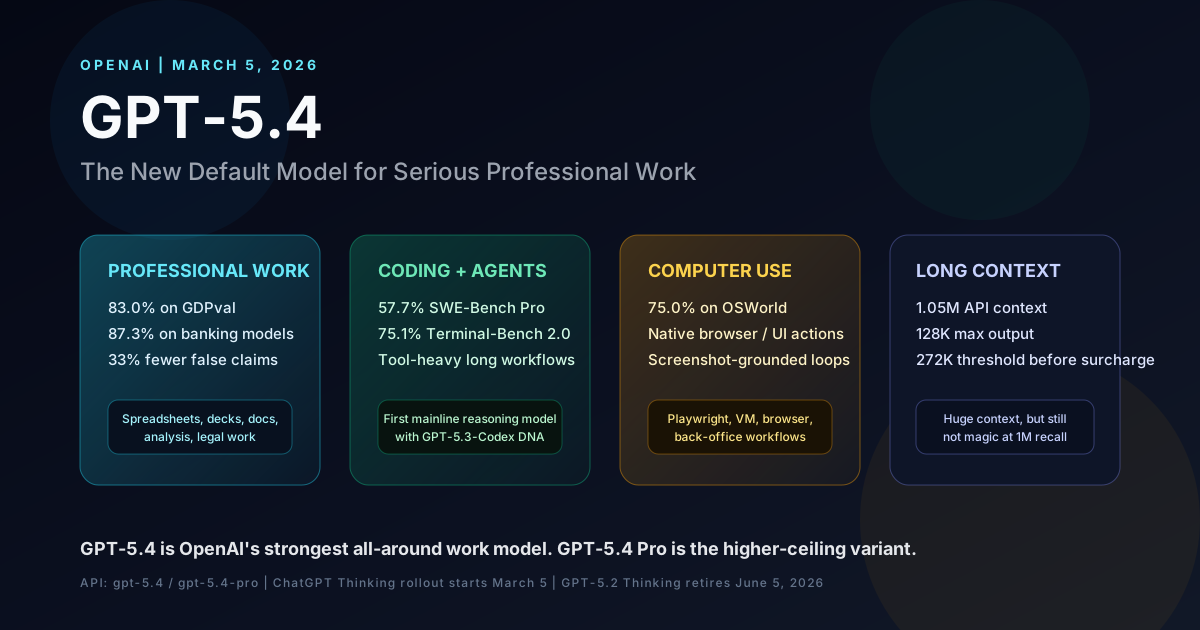
GPT-5.4 for Agents: Computer Use, MCP Tool Calls, and Real Pricing
GPT-5.4's native computer use and MCP tool calls are the real upgrade for agents. What holds up in a loop, what the 1M context costs, and how Pro compares.
LLM Engineering
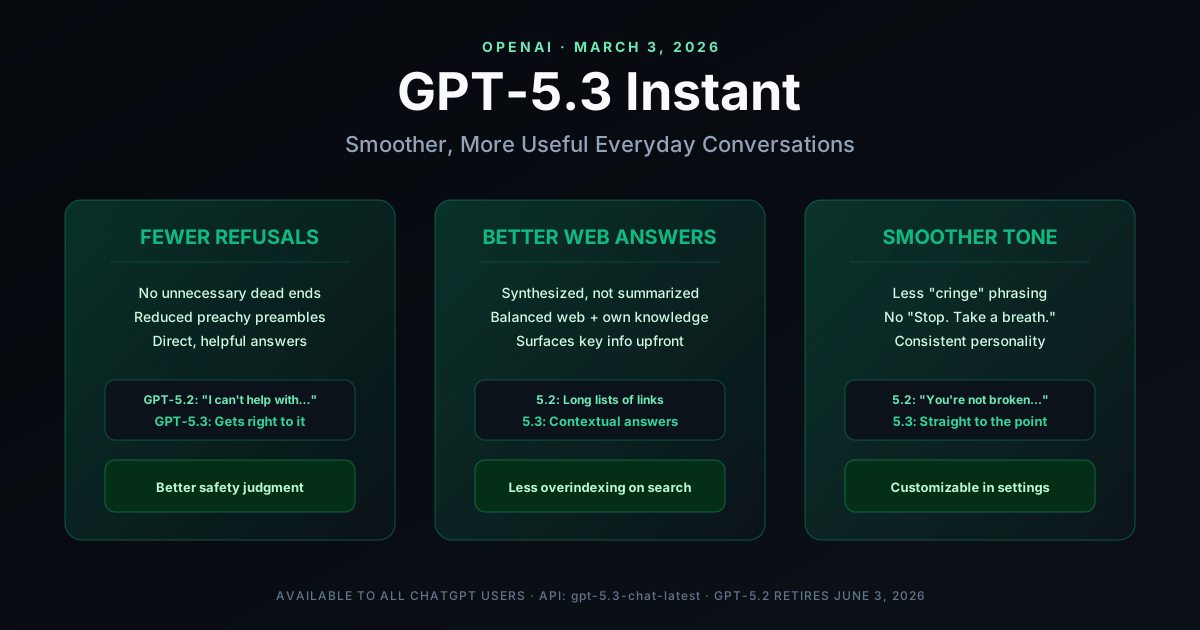
OpenAI GPT-5.3 Instant: 26.8% Fewer Hallucinations, Reduced Refusals, and Better Web Answers
GPT-5.3 Instant brings 26.8% fewer hallucinations, fewer needless refusals, and better web-sourced answers — what changed and why it matters for devs.
Keep reading
Get new posts on AI, Claude Code & LLMs
New deep-dives on AI engineering, Claude Code, and developer tooling — follow along however you prefer.
About the Author

Software engineer writing about AI, Claude Code, LLMs, OpenAI, Anthropic, and developer tooling. 5+ years building production systems at Expedia Group, Tekion, and BYJU'S.