GPT-5.6 API: Pricing, Thinking Modes, and the Shared Context Trap
GPT-5.6 API pricing ($1-$30/1M), the Ultra and Max thinking modes, and a 1.05M context window that is shared — with the fine print that breaks agent loops.

The GPT-5.6 API is OpenAI’s July 2026 model family — three tiers (Sol, Terra, and Luna) that share a 1.05M-token context window and range from $1 to $30 per million tokens. Sol is the coding-and-reasoning flagship, Terra is the balanced everyday model, and Luna is the fastest and cheapest.
OpenAI released GPT-5.6 on July 9, 2026, and for the first time in the GPT-5 line the headline is not a single model. It is three: Sol, Terra, and Luna.
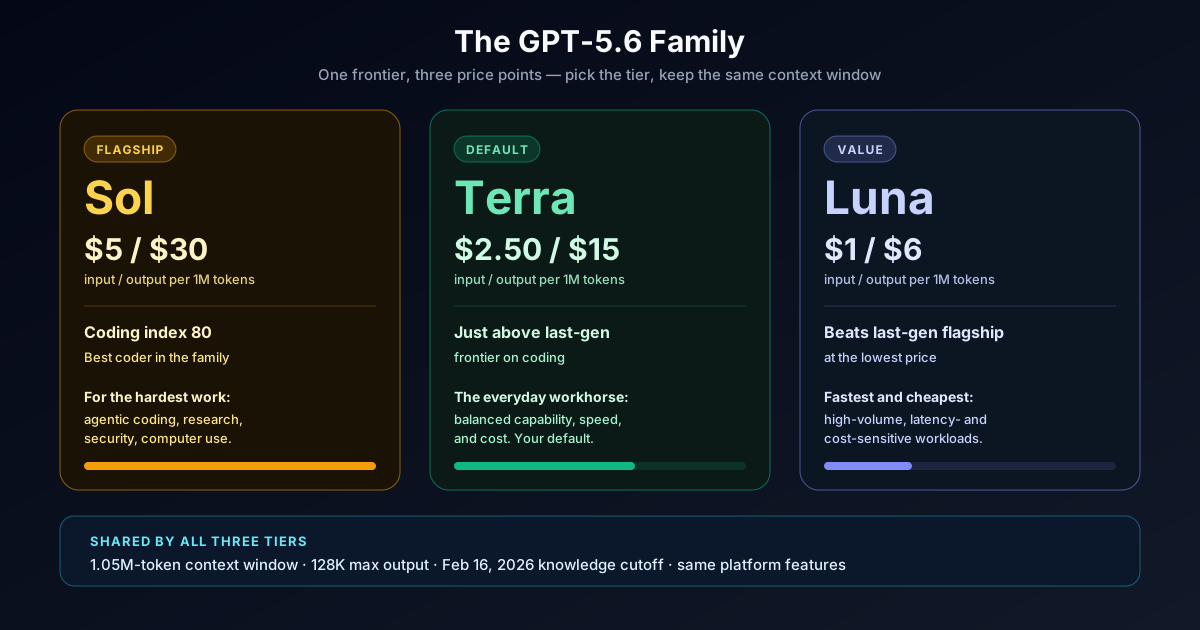
That naming change is the whole story. Instead of shipping one frontier model and a -pro step-up, OpenAI split the release into a capability-and-cost ladder where each rung is tuned for a different budget and workload. Sol is the flagship. Terra is the everyday workhorse. Luna is the speed-and-price play. And crucially, they all share the same 1.05M-token context window, the same February 16, 2026 knowledge cutoff, and the same platform features — so you can move up and down the ladder without rewriting your integration.
The short answer: GPT-5.6 is OpenAI’s most efficiency-focused release yet. Sam Altman is on record calling the family “orders of magnitude more efficient and cost-effective than previous versions,” and the coding numbers back the claim — Sol reportedly finishes agentic coding tasks with 54% better token efficiency than the previous generation. If you run models at scale, this release is less about a new capability ceiling and more about doing the same work for a fraction of the tokens.
GPT-5.6 AT A GLANCE
3
Model tiers
Sol · Terra · Luna
80
Sol coding index
Artificial Analysis
1.05M
Context window
shared across all three
$1-$5
Input / 1M tokens
Luna to Sol
WHO SHOULD READ WHAT
This guide covers three different decisions — model selection, coding fit, and cost. Start with the path that matches yours.
Use this to skip to what matters
ENGINEERING LEADS
You need to pick a default model
Start with the tier ladder, then the pricing and migration sections.
Focus on
OutcomeYou will know which of Sol, Terra, or Luna becomes your default and where to split traffic.
AI / AGENT BUILDERS
You care about coding and tool use
Focus on the coding benchmarks, thinking modes, and token-efficiency section.
Focus on
OutcomeYou will see exactly where Sol earns its price and where Terra is the smarter call.
SECURITY + PLATFORM
You evaluate risk before rollout
Read the cybersecurity positioning, long-context caveats, and what GPT-5.6 still does not fix.
Focus on
OutcomeYou will leave with a rollout plan instead of over-trusting the launch benchmarks.
TL;DR
- GPT-5.6 launched July 9, 2026 as a three-model family: Sol (flagship), Terra (balanced), and Luna (fast and cheap).
- All three share a 1.05M-token context window, 128K max output, and a February 16, 2026 knowledge cutoff.
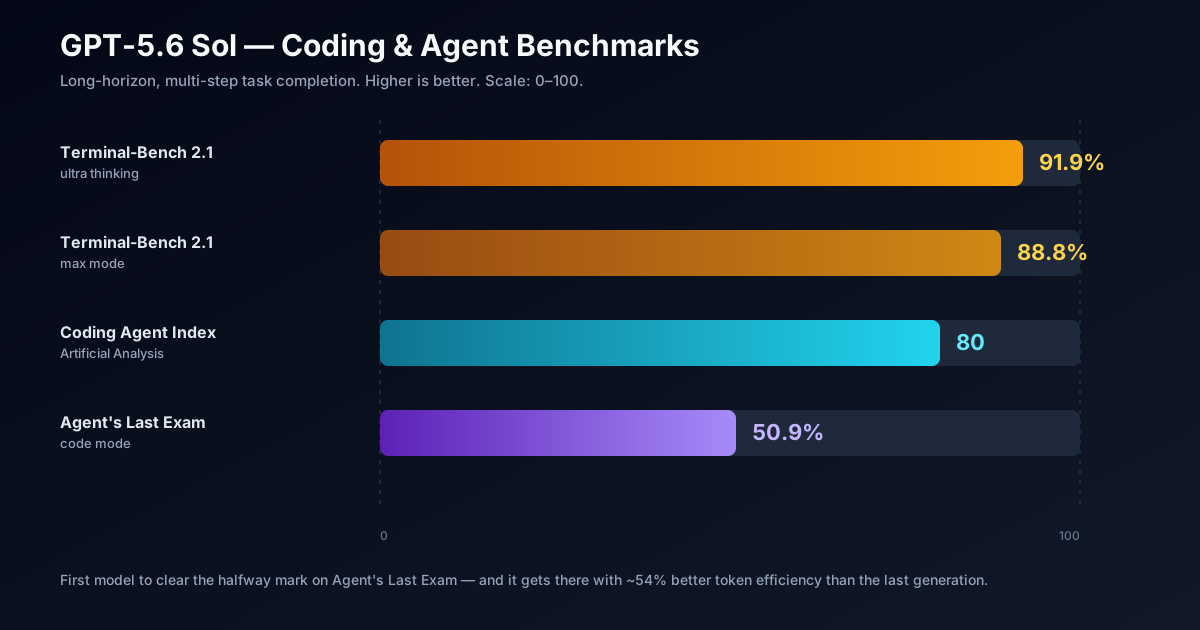
- Sol is the best coding model in the family, scoring 80 on the Artificial Analysis Coding Agent Index — about 2.8 points above the previous frontier competitor — and 91.9% on Terminal-Bench 2.1 with ultra thinking.
- Sol is the first model to clear the halfway mark on Agent’s Last Exam, at roughly 50.9% in code mode.
- Terra lands just above the previous frontier tier on coding, and Luna outperforms the last generation’s flagship while being the cheapest option.
- Pricing per 1M tokens: Sol
$5 / $30, Terra$2.50 / $15, Luna$1 / $6. - New ultra thinking and max reasoning modes push the ceiling on hard, long-horizon tasks.
- OpenAI calls GPT-5.6 its strongest cybersecurity model yet, tuned for defensive work like threat modeling, code review, and blue teaming.
- API names:
gpt-5.6-sol,gpt-5.6-terra,gpt-5.6-luna; the aliasgpt-5.6routes to Sol. Available in ChatGPT, Codex, the API, and GitHub Copilot.
What the GPT-5.6 API Actually Is
GPT-5.6 is not “GPT-5.5 but smarter.” It is a repackaging of the frontier into three price points, and that is a more interesting decision than another benchmark bump.
Here is the mental model:
- Sol — the flagship. Built for complex work across coding, knowledge work, research, cybersecurity, science, computer use, and design. This is the one you reach for when the task is genuinely hard.
- Terra — the middle tier. A deliberate balance of capability, speed, and cost for everyday production work. It is the model most teams will actually run by default.
- Luna — the floor. The fastest and lowest-cost member of the family, aimed at high-volume, latency-sensitive, or cost-capped workloads.
The important part is what they have in common. Every tier gets the same 1.05M context window, the same 128K max output, and the same knowledge cutoff. There is no “the cheap model also has a smaller brain for context” catch. You are trading raw reasoning depth for price and speed — not memory.
THE GPT-5.6 LADDER
One family, three price points, shared context.
Each tier keeps the full 1.05M-token window and platform features. You move up for reasoning depth, down for speed and cost.
Flagship for hard coding, research, cybersecurity, and computer use.
Balanced everyday model — the default for most production traffic.
Fastest and cheapest — high-volume, latency-sensitive, cost-capped work.
Prices are per 1M tokens (input / output). The fill meter encodes relative output cost, not a benchmark score.
-
June 26, 2026
GPT-5.6 Sol previewed
OpenAI previews the flagship Sol model to a narrow set of partners, teasing record coding and agent scores.
-
July 9, 2026
GPT-5.6 Sol, Terra, and Luna launch
The full three-tier family ships across ChatGPT, Codex, the OpenAI API, and GitHub Copilot.
-
Coming weeks
Broader rollout and higher-effort modes
Ultra thinking and max modes expand access as OpenAI scales capacity beyond the initial launch cohort.
1. The Real Headline Is Efficiency, Not a New Ceiling
Most model launches lead with “we beat the benchmark.” GPT-5.6 leads with “we beat it for less.”
That is a genuine shift. The standout claim is that Sol is 54% more token-efficient on AI coding tasks than the previous generation. On head-to-head coding runs, OpenAI says Sol uses less than half the output tokens of a comparable frontier model, finishes in less than half the time, and costs about a third less to complete the same task.
For anyone paying a real API bill, that math matters more than a two-point benchmark win.
output tokens, time, and cost = 100%
less than half the tokens on the same task
finishes in under half the time
about one-third cheaper end-to-end
Why does this land now? Because the bottleneck for most production LLM systems in 2026 is not “the model cannot do it.” It is “the model does it, but the token bill and latency make it uneconomical at scale.” A model that produces the same answer with half the tokens changes which use cases are actually viable.
💡 Key insight: GPT-5.6’s most important number is not a benchmark score — it is the token count it takes to reach that score. Efficiency is the feature.
2. Coding and Agents: Where Sol Actually Wins
Sol is positioned as the best coding model in the family, and the public numbers are strong.
| Coding / agent eval | GPT-5.6 Sol | Notes |
|---|---|---|
| Artificial Analysis Coding Agent Index | 80 | ≈2.8 pts above the previous frontier competitor |
| Terminal-Bench 2.1 (ultra thinking) | 91.9% | Record score at launch |
| Terminal-Bench 2.1 (max mode) | 88.76% | Still leading without ultra thinking |
| Agent's Last Exam (code mode) | ≈50.9% | First model to clear the halfway mark |
The Terminal-Bench and Agent’s Last Exam numbers are the ones agent builders should care about. They measure long-horizon, multi-step task completion — the model has to plan, run commands, read output, recover from errors, and keep going without a human babysitting each step. Clearing 50% on Agent’s Last Exam is a milestone; most models still stall well before the halfway point.
For a concrete sense of how Codex-class coding behaves inside a real agent loop, I walked through building frontend UIs with Codex and Figma — the same plan-run-inspect-iterate pattern these benchmarks are trying to measure.
3. Thinking Modes: Ultra and Max
GPT-5.6 introduces higher-effort reasoning modes that let you dial compute up for the hardest work.
- Ultra thinking — the top reasoning setting, used to post Sol’s record 91.9% on Terminal-Bench 2.1. Reserve it for genuinely hard, long-horizon problems where extra deliberation pays for itself.
- Max mode — a strong high-effort tier that still hit 88.76% on the same benchmark without going all the way to ultra.
The practical rule is the same as it has always been with reasoning models: effort is a cost dial, not a free upgrade. Higher thinking modes consume more (billed) reasoning tokens and add latency. Use them where the task genuinely needs multi-step planning — agentic coding, deep research, complex analysis — and drop back to lower effort for extraction, formatting, and simple transforms.
4. Cybersecurity: OpenAI’s “Strongest Yet”
OpenAI describes GPT-5.6 as its strongest cybersecurity model to date, explicitly tuned to help with defensive security work:
- threat modeling and architecture review
- security-focused code review and vulnerability triage
- patch generation and remediation guidance
- blue-team workflows and detection engineering
This is a meaningful positioning choice. A model that is good at finding and fixing vulnerabilities is, by definition, also more capable in the offensive direction — so OpenAI pairs the capability with monitoring and access controls, and frames the sanctioned use cases around defense. If your security team has been waiting for a model strong enough to sit inside real review pipelines, Sol is the one to evaluate.
If you are thinking about agents with this much capability touching production systems, the governance questions in the agentic AI enterprise security model apply directly here.
5. The 1.05M Context Window Is Shared — but Read the Fine Print
Every GPT-5.6 tier ships with a 1,050,000-token context window and 128,000 max output tokens. That is a real capability, and the fact that even Luna gets the full window is genuinely useful.
But the same caveat from every large-context model still holds: a big window is not perfect recall. Long-context retrieval quality degrades at the far edge of the window, and giant prompts carry hidden cost and latency. Treat 1M context as a tool for broad synthesis and large working memory, not as a replacement for retrieval discipline.
1M CONTEXT: USE IT WELL
The shared 1.05M window is one of the best parts of this release. The failure mode is trusting it for precise far-edge retrieval.
GREAT FOR
Broad synthesis and big working memory
The full window shines when the job is to hold a lot of context at once and reason over it as a whole.
- Whole-codebase planning and refactor scoping
- Long diligence rooms or policy bundles for first-pass synthesis
- Many prior conversation turns plus tools plus scratch memory
- Large multi-document comparison where partial recall is still useful
DO NOT ASSUME
A huge window replaces retrieval
OpenAI-class long-context evals consistently show recall dropping near the far edge, and giant prompts inflate cost.
- You can skip chunking, ranking, or tool-based search
- Needle retrieval stays reliable near the 1M edge
- Reasoning tokens are free because they are invisible
- Latency and price are flat as prompts grow
Sol vs Terra vs Luna: The Decision
If you only remember one section, make it this one.
| Dimension | Sol | Terra | Luna |
|---|---|---|---|
| Role | Flagship for hard work | Balanced default | Fast + cheap volume model |
| Input / output per 1M | $5 / $30 | $2.50 / $15 | $1 / $6 |
| Context window | 1.05M | 1.05M | 1.05M |
| Coding strength | Best in family (index 80) | Just above last-gen frontier | Beats last-gen flagship |
| Best when | Task is genuinely hard or agentic | You want one solid default | Volume and latency dominate cost |
The simplest rule:
- Default to Terra. It is the balanced everyday model and will be the right call for most production traffic.
- Escalate to Sol when the task is genuinely hard — agentic coding, deep research, security review, or anything where a wrong answer is expensive.
- Drop to Luna for high-volume, latency-sensitive, or cost-capped work where “good and fast and cheap” beats “best.”
I go much deeper on this — including the break-even math and a routing strategy — in the companion post: GPT-5.6 Sol vs Terra vs Luna: which one to actually use.
Using GPT-5.6 in the API
The models are available as gpt-5.6-sol, gpt-5.6-terra, and gpt-5.6-luna, with the alias gpt-5.6 routing to Sol. Here is a minimal call:
import OpenAI from 'openai';

const client = new OpenAI();

const response = await client.responses.create({
  model: 'gpt-5.6-terra', // default workhorse; swap to sol/luna as needed
  input: 'Summarize this incident timeline and propose three remediation steps.',
  reasoning: { effort: 'medium' }
});

console.log(response.output_text);
Escalating a single hard request to Sol with a higher thinking mode is a one-line change:
const hard = await client.responses.create({
  model: 'gpt-5.6-sol',
  input: 'Audit this auth module for vulnerabilities and produce a patch.',
  reasoning: { effort: 'high' } // dial up for long-horizon, high-stakes work
});
API PLAYBOOK
Five decisions that matter most when moving GPT-5.6 from a demo into production.
ROUTING
Route by difficulty, not by habit
Send the bulk of traffic to Terra or Luna and reserve Sol for the requests that actually need it.
- Classify request difficulty up front
- Escalate to Sol on failure or low confidence
EFFORT
Treat thinking mode as a cost dial
Ultra and max are for hard, long-horizon work — not a default to leave on.
- Low effort for extraction and formatting
- High / ultra for planning and agent loops
BUDGET
Watch hidden reasoning tokens
Invisible reasoning tokens are billed as output and eat your context budget.
- Leave output headroom while tuning
- Alert on truncated / incomplete responses
CONTEXT
Do not over-trust 1M recall
Keep retrieval and ranking even though the window is huge.
- Use the window for synthesis
- Keep search for precise lookups
RELIABILITY
Pin snapshots in production
Evaluate on the rolling alias, then pin a dated snapshot for stable releases.
- Avoid silent behavior drift
- Re-evaluate before bumping the pin
Migration and Rollout
GPT-5.6 migration checklist
Track progress as you work through the list
0%
0/6 done
What GPT-5.6 Still Does Not Solve
The release is strong, but read the tradeoffs before you over-index on the launch numbers.
1. The knowledge cutoff is February 16, 2026
Impressive, but still a cutoff. For genuinely current facts you still need web search or your own retrieval layer. Do not assume the model “knows” anything after mid-February 2026.
2. A 1M window is not 1M of perfect recall
Shared context across all three tiers is great, but far-edge retrieval still degrades. Keep your retrieval discipline.
3. Higher thinking modes cost real time and money
Ultra and max deliver the record scores, but they are slower and more expensive. They are not a default; they are an escalation.
4. Cheaper does not mean free to misroute
The whole point of three tiers is routing. If you send everything to Sol out of caution, you lose the entire cost advantage of the family. If you send everything to Luna to save money, you will pay for it in quality failures. The value is in matching the tier to the task.
5. Powerful cyber capability is a double-edged surface
A model strong enough to be OpenAI’s best defensive security tool is also more capable in the wrong hands. Treat security-related agent workflows as privileged, with logging, scope limits, and human confirmation.
FAQ
Questions readers usually have
The repeat questions cluster around four things: what the tiers are, which to pick, what it costs, and how to call it.
Final Take
The most important thing to understand about GPT-5.6 is that OpenAI stopped competing purely on the capability ceiling and started competing on capability per dollar.
Splitting the release into Sol, Terra, and Luna — all sharing the same 1.05M context and platform features — turns model selection into a routing problem instead of an all-or-nothing bet. The flagship is genuinely strong on coding and agents. But the release’s real weapon is that even the cheap tier is roughly a last-generation frontier model, and the flagship finishes the same work with half the tokens.
If you run LLMs at any real scale, evaluate GPT-5.6 with a cost-per-successful-task lens, not just a leaderboard lens. Then set Terra as your default, escalate to Sol where it earns its price, and push volume to Luna. That is the whole game this release is built around.
Next, read the companion deep-dive on choosing between Sol, Terra, and Luna, and the breakdown of the ChatGPT super-app reform and Apps SDK that shipped alongside it.
Sources
- TechCrunch: OpenAI launches its new family of models with GPT-5.6
- OpenAI: GPT-5.6
- OpenAI Help Center: A preview of GPT-5.6 Sol, Terra, and Luna
- GitHub Changelog: GPT-5.6 Sol, Terra, and Luna in GitHub Copilot
- Simon Willison: The new GPT-5.6 family — Luna, Terra, Sol
Explore more: LLM Engineering — RAG, Fine-Tuning & Production LLMs
Google Search · Preferred sources
Prefer this site on Google
If you already read this writing, add umesh-malik.com as a Preferred Source. Google can then highlight it with a preferred badge in Top Stories, AI Overviews, and AI Mode — for you, not as a site-wide ranking boost.
Related Articles
LLM Engineering
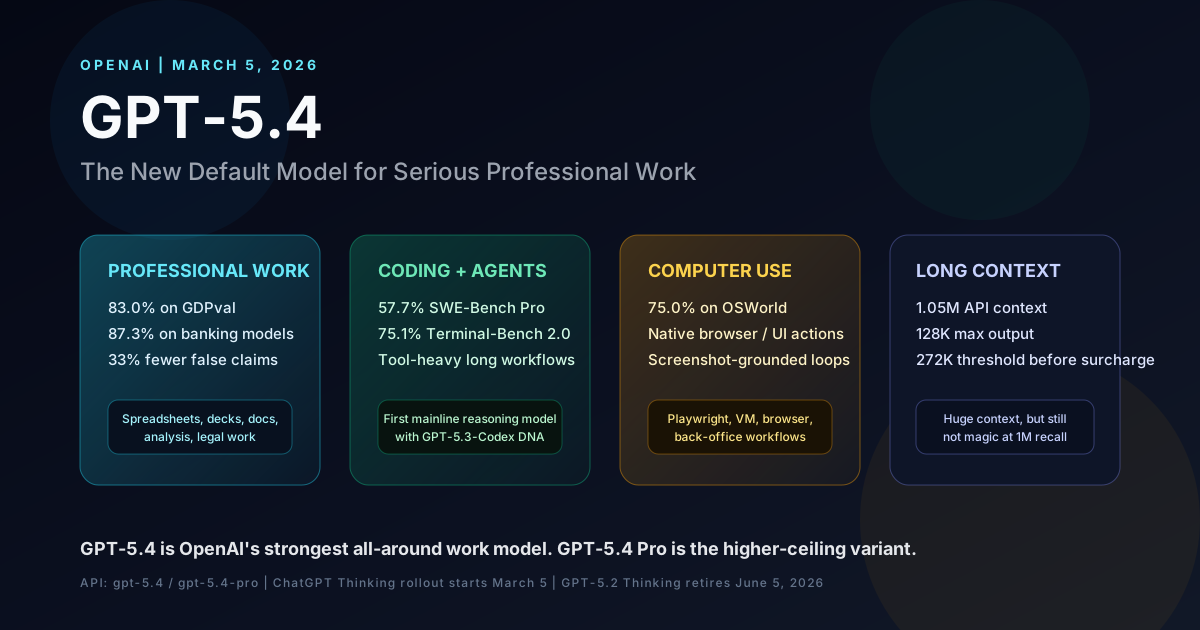
GPT-5.4 for Agents: Computer Use, MCP Tool Calls, and Real Pricing
GPT-5.4's native computer use and MCP tool calls are the real upgrade for agents. What holds up in a loop, what the 1M context costs, and how Pro compares.

LLM Engineering
GPT-5.6 Sol vs Terra vs Luna: The Routing Strategy That Cuts Cost
GPT-5.6 Sol vs Terra vs Luna compared on price, coding, latency, and cost per task — plus a routing strategy that cuts your bill without wrecking quality.
LLM Engineering
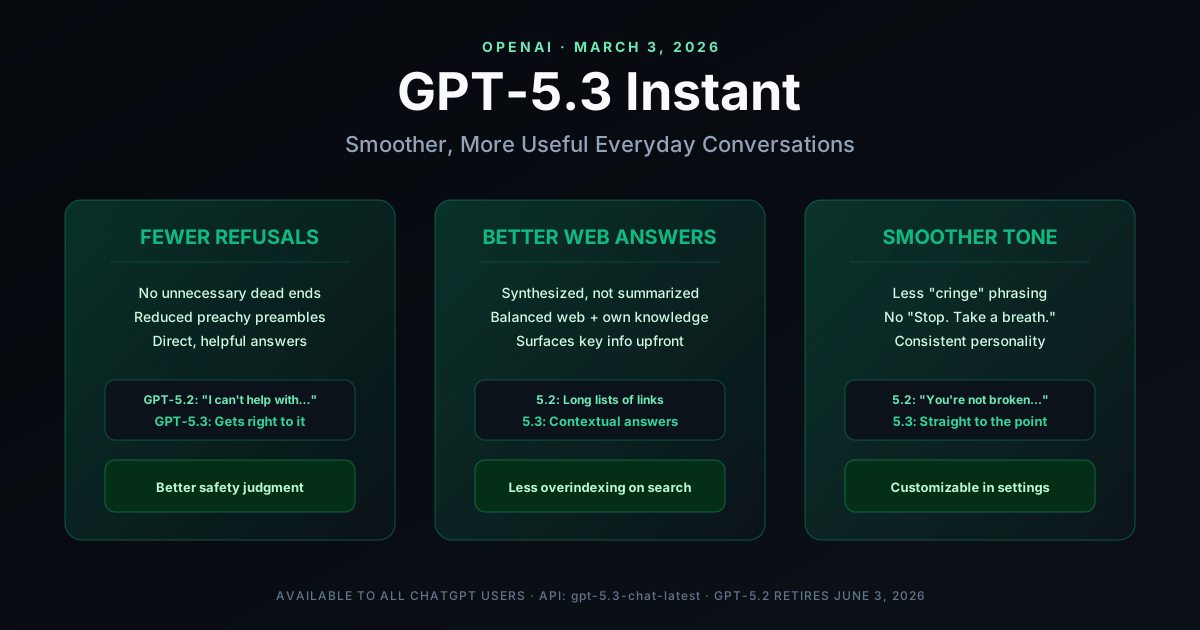
OpenAI GPT-5.3 Instant: 26.8% Fewer Hallucinations, Reduced Refusals, and Better Web Answers
GPT-5.3 Instant brings 26.8% fewer hallucinations, fewer needless refusals, and better web-sourced answers — what changed and why it matters for devs.
Keep reading
Get new posts on AI, Claude Code & LLMs
New deep-dives on AI engineering, Claude Code, and developer tooling — follow along however you prefer.
About the Author

Software engineer writing about AI, Claude Code, LLMs, OpenAI, Anthropic, and developer tooling. 5+ years building production systems at Expedia Group, Tekion, and BYJU'S.