Kimi K3 vs Claude Fable 5: When the Open Model Is Worth the Switch
Kimi K3 beats Claude Fable 5 on cost by a wide margin and loses on agentic tasks. The benchmarks that decide it, and how to run K3 where it actually wins.

Kimi K3 vs Claude Fable 5 is the matchup nobody in the West saw coming this fast. On July 16, 2026, Moonshot AI shipped Kimi K3 — a 2.8-trillion-parameter open-weight model — and it did something no Chinese lab had done before: it beat Anthropic’s flagship Claude Fable 5 outright on multiple frontier benchmarks, including topping the Frontend Code Arena.
Let me be honest up front, because the headlines are not: K3 does not dethrone Fable 5 overall. Fable 5 still wins the broader set of evaluations and leads the composite intelligence index. Moonshot’s own launch post admits K3 trails Fable 5 and GPT-5.6 Sol on aggregate.
But that framing misses the real story. Where Kimi K3 wins, it wins the lanes that matter most for agent builders — long-horizon coding, terminal automation, agentic browsing, and frontend generation — and it does it at roughly one-third the price. For a huge class of production workloads, “slightly behind the absolute frontier, at 70% lower cost, with open weights” is not second place. It is the new default.
KIMI K3 AT A GLANCE
2.8T
Parameters
16/896 experts active
1M
Context window
native, flat-priced
$3 / $15
Input / output
per 1M tokens
#1
Frontend Arena
1,679 Elo, ahead of Fable 5
WHO SHOULD READ WHAT
This is a decision post. Jump to the section that matches why you're comparing these two.
Use this to skip to what matters
AGENT BUILDERS
You run high-volume agent loops
Go to the scorecard and the where-K3-wins section — this is where the cost story pays off.
Focus on
OutcomeYou will know which workloads to move to K3 and how much you save.
ENGINEERING LEADS
You care about the quality ceiling
Focus on where Fable 5 still leads and the honest caveats.
Focus on
OutcomeYou will know exactly which tasks still justify Fable 5’s premium.
PLATFORM / INFRA
You want to self-host
Read the architecture section and the how-to-use options.
Focus on
OutcomeYou will understand what running the largest open model ever actually takes.
TL;DR
- Kimi K3 launched July 16, 2026 from Moonshot AI: a 2.8T-parameter mixture-of-experts model (16 of 896 experts active per token), 1M context, native multimodal. Open weights followed within weeks — the largest open model ever released.
- It genuinely beats Claude Fable 5 on Terminal-Bench 2.1 (88.3 vs 84.6), SWE-Marathon (42.0 vs 35.0), BrowseComp (91.2 vs 88.0), and the Frontend Code Arena (#1, 1,679 Elo).
- Fable 5 still wins overall: it leads the Artificial Analysis Intelligence Index (59.9 vs 57.1) and takes FrontierSWE (86.6 vs 81.2), DeepSWE (70.0 vs 67.5), GDPval, JobBench, and vision.
- K3 costs about 70% less: $3 / $15 per 1M tokens vs Fable 5’s $10 / $50 — roughly 3.3x cheaper, flat across the full 1M window.
- The right move is workload routing, not wholesale switching: K3 for agentic/terminal/browsing/high-volume, Fable 5 for frontier-difficulty engineering, vision, and knowledge work.
- Big caveat: the two ran through different harnesses (KimiCode vs Claude Code/Codex), which limits clean model-to-model conclusions.
Kimi K3 vs Claude Fable 5: The Benchmark Scorecard
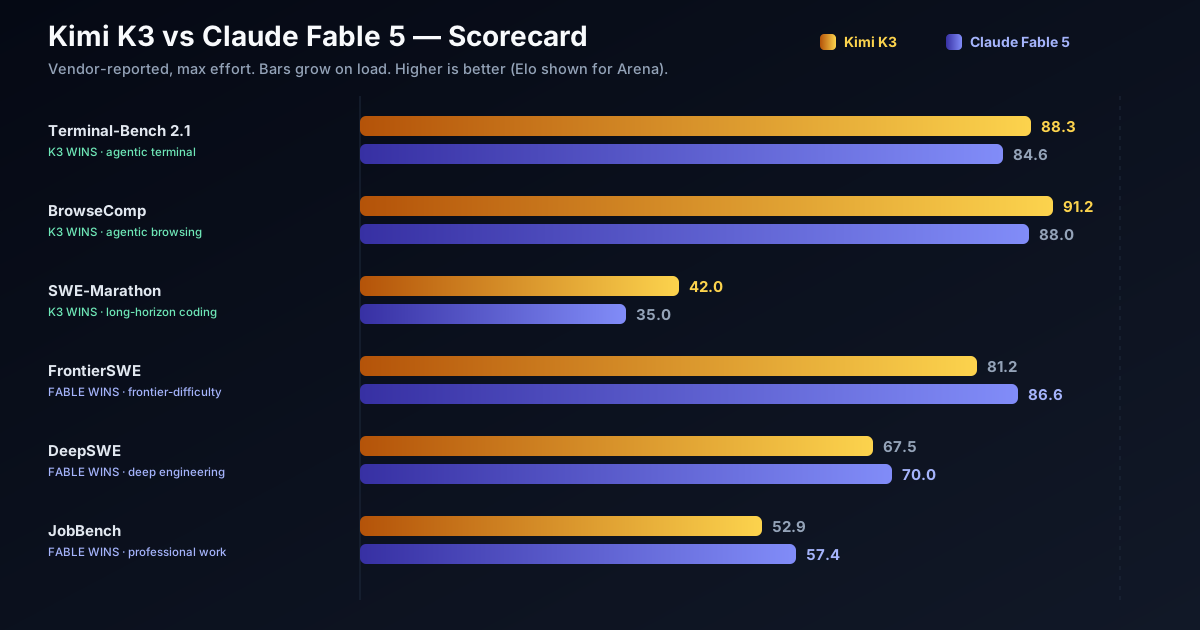
Here is the full head-to-head on vendor-reported, max-effort numbers. I’ve marked the winner of each row honestly — including the ones where the open model loses.
| Benchmark | Kimi K3 | Claude Fable 5 | Winner |
|---|---|---|---|
| Terminal-Bench 2.1 (agentic terminal) | 88.3 | 84.6 | Kimi K3 |
| SWE-Marathon (long-horizon coding) | 42.0 | 35.0 | Kimi K3 |
| BrowseComp (agentic browsing) | 91.2 | 88.0 | Kimi K3 |
| Frontend Code Arena (Elo) | 1,679 | lower | Kimi K3 |
| Program Bench | 77.8 | 76.8 | Kimi K3 |
| Automation Bench | 30.8 | 29.1 | Kimi K3 |
| FrontierSWE (frontier-difficulty) | 81.2 | 86.6 | Fable 5 |
| DeepSWE | 67.5 | 70.0 | Fable 5 |
| Kimi Code Bench 2.0 | 72.9 | 76.9 | Fable 5 |
| JobBench (professional work) | 52.9 | 57.4 | Fable 5 |
| GDPval-AA (Elo) | 1,668 | 1,760 | Fable 5 |
| Intelligence Index v4.1 (composite) | 57.1 | 59.9 | Fable 5 |
Count it up and the pattern is clear: Fable 5 wins the broader board, but every single one of K3’s wins is in the agentic / long-horizon / automation lane. That is not a coincidence — it is what Moonshot optimized for.
💡 Key insight: K3 and Fable 5 are not fighting for the same crown. Fable 5 is the frontier-intelligence ceiling; K3 is the agentic-throughput value leader. Which one is “better” depends entirely on whether your workload looks like a hard exam or a long, cheap, repetitive grind.
Watch the Agentic Gap Animate
The wins that matter for agent builders are the long-horizon ones — the tasks where the model has to keep going for dozens or hundreds of steps without losing the thread. Here is how K3 stacks up against Fable 5 on exactly those, as an animated reveal.
agentic browsing (Fable 5: 88.0)
agentic terminal (Fable 5: 84.6)
program synthesis (Fable 5: 76.8)
long-horizon coding (Fable 5: 35.0)
Where Kimi K3 Actually Wins
Strip away the leaderboard noise and K3’s edge is specific and real.
THE TWO MODELS, HONESTLY
This is the cleanest way to think about the matchup — not 'which is smarter' but 'which shape of work.'
CHOOSE KIMI K3
Long, cheap, agentic grinds
K3 is tuned for workloads that run long and repeat often — where cost per run and stamina beat peak IQ.
- Long-horizon coding agents (SWE-Marathon +7.0)
- Terminal / shell automation loops (+3.7)
- Agentic browsing and research (BrowseComp +3.2)
- Frontend generation (Arena #1, ahead of Fable 5)
- High-volume pipelines where 70% cost savings compound
CHOOSE CLAUDE FABLE 5
Frontier-difficulty and knowledge work
Fable 5 keeps the ceiling on the hardest single tasks and the widest general capability.
- Frontier-difficulty engineering (FrontierSWE +5.4)
- Professional knowledge work (JobBench, GDPval)
- Vision and multimodal reasoning (CharXiv, Zerobench)
- Highest composite intelligence (Index 59.9)
- Adaptive reasoning effort from low to max
The most quotable single result is the Frontend Code Arena: in blind developer testing, K3 ranked first at 1,679 Elo, ahead of Fable 5. That is a human-preference benchmark, not a synthetic one — real developers picked K3’s UI code more often. For anyone shipping frontend work, that is the result to actually test against your own prompts.
If you want context on how fast Chinese labs have been closing this gap, I traced the earlier jump in DeepSeek V4’s challenge to US AI rivals — K3 is that trajectory reaching the frontier.
The Cost Story Is the Real Weapon
Benchmarks get the headlines. Price gets the migration.
KIMI K3 vs CLAUDE FABLE 5 — PRICING (PER 1M TOKENS)
Kimi K3
3.3x cheaperThe deal
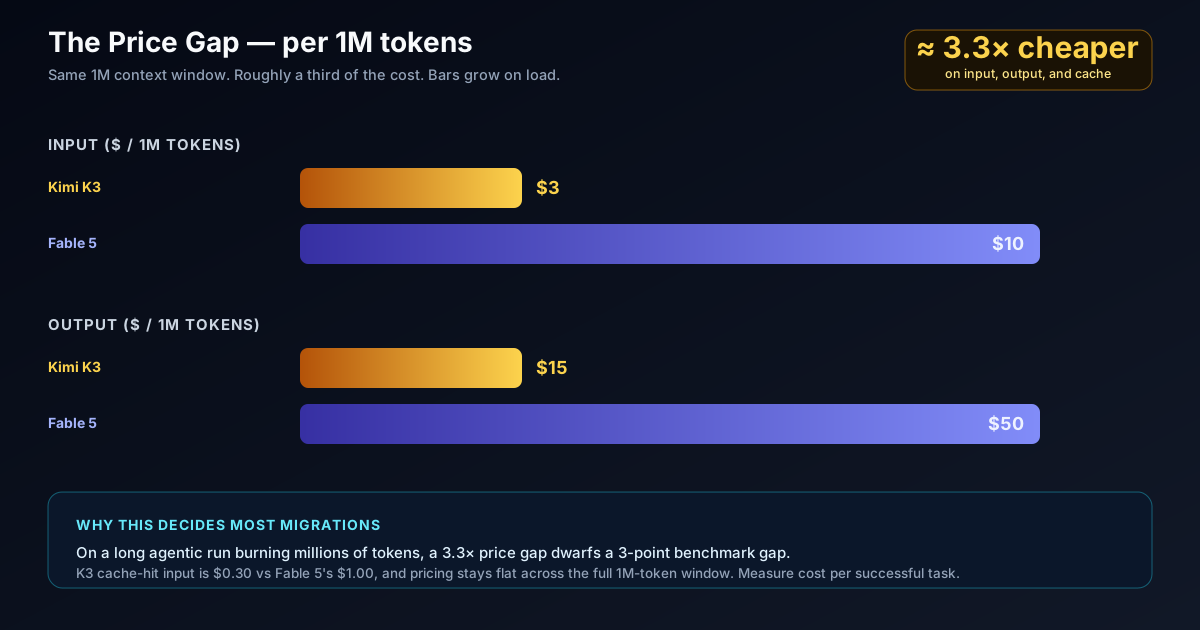
$3.00 input / $15.00 output · $0.30 cache-hit
What you get
Flat pricing across the full 1M-token window, with no long-context surcharge. Open weights let you self-host to cut cost further.
Claude Fable 5
PremiumThe deal
$10.00 input / $50.00 output · $1.00 cache-hit
What you get
The frontier-intelligence ceiling, priced like it. Worth it for the hardest tasks; expensive for high-volume agentic grinds.
The break-even math
Why it mattersThe deal
K3 saves ~70% per token
What you get
On a long agentic run that burns millions of tokens, a 3.3x price gap dwarfs a 3-point benchmark gap. Cost, not IQ, decides most production choices.
The catch
Be honestThe deal
Cheaper per token ≠ cheaper per task
What you get
If K3 needs more retries on a frontier-hard task, the savings shrink. Measure cost per SUCCESSFUL task, not per token, before you commit.
Do the arithmetic on a real agentic workload. A long-horizon coding agent that consumes, say, 20M input and 4M output tokens across a run costs about $260 on Fable 5 and about $120 on K3 — and K3 actually scores higher on SWE-Marathon. That is the entire pitch in one line: more agentic stamina, less than half the bill.
Interactive: The Same Prompt, Two Models
Toggle between the two to see how the tradeoff plays out on a representative agentic-coding task.
PROMPT
"Build and iterate on a full-stack feature across ~40 tool-calling steps: read the repo, write code, run the terminal, fix failures, and open a PR."
Currently viewing: Kimi K3
Frontier ceiling, premium bill. Fable 5 is the stronger single-shot reasoner and edges ahead on frontier-difficulty subtasks. Adaptive reasoning effort lets it dial compute up on the hard steps. But at $10 / $50, a 40-step run that burns millions of tokens gets expensive fast, and on the long-horizon version of this task it actually scores lower than K3 (SWE-Marathon 35.0).
Pick it when: the task has genuinely frontier-hard steps, needs top-tier vision, or a single wrong answer is costly.
Agentic stamina, one-third the cost. K3 leads on SWE-Marathon (42.0), Terminal-Bench (88.3), and BrowseComp (91.2) — exactly the skills this loop stresses. At $3 / $15 the same 40-step run costs less than half as much, and open weights mean you can self-host to cut it further.
Pick it when: the workload is long, repetitive, high-volume, or agentic — and cost per run matters more than peak IQ.
Under the Hood: The Largest Open Model Ever
K3’s specs are a statement of intent as much as an engineering result.
KIMI K3 ARCHITECTURE
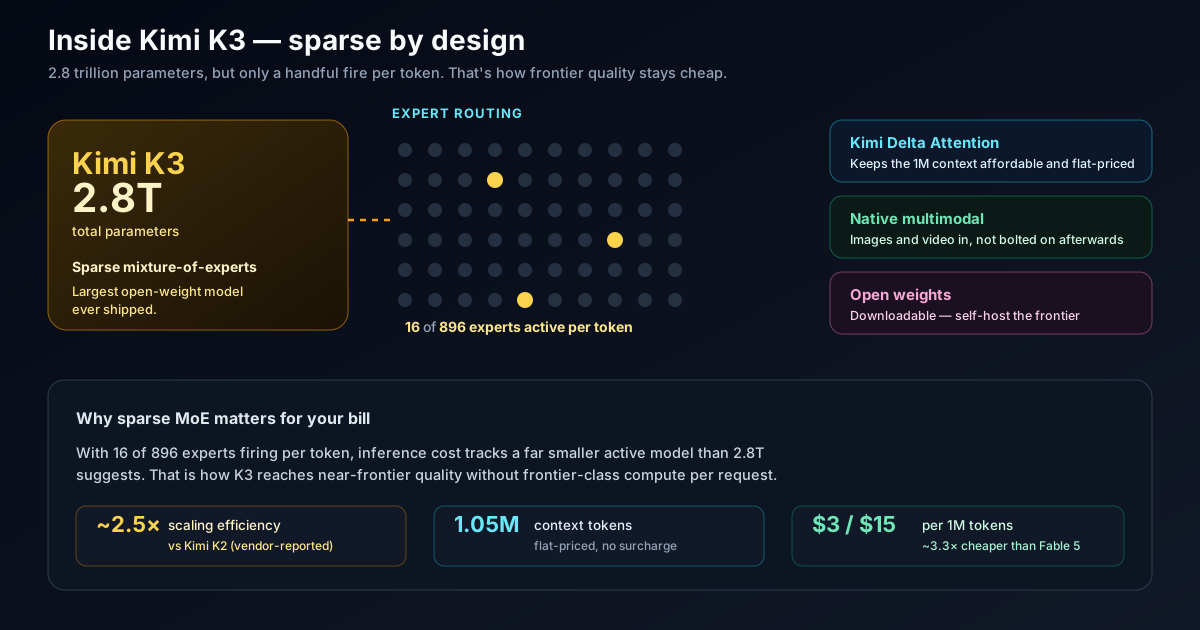
2.8T
Total parameters
largest open model ever
16 / 896
Experts active
sparse MoE per token
1.05M
Context tokens
Kimi Delta Attention
~2.5x
Scaling vs K2
vendor-reported
The design choices tell you what Moonshot cares about:
- Sparse mixture-of-experts — 2.8T total parameters, but only 16 of 896 experts fire per token, so inference cost tracks a far smaller active model. This is how they hit frontier quality without frontier-class compute per request.
- Kimi Delta Attention — a linear-attention variant that keeps the 1M-token context affordable and flat-priced instead of ballooning cost at long context.
- Native multimodal — images and video in, not bolted on.
- Open weights — the whole thing is downloadable, which is why “largest open model ever” is not just a spec-sheet flex. It changes who can build on the frontier.
How to Use Kimi K3
You have four realistic paths, from zero-effort to full control.
| Path | How | Best for |
|---|---|---|
| Moonshot API | OpenAI-compatible endpoint from platform.moonshot.ai | Fastest drop-in; keep your existing SDK |
| OpenRouter | Model id moonshotai/kimi-k3 | Trying it with no new account or commitment |
| KimiCode CLI | Moonshot’s agentic coding harness | Getting K3’s best agentic behavior out of the box |
| Self-host (open weights) | Download the weights; serve on your own GPUs | Data control and lowest marginal cost at scale |
Because the API is OpenAI-compatible, switching an existing integration is often a base-URL and model-string change:
import OpenAI from 'openai';

// Point the standard SDK at Moonshot's OpenAI-compatible endpoint.
const client = new OpenAI({
  apiKey: process.env.MOONSHOT_API_KEY,
  baseURL: 'https://api.moonshot.ai/v1'
});

const res = await client.chat.completions.create({
  model: 'kimi-k3',
  messages: [
    { role: 'user', content: 'Refactor this module and run the tests until they pass.' }
  ]
});

console.log(res.choices[0].message.content);A Migration Plan That Won’t Burn You
Moving workloads to Kimi K3
Track progress as you work through the list
0%
0/6 done
Timeline
-
July 16, 2026
Kimi K3 ships
Moonshot AI releases the 2.8T MoE model across API and OpenRouter, topping the Frontend Code Arena and beating Fable 5 on several agentic benchmarks.
-
July 19, 2026
The head-to-head lands
Independent comparisons confirm the split: Fable 5 wins the broad board and the intelligence index; K3 wins the agentic lane at a third of the price.
-
By July 27, 2026
Open weights release
Moonshot publishes the weights, making K3 the largest open model ever and opening frontier-class capability to self-hosting.
The Verdict
KIMI K3 — THE BOTTOM LINE
An honest ledger. K3 is not the best model in the world. It might be the best value at the frontier.
The pros
- Beats Fable 5 on terminal, long-horizon coding, browsing, and frontend
- Roughly 3.3x cheaper per token — savings compound on agentic runs
- Largest open-weight model ever; self-hostable for data control
- 1M context at flat pricing, no long-context surcharge
- #1 in blind Frontend Code Arena testing
The cons
- Loses the broader board and the composite intelligence index to Fable 5
- Trails on frontier-difficulty engineering, vision, and knowledge work
- Fixed temperature 1.0 and max-only effort at launch
- Benchmarks used different harnesses — gaps are directional, not exact
- Self-hosting a 2.8T model is a serious infrastructure commitment
Kimi K3 doesn't beat Claude Fable 5 everywhere — but it wins the agentic lane at a third of the cost, and that's enough to make it the new default for a huge slice of production work.
The takeaway is not “Kimi K3 killed Claude Fable 5.” It didn’t. Fable 5 is still the sharper model on the hardest single tasks, and the intelligence index says so.
The takeaway is that the frontier is no longer a single-vendor, closed-weights club, and the price of “good enough to ship” just fell by 70%. For agent builders running long, repetitive, high-volume workloads, K3 is the most disruptive release of the summer — not because it’s the smartest model, but because it makes the second-smartest model cheap and open.
Route your workloads. Send the agentic grinds to K3, keep the frontier-hard exams on Fable 5, and measure cost per successful task. That’s how you turn this rivalry into a lower bill without giving up quality where it counts.
For the other side of this matchup, read the Claude Fable 5 deep-dive and the GPT-5.6 Sol / Terra / Luna guide — the third model in the frontier race K3 just crashed.
FAQ
Questions readers usually have
The questions everyone asks when a cheaper open model starts beating the flagship on benchmarks.
Sources
- Fortune: Moonshot’s Kimi K3 pushes Chinese AI into Fable-level territory
- Tom’s Hardware: Kimi K3 beats Claude Fable 5 in Frontend Code Arena
- MarkTechPost: Kimi K3 — a 2.8T open MoE with Kimi Delta Attention and 1M context
- OpenRouter: Kimi K3 API pricing & benchmarks
- Simon Willison: Kimi K3, and the pelican benchmark
Explore more: LLM Engineering — RAG, Fine-Tuning & Production LLMs
Google Search · Preferred sources
Prefer this site on Google
If you already read this writing, add umesh-malik.com as a Preferred Source. Google can then highlight it with a preferred badge in Top Stories, AI Overviews, and AI Mode — for you, not as a site-wide ranking boost.
Related Articles

LLM Engineering
GPT-5.6 Sol vs Terra vs Luna: The Routing Strategy That Cuts Cost
GPT-5.6 Sol vs Terra vs Luna compared on price, coding, latency, and cost per task — plus a routing strategy that cuts your bill without wrecking quality.

LLM Engineering
GPT-5.6 API: Pricing, Thinking Modes, and the Shared Context Trap
GPT-5.6 API pricing ($1-$30/1M), the Ultra and Max thinking modes, and a 1.05M context window that is shared — with the fine print that breaks agent loops.
LLM Engineering
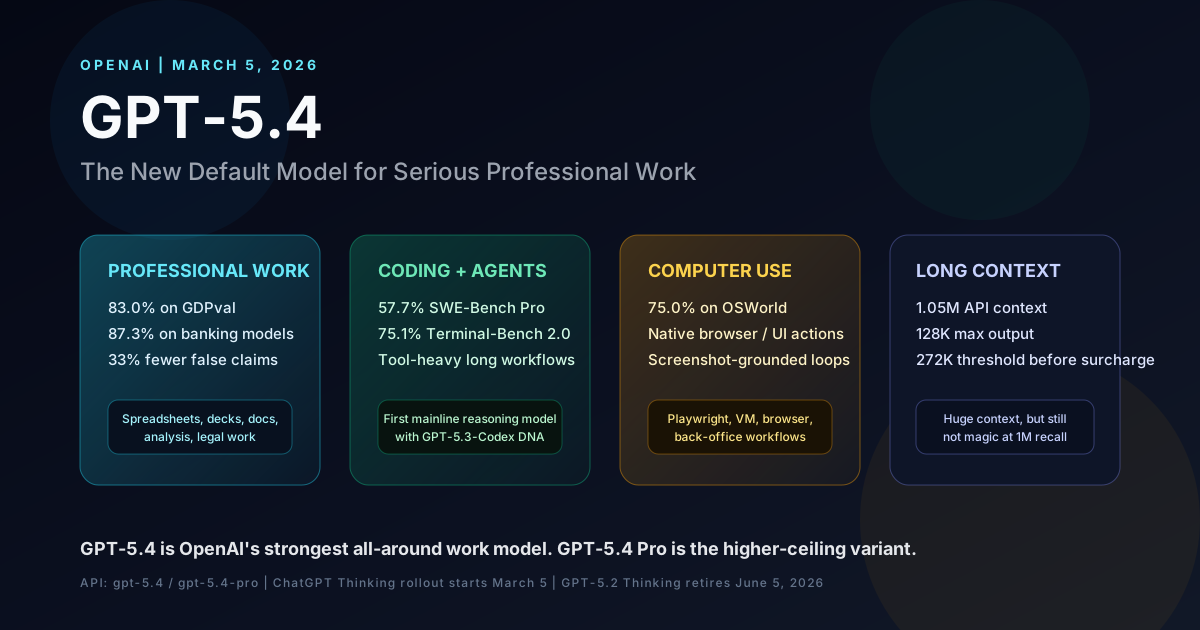
GPT-5.4 for Agents: Computer Use, MCP Tool Calls, and Real Pricing
GPT-5.4's native computer use and MCP tool calls are the real upgrade for agents. What holds up in a loop, what the 1M context costs, and how Pro compares.
Keep reading
Get new posts on AI, Claude Code & LLMs
New deep-dives on AI engineering, Claude Code, and developer tooling — follow along however you prefer.
About the Author

Software engineer writing about AI, Claude Code, LLMs, OpenAI, Anthropic, and developer tooling. 5+ years building production systems at Expedia Group, Tekion, and BYJU'S.