How to Decide When to Give an AI Agent Autonomy: 3:1 Test
How to decide when to give an AI agent autonomy: chip design keeps 3 to 5 spec engineers per builder before trusting it — the same ratio tests your task.

TL;DR Here’s how to decide when to give an AI agent autonomy: run the specification test before letting it act without review. Can a wrong answer be caught by something cheap and automatic, or only by a careful human read? Chip design trusts autonomous tooling because it already runs three to five specification engineers per designer — most software teams have zero. An agent solving a rigorously-specified math problem tells you almost nothing about whether it can handle your ambiguous backlog ticket alone.
Every few weeks another headline claims an LLM “autonomously” cracked something hard — a proof, a benchmark, a from-scratch driver — and every few weeks a team reads that headline and hands their agent a task with no spec, no test, and no human checkpoint. Most of those handoffs go badly, and not because the model got dumber between the demo and your ticket. It’s because the demo picked a task where correctness is cheap to check, and your ticket didn’t.
What Is the Specification Test for AI Agent Autonomy?
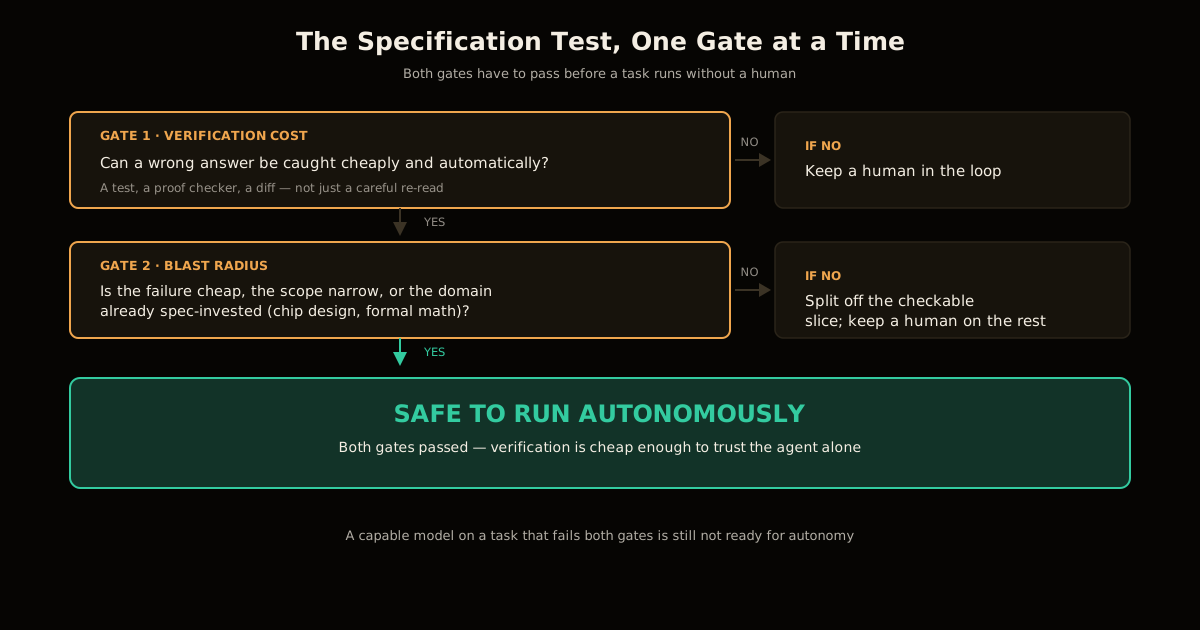
The specification test asks one question: can the correct answer be verified by something cheap and automatic, or only by careful human judgment? If a test suite, a proof checker, a byte-for-byte diff, or a linter can catch a wrong output before it ships, the task can run without a human watching every step. If the only available check is “have someone experienced read this closely,” the task isn’t ready for unattended autonomy yet — regardless of how good the model scored on last month’s benchmark.
This isn’t a knock on model capability. It’s a statement about verification cost. A brilliant answer to an unverifiable question is still unverifiable, and an agent that’s right 95% of the time is worse than useless on the 5% you can’t catch.
Why Chip Design Trusts Autonomy and Your Backlog Doesn’t
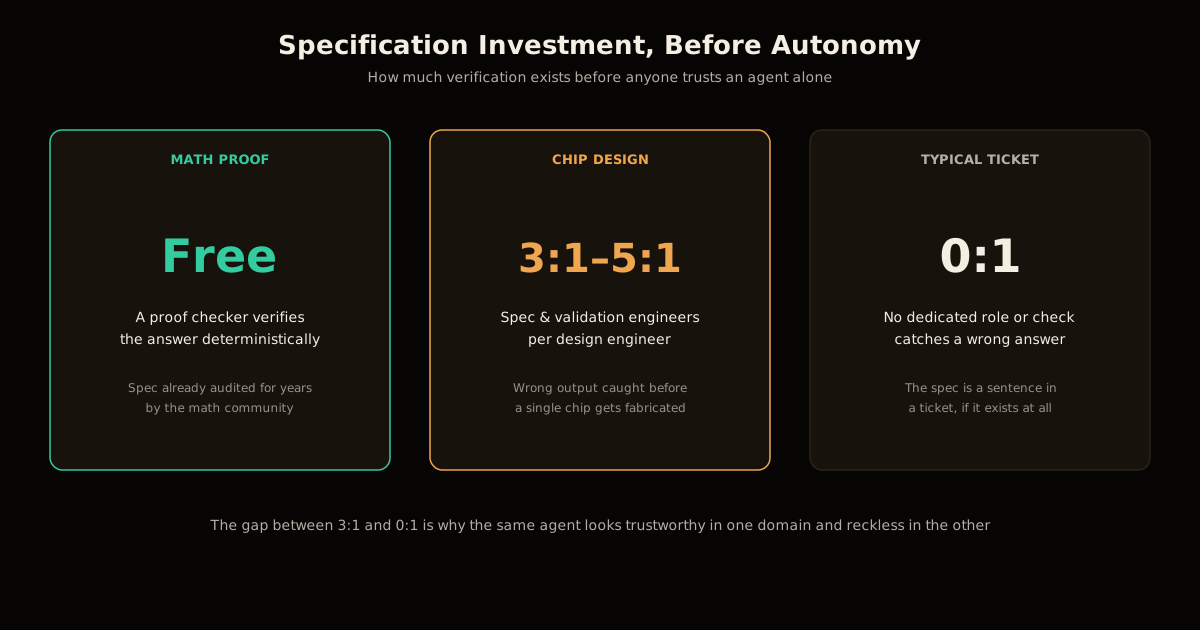
Hardware teams have been living with this tradeoff for decades, long before LLMs existed, and their staffing ratio gives away the answer. Engineer and systems writer Jay Kruer, arguing on dank.systems for why he remains skeptical of headline AI-autonomy claims, points out that CPU design projects run “about three times as many specification and validation engineers as design engineers, and a 5:1 ratio is not unheard of.” Before an agent — human or AI — writes a line of RTL, a team has already spent more effort defining what “correct” means and building the machinery to check it than they spent building the thing itself.
Compare that to a typical software team handing an agent a ticket. There’s usually no specification engineer, no formal verification pass, and no dedicated role whose entire job is “catch a wrong answer before it ships.” The spec is a paragraph in a ticket, maybe a Figma link. That’s a 0:1 ratio, not 3:1 — and the gap between those two numbers is the entire reason the same agent architecture looks trustworthy in one domain and reckless in the other.
The Three Categories Where Autonomous Agents Actually Work
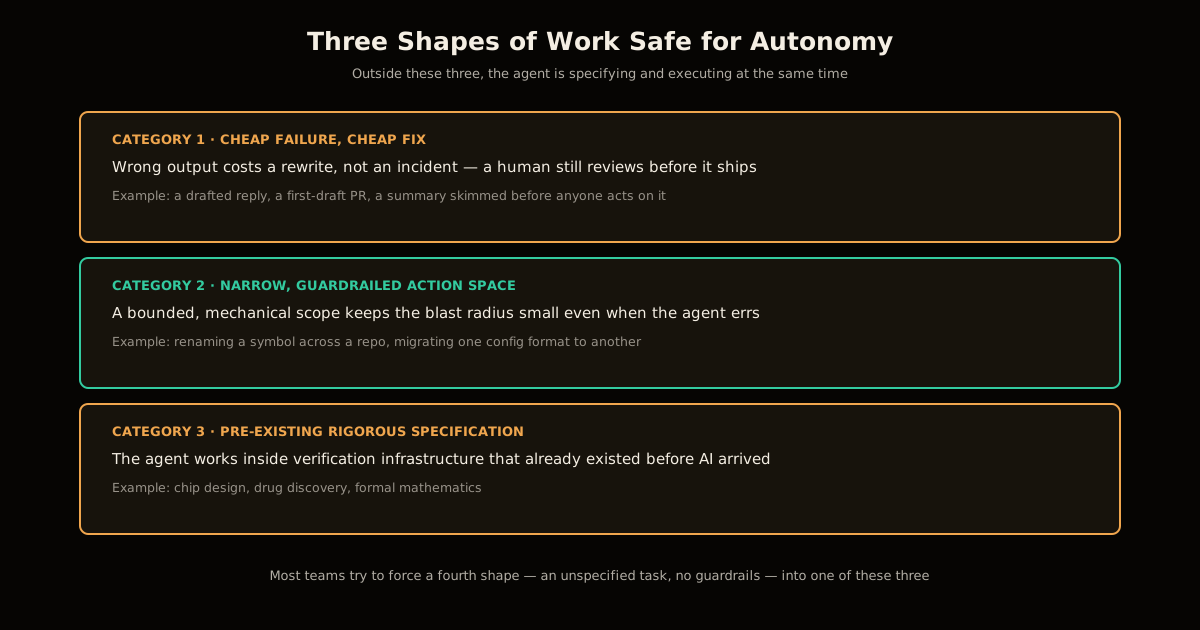
Kruer’s argument narrows the safe zone for autonomous AI down to three shapes of work, and it’s worth naming them plainly because most teams are trying to force a fourth shape into one of these buckets:
Cheap failure, cheap fix. A drafted reply a human still sends, a first-draft PR a human still merges, a summary a human still skims before acting on it. Being wrong costs a rewrite, not an incident.
Narrow, guardrailed action space. A bounded, mechanical change — renaming a symbol across a repo, migrating one config format to another, running a fixed script against a known input shape. The blast radius stays small even when the agent gets a case wrong.
Domains with pre-existing rigorous specification. Chip design, drug discovery, formal mathematics — fields that already built expensive verification infrastructure long before an AI agent touched them. The agent works inside that infrastructure; it doesn’t replace the need for it.
Outside those three, you’re asking an agent to do the specification work and the execution work at the same time, with nothing independent checking either one.
How to Run the Specification Test on Your Own Task in 5 Steps
Before you wire an agent into a workflow and walk away, run this checklist against the actual task, not the category of task it resembles:
Write the spec as a checkable statement, not a sentence of intent. “Improve onboarding” isn’t a spec. “Reduce the number of required form fields from 12 to 6 without breaking the existing validation tests” is. If you can’t phrase a pass/fail condition, you don’t have a spec yet — write one before you automate anything.
Price out verifying a wrong answer. Can a test suite, a diff, or a domain expert’s five-minute read catch a bad output? If checking the work takes as long as doing it yourself, autonomy hasn’t saved you time — it’s moved the labor from doing to reviewing, which is sometimes worse.
Estimate your own spec-to-build ratio. Hardware lives at 3:1 to 5:1. If your task has zero people or zero automated checks dedicated to catching a wrong answer, you’re at roughly 0:1 — nowhere near the territory where unattended autonomy is safe.
Sort the task into one of the three safe categories above — or admit it doesn’t fit. Be honest here; “it’s kind of narrow” is how scope creep turns a guardrailed task into an unbounded one.
If it doesn’t fit, split it instead of forcing it. Hand the agent the sliver that is cheap to verify or narrowly scoped, and keep a human on the ambiguous judgment call. This is the same instinct behind test-first scoping for reverse-engineering tasks: one small, checkable unit beats one large, unverifiable one.
Math Proofs vs. Your Codebase: Why a Navier-Stokes Headline Doesn’t Transfer
When a headline claims an agent made progress on a problem like the Navier-Stokes existence and smoothness question — one of the Clay Mathematics Institute’s Millennium Prize Problems — it’s easy to read that as evidence the same agent can run your sprint. It can’t, and the reason is entirely about specification, not intelligence.
A theorem statement is a complete, unambiguous specification that mathematicians have spent years auditing before an agent ever saw it. Verifying a claimed proof step is (in the best case) mechanical and deterministic — a proof checker either accepts the logic or it doesn’t, and it costs nothing to run again. Kruer’s framing is blunt about this: math problems “are the absolute best case scenario for agentic work,” precisely because the hard part — writing a rigorous, unambiguous spec — was already done by someone else, for free, before the agent started.
Your codebase doesn’t offer that. Models generalize well within “a small neighborhood of the specific tasks they’ve been trained on” and degrade with “even small perturbations within a covered class of task,” which is exactly what an ambiguous ticket, an undocumented legacy module, or a half-written design doc produces: perturbation after perturbation, with no proof checker waiting at the end to tell you if the output is right.
What Breaks When You Skip the Specification Test?
Skipping the test doesn’t remove the cost of verification — it just delays it and makes it more expensive. A team that hands an agent an unspecified task and walks away doesn’t get fewer mistakes; it gets the same mistakes surfacing later, in production, in a customer’s inbox, or three sprints from now when someone finally reads the generated code closely enough to notice it solved the wrong problem convincingly.
This is the same failure mode covered in why AI agent benchmark claims deserve scrutiny before you act on them: an agent that looks capable on a well-specified demo can produce output that is fluent, confident, and wrong on a task that never had a real spec to begin with. Fluency is not the same signal as correctness, and without a cheap way to tell them apart, you’re trusting the output on vibes.
When Should a Human Stay in the Loop?
A human should stay in the loop whenever the task’s verification cost is high and the failure cost is high at the same time — which describes most real engineering and product decisions, not the edge cases. Delegating a task from an agent back to a human isn’t a failure of the automation; it’s the correct outcome when the specification test comes back negative. The 2026 data on this backs up the caution: most autonomous AI agent projects still don’t reach production, and the gap tracks almost exactly with how well the underlying task was specified before anyone tried to automate it.
Keeping a human in the loop isn’t the opposite of using agents well — it’s the mechanism that makes the other two safe categories (cheap failure, narrow guardrails) actually cheap and actually narrow in practice, because someone is still watching the boundary.
Task Type vs. Specification Cost vs. Autonomy Readiness
| Task type | Cost to catch a wrong answer | Spec cost | Safe for autonomy? |
|---|---|---|---|
| Formal math proof | Free — a checker verifies it | Pre-audited by mathematicians | Yes — best case |
| Chip design (RTL) | Cheap, once funded | High — 3:1 to 5:1 ratio | Yes, inside that investment |
| Narrow scripted migration | Cheap — a diff catches it | Low — scope is bounded | Yes — narrow-guardrail |
| Draft reply, human-reviewed | Cheap — human catches it | Low, but tolerable | Yes — cheap-failure |
| Ambiguous product ticket | Expensive — silent for weeks | None — a sentence | No — keep a human |
Common Mistakes Teams Make Handing Off to Agents
Treating an impressive demo as proof of general competence. A model that shines on a rigorously-specified benchmark or a math problem hasn’t demonstrated it can handle your undocumented internal API — it’s demonstrated it can handle rigorously-specified problems, which is a much narrower claim.
Confusing “the model is capable” with “the task is specified.” These are independent variables. A frontier model pointed at an unspecified task produces confident, fluent, and frequently wrong output — capability doesn’t manufacture a spec that was never written.
Skipping straight to full autonomy instead of the narrow slice. If a task doesn’t pass the specification test, the fix is almost never “don’t use the agent at all” — it’s “shrink the task until the checkable part and the judgment part are separate,” the same move behind spec-driven development for AI agents.
Assuming the ratio fixes itself over time. Hardware’s 3:1 to 5:1 ratio didn’t appear because the tools got better; it exists because the cost of a wrong answer (a fabricated chip) is enormous. Software’s ratio will only rise for tasks whose failure cost genuinely justifies the investment — not automatically, and not for every ticket in the backlog.
The Takeaway: How to Decide When to Give an AI Agent Autonomy
The question worth asking about any handoff isn’t “is the model good enough?” It’s “can I check whether it got this right for less than it would cost to just do it myself?” Chip design answers yes because it pays for that answer in advance, with a 3:1 to 5:1 staffing ratio most software teams have never budgeted for. A proof checker answers yes for free, because mathematicians already did the specification work. Your Tuesday-morning backlog ticket usually answers no — and the fix isn’t a better model, it’s a better spec, or a human still in the loop until you write one. For more on scoping agent work so the checkable part and the judgment part don’t get tangled together, see the AI coding agents topic hub.
FAQ
What is the specification test for AI agent autonomy? Can a wrong answer be caught by something cheap and automatic — a test, a proof checker, a diff — or only by a careful human read? If the former, autonomy is safe; if only the latter, keep a human checkpoint.
Why does chip design trust AI agents more than most software teams do? Because it already runs three to five specification and validation engineers for every design engineer, so wrong outputs get caught by existing verification infrastructure, not by hoping the model got it right.
Does an LLM solving a hard math problem prove it can work autonomously on my codebase? No. A theorem statement is a complete specification the math community already audited, and a proof checker verifies the answer for free. Your ticket has neither property.
What are the three situations where autonomous AI agents are actually safe? Cheap-to-fail tasks a human still reviews, narrow bounded action spaces with a small blast radius, and domains that already invested in rigorous specification before AI arrived.
What breaks if I skip the specification test and automate anyway? The verification cost doesn’t disappear — it moves later and gets more expensive, surfacing in production or a customer’s inbox instead of at generation time.
Is the answer just to never let agents run without a human? No. Plenty of real work already fits the cheap-failure or narrow-guardrail categories. The mistake is assuming a demo on a well-specified problem transfers to an ambiguous one.
Sources
- Why I’m still bearish on LLMs after Navier-Stokes — Jay Kruer, dank.systems, September 15, 2026. The specification-cost argument, the 3:1/5:1 hardware staffing ratio, and the three safe-autonomy categories this post builds on.
- Navier-Stokes existence and smoothness — Clay Mathematics Institute. Background on why the underlying math problem is a rigorously specified, decades-audited statement.
Frequently asked questions
Google Search · Preferred sources
Prefer this site on Google
If you already read this writing, add umesh-malik.com as a Preferred Source. Google can then highlight it with a preferred badge in Top Stories, AI Overviews, and AI Mode — for you, not as a site-wide ranking boost.
Related Articles

AI Coding Agents & DX
Build an AI Agent Knowledge Base: The Pattern That Cut Tokens 80%
How to build an AI agent knowledge base: the wiki-plus-recipes pattern that cut per-turn tokens 80% and turned days of expert review into minutes.

AI Coding Agents & DX
Build AI-Generated Code Guardrails: The 6 Checks Anthropic Runs
How to build AI-generated code guardrails before shipping: the six checks Anthropic runs, what each catches, and the cost of running them on your own repo.

AI Coding Agents & DX
Rust LSP Low Memory: How to Run Glancer Locally on 8GB RAM
Rust LSP low memory is achievable: Rust Glancer runs on 8GB machines by freezing analysis at save and offloading to disk.
Keep reading
Get new posts on AI, Claude Code & LLMs
New deep-dives on AI engineering, Claude Code, and developer tooling — follow along however you prefer.
About the Author

Software engineer writing about AI, Claude Code, LLMs, OpenAI, Anthropic, and developer tooling. 5+ years building production systems at Expedia Group, Tekion, and BYJU'S.