Fix CLS Issue More Than 0.1: From 0.25 to 0 in Three Changes
CLS issue more than 0.1 means a quarter of mobile visits saw the page jump. Image dimensions halved my test page's 0.25 and still failed. Three fixes hit 0.

TL;DR — CLS issue more than 0.1 is the Search Console flag for a group of pages where at least 25% of real mobile visits saw content jump by more than a 0.1 layout shift score. On my test page, adding width and height to the hero image, the fix every guide leads with, only took CLS from 0.249 to 0.127, which still fails. Reserving space for a late banner and an ad slot took it to 0, and the popular font fallback tweak made things worse.
Layout shift is the Core Web Vital people notice before they can name it: you go to tap a link and the page drops 64 pixels, so you hit an ad instead. Search Console reports it as one number per URL group, with no hint of which element moved.
So I built a page with the three shifts I find most often in audits, measured each one on a phone profile, and fixed them one at a time. Here’s what each fix was worth, and the one that backfired.
What Does CLS Issue More Than 0.1 Mean?
CLS issue: more than 0.1 means a URL group’s Cumulative Layout Shift is above 0.1 at the 75th percentile of real Chrome visits. CLS measures how much visible content moves without the user asking it to. Unlike LCP and INP, it isn’t a time. It’s a unitless score.
The thresholds come from Google’s Core Web Vitals report documentation:
| CLS at p75 | Search Console status | What a user feels |
|---|---|---|
| ≤ 0.1 | Good | The page holds still while it loads |
| 0.1–0.25 | Need improvement (this issue) | Text jumps once or twice as things arrive |
| > 0.25 | Poor (“more than 0.25”) | Mis-taps, lost reading position, rage |
Like the other Core Web Vitals issues, it’s built from Chrome UX Report field data over a rolling 28 days, and URLs are grouped by similar experience. One bad template, such as a blog layout with an ad slot, flags every URL that uses it.
How Is CLS Calculated? Session Windows Explained
Each layout shift gets a score of impact fraction × distance fraction: how much of the viewport the moving elements cover, times how far they moved relative to the viewport. A paragraph block filling half the screen that moves down 10% of the screen height scores about 0.05.
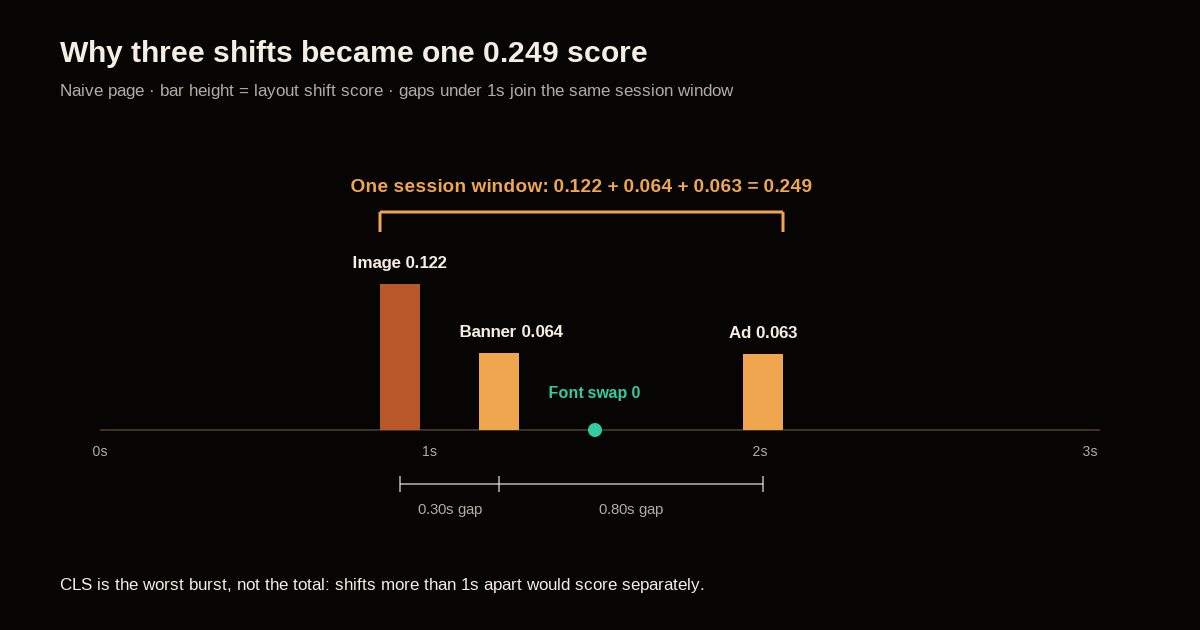
CLS is not the sum of every shift on the page. Per web.dev’s CLS definition, shifts are grouped into session windows: bursts where each shift is less than 1 second after the previous one, capped at 5 seconds. CLS is the score of the worst window.
Two more rules matter in practice:
- Shifts within 500ms of user input don’t count. They carry the
hadRecentInputflag. Tapping “Show more” and watching content expand is fine. - Scrolling isn’t input. Content that loads while someone scrolls and pushes the page around still counts, for the whole life of the page.
On my test page, all three shifts landed in a single window, which is why they added up:
Where Did the 0.249 Come From? Measuring Each Shift
My test page is a typical store landing page on a 412px phone viewport: header, headline, a paragraph, a hero image, a placeholder for a promo bar, an ad slot and body copy. It has three common mistakes:
- The hero
<img>has nowidthandheight, and it arrives at 900ms. - A “Free shipping” bar of 64px is injected at the top by JavaScript at 1.2s.
- An ad slot starts empty and fills with a 250px creative at 2s.
The headline and body use a self-hosted web font with font-display: swap, arriving at 1.5s over an Arial fallback.
Setup: Playwright 1.63 driving headless Chromium, 412×915 viewport at 2.625x density with mobile emulation, resources delayed on a fixed schedule so every run is identical, 5 loads per version. I read shifts from the browser’s own PerformanceObserver and computed CLS with the session-window rules above. All runs within a version scored the same.
| Version | Shifts left | CLS | Status |
|---|---|---|---|
| Naive | image 0.122, banner 0.064, ad 0.063 | 0.249 | Need improvement |
+ width/height on the image | banner 0.064, ad 0.063 | 0.127 | Need improvement |
| + reserved banner slot | ad 0.063 | 0.063 | Good |
| + reserved ad slot | none | 0 | Good |
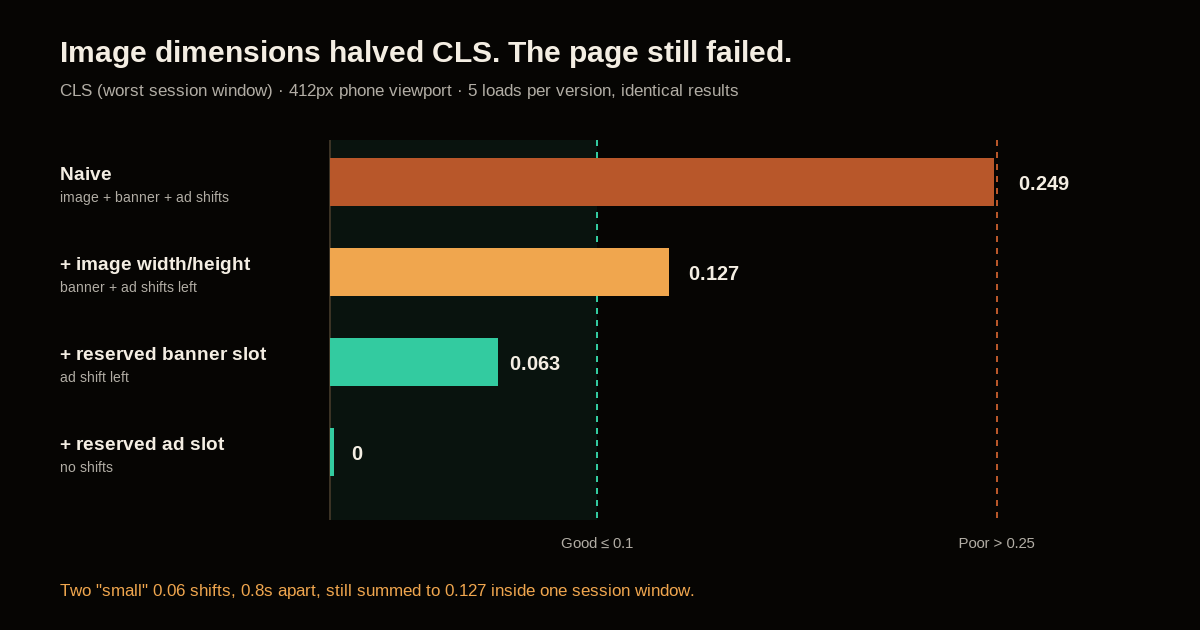
The surprise: the famous fix halves CLS and still fails. Image dimensions removed the biggest shift, 0.122, exactly as advertised. But two “small” shifts of about 0.06 each were left, and because they arrived 0.8s apart they shared a session window. Together they were 0.127, still above 0.1. A page with only the image fix stays flagged in Search Console.
How to Fix CLS Issue More Than 0.1 in 6 Steps
Open the issue and note the URL group. In Search Console, go to Experience → Core Web Vitals → Mobile, open the CLS issue and click an example URL. Find the template the group shares: post layout, product page, category page.
Find which elements moved, from real users. Search Console won’t tell you. The attribution build of
web-vitalswill:import { onCLS } from 'web-vitals/attribution'; onCLS(({ value, attribution }) => { console.log(value, { target: attribution.largestShiftTarget, shift: attribution.largestShiftValue, at: attribution.largestShiftTime, state: attribution.loadState, }); });Send this to your analytics.
largestShiftTargetis a CSS selector for the element that moved most, andloadStatetells you whether it happened during load or later.Give every image and video its size. Add
widthandheightattributes that match the aspect ratio, and keepheight: autoin CSS so it still scales. The browser then reserves the box before the bytes arrive. For embeds and iframes, useaspect-ratioin CSS.<img src="/hero.webp" width="1200" height="630" alt="Launch hero">Reserve space for anything injected later. Banners, cookie bars, ad slots, “related posts” widgets, review stars. Give the container a
min-heightequal to the content it will hold. For notices, prefer an overlay (position: fixedat the bottom) that doesn’t push the page at all..promo-slot { min-height: 64px; } .ad-slot { min-height: 250px; }Check the font swap before you “fix” it. Use DevTools’ Rendering → Layout Shift Regions or the
web-vitalstarget. If text doesn’t move on swap, leave fonts alone. If it does, tryfont-display: optionalfirst (see below).Ship, then click Validate fix. Wait until your own field data shows mobile p75 under 0.1 for a few days, then start validation and wait out the 28-day window.
What Breaks When You Tune the Font Fallback Blindly?
Fallback font metrics (size-adjust, ascent-override and friends) are standard advice in web.dev’s CLS optimization guide. On my page they backfired.
The swap from Arial to the web font caused zero shift. With a fixed line-height, a font swap only moves layout if the text wraps to a different number of lines, and here it didn’t. Then I added a metric-matched fallback face, scaled to the web font’s measured width (94.6% size-adjust). The narrower fallback wrapped the opening paragraph differently, so when the real font arrived, the paragraph changed height and pushed the hero image down.
| Font strategy (all other fixes applied) | CLS from the font swap |
|---|---|
font-display: swap, plain Arial fallback | 0 |
+ fallback face with size-adjust only | 0.022 |
+ size-adjust and ascent/descent overrides | 0.018 |
font-display: optional instead | 0 |
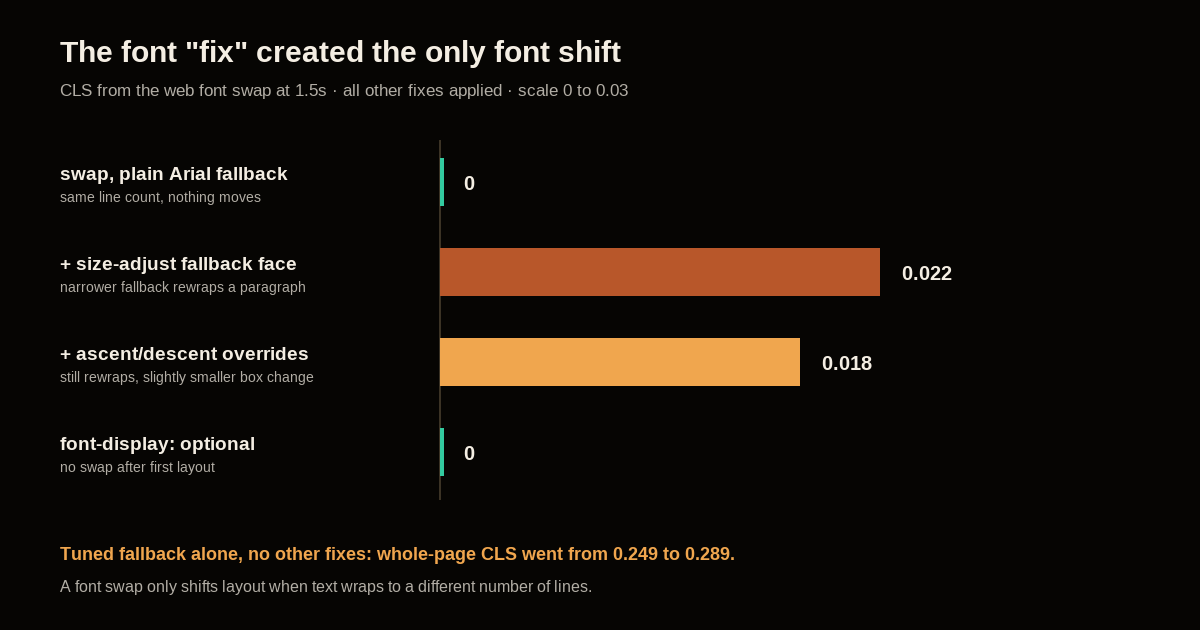
Applied on its own, without the other fixes, the tuned fallback made the whole page worse: CLS went from 0.249 to 0.289. That’s because the font shift landed in the same session window as the image, banner and ad shifts.
This doesn’t mean metric overrides are bad. On a site whose fallback wraps very differently from the web font, they’re the right tool. It means a font fix is a guess until you’ve seen text move. font-display: optional is the safer default when you can’t tune per font: the web font is used only if it’s ready at first layout, so a swap never happens on slow first visits.
Which Fix Matches Which Layout Shift?
Use the largestShiftTarget and loadState from step 2 to pick:
| What moved | Usual cause | Fix that works |
|---|---|---|
| Content below an image or video | No width/height, or CSS that overrides the ratio | Size attributes plus height: auto, or aspect-ratio |
| Everything below a banner | Promo, cookie or app-install bar injected at the top | min-height slot in the HTML, or a fixed overlay |
| Content around an ad | Empty slot that fills late or resizes | min-height for the most common creative size, no collapsing |
| Text blocks at font load | Web font wraps lines differently from the fallback | font-display: optional, or a measured fallback face |
| Shifts long after load | Infinite scroll, lazy widgets, animations using top/height | Placeholders with fixed size, animate transform only |
| Shifts on back navigation | Page not eligible for back/forward cache | Remove unload handlers and Cache-Control: no-store |
How Long Does Search Console Validation Take?
About 28 days. Validate fix starts a 28-day monitoring session, and the issue passes only if no URL in the group shows it during the whole window.
Statuses along the way: Started (running, nothing failing yet), Looking good (every URL checked so far is fixed), Passed, or Failed, which restarts the 28 days after your next fix. Don’t click Validate fix on deploy day. Let your own field data settle under 0.1 first.
CLS is the last of the three Core Web Vitals in this series. If the same URL group is also slow to paint, I measured that in Fix LCP issue longer than 2.5s, and slow taps are covered in Fix INP issue longer than 200ms. For all three metrics in one place, see my Core Web Vitals optimization guide. To stop a new widget from bringing shifts back, add a CLS budget to CI with a benchmark ratchet. And a stable page still has to be indexed: if it isn’t, start with Crawled – currently not indexed. Sizing a video embed with aspect-ratio matters twice on video pages, and the other half of that story is in Fix Video isn’t on a watch page. The rest of this technical SEO series is in the AI search hub.
FAQ
What does CLS issue more than 0.1 mean in Search Console?
It means a group of your URLs has a Cumulative Layout Shift score above 0.1 at the 75th percentile of real Chrome visits. At least a quarter of visits saw visible content move unexpectedly while they were reading. Scores between 0.1 and 0.25 are rated Need improvement, and scores above 0.25 are Poor.
Is adding width and height to images enough to fix CLS?
Often not. In my test it removed the largest single shift and cut CLS from 0.249 to 0.127, but the page still failed. A late promo banner and an ad slot each added about 0.06 on their own. Every element that appears after first paint needs reserved space, not only images.
Do web font swaps cause layout shift?
Only when the swap changes the size of a box, which in practice means a different number of text lines or a different line height. In my test, swapping from Arial to Space Grotesk with a fixed line-height caused no shift at all. Adding a size-adjust fallback face actually introduced a 0.02 shift by changing where lines wrapped, so measure before tuning fonts.
Why is my CLS bad on mobile but fine on desktop?
Layout shift is scored as a fraction of the viewport, and a phone viewport is small. A 64px banner pushing content down moves a much larger share of a 412px-wide screen than of a 1440px desktop window. Phones also load slower, so more content arrives after the first paint and has room to move things.
Do layout shifts after user interaction count toward CLS?
No, as long as they happen within 500 milliseconds of a tap, click or key press. Those shifts carry the hadRecentInput flag and are excluded. Scrolling does not count as input, so content that loads in and pushes the page while the user scrolls still adds to CLS.
How long does Search Console take to clear a CLS issue?
Clicking Validate fix starts a 28-day monitoring session, because the report uses a rolling 28 days of Chrome UX Report data. The issue passes only if no URL in the group shows it during the whole window. Plan on about a month between shipping the fix and seeing Passed.
Sources
- Google Search Console Help, Core Web Vitals report: CLS thresholds (0.1 and 0.25), URL groups, CrUX data and the 28-day validation session.
- web.dev, Cumulative Layout Shift (CLS): impact and distance fractions, session windows (under 1 second apart, 5 seconds max), and the 500ms
hadRecentInputexclusion. - web.dev, Optimize Cumulative Layout Shift: image dimensions, reserved space for late content, font fallback overrides,
font-display: optionaland bfcache. - GoogleChrome, web-vitals library: the attribution build’s
largestShiftTarget,largestShiftValueandloadStatefields. - First-party measurement: Playwright 1.63, headless Chromium, 412×915 viewport at 2.625x density, mobile emulation, image delayed 900ms, banner injected at 1.2s, web font (Space Grotesk,
font-display: swap) at 1.5s, ad filled at 2s, 5 loads per version, November 24, 2026.
Frequently asked questions
Google Search · Preferred sources
Prefer this site on Google
If you already read this writing, add umesh-malik.com as a Preferred Source. Google can then highlight it with a preferred badge in Top Stories, AI Overviews, and AI Mode — for you, not as a site-wide ranking boost.
Related Articles

Web Engineering
Fix INP Issue Longer Than 200ms: 280ms to 24ms With One Yield
INP issue longer than 200ms means 75% of mobile clicks paint slower than 200ms. One yield took my test page from 280ms to 24ms. The catch is in the render.

Web Engineering
Fix LCP Issue Longer Than 2.5s: 3.4s to 0.87s in Three Changes
LCP issue longer than 2.5s means 25% of mobile visits paint the main content late. Three changes cut my test page from 3.4s to 0.87s. The famous fix barely did.

Web Engineering
Fix Video Isn't on a Watch Page: Moving the Player Isn't Enough
Video isn't on a watch page means Google sees the video as secondary. I measured 6 layouts: moving the player up fixes nothing if the page is an article.
Keep reading
Get new posts on AI, Claude Code & LLMs
New deep-dives on AI engineering, Claude Code, and developer tooling — follow along however you prefer.
About the Author

Software engineer writing about AI, Claude Code, LLMs, OpenAI, Anthropic, and developer tooling. 5+ years building production systems at Expedia Group, Tekion, and BYJU'S.