How to Fix Google Chose Different Canonical: 3 Hosts Served 200
Fix Google chose different canonical than user: make every duplicate 301 to the URL you declared. On my site 3 hosts served 200 copies of all 39 pages I probed.

TL;DR — To fix Google chose different canonical than user, make every duplicate URL 301 to the URL your rel=canonical names, then align the sitemap and internal links with it. A canonical tag is a hint Google can overrule, and a redirect is the stronger signal. On this site, every page’s markup was clean, but www, http and a legacy .in domain still served 200 copies of all 39 pages I probed, and trailing-slash variants used a 307 that Google doesn’t count as a canonical signal.
Duplicate, Google chose different canonical than user is the Search Console status for a page that names itself as canonical while Google indexes a different URL from the same duplicate set. Google treats your tag as a vote. When enough other signals point the other way, it overrules you.
What Does Google Chose Different Canonical Than User Mean?
Google’s Page indexing report docs define it this way: “This page is marked as canonical for a set of pages, but Google thinks another URL makes a better canonical. Google has indexed the page that we consider canonical rather than this one.”
Two things follow. The URL in the row is not indexed, and the content isn’t lost: it’s indexed under a URL you didn’t choose. The question is whether you care which URL that is.
It sits next to two other duplicate statuses that people often mix up:
| Search Console status | Did you declare a canonical? | Did Google agree? | Typical cause | Action |
|---|---|---|---|---|
| Alternate page with proper canonical tag | Yes, pointing elsewhere | Yes | Mobile, AMP or a parameter URL with a correct tag | None |
| Duplicate without user-selected canonical | No | Google picked one | Missing rel=canonical | Add the tag |
| Duplicate, Google chose different canonical than user | Yes, pointing at itself | No | Conflicting signals, usually duplicates that return 200 | Redirect the duplicates, align signals |
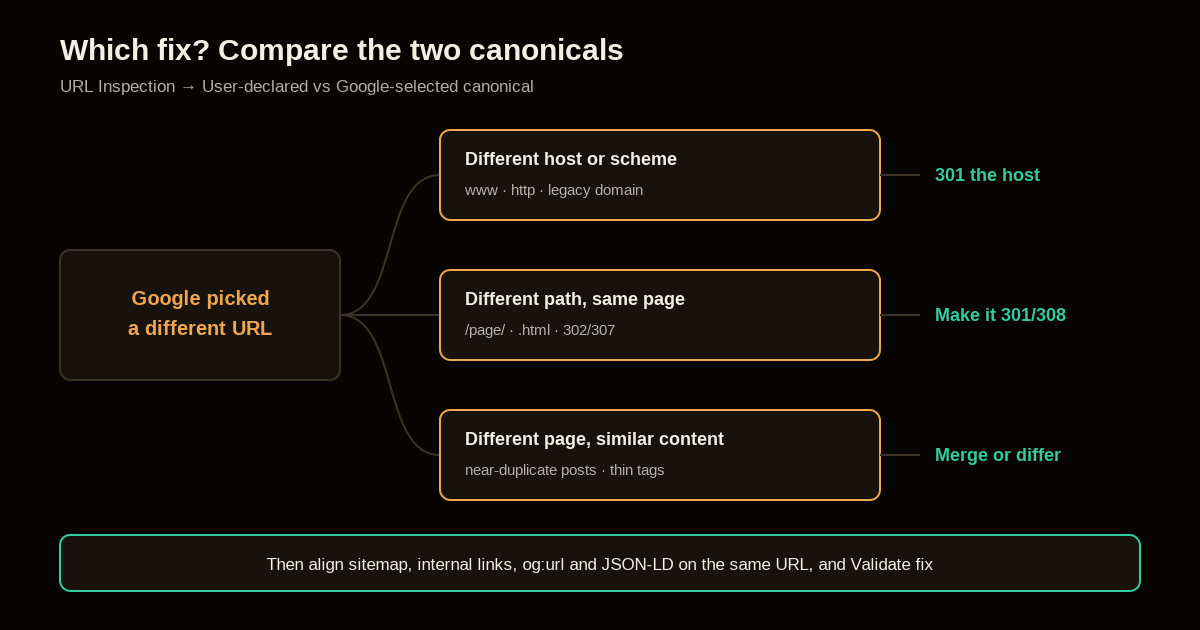
Open URL Inspection on the row and compare User-declared canonical with Google-selected canonical. Which of these you see decides the fix:
- Another host or scheme (
www,http, an old domain) means a missing host redirect. - A different path (trailing slash,
.html, uppercase) means a path redirect that is missing or temporary. - A different page entirely means Google thinks the two pages say the same thing. That’s a content problem, covered below.
Why Does Google Ignore Your rel=canonical?
Because Google never promised to obey it. Its consolidation guide lists the canonical signals “in order of how strongly they can influence canonicalization”:
- Redirects: “A strong signal that the target of the redirect should become canonical.”
rel="canonical"link annotations: “A strong signal that the specified URL should become canonical.”- Sitemap inclusion: “A weak signal.”
The canonicalization overview adds HTTPS versus HTTP and internal links as inputs. Your tag is one strong vote among several. A duplicate that answers 200 contributes no redirect vote at all. It just sits there as a second live copy, and every external link that points at it pulls Google toward it.
The detail that catches most sites is in Google’s redirect documentation. For a permanent redirect, “the indexing pipeline uses the redirect as a signal that the redirect target should be canonical.” For a temporary one, Googlebot “follows the redirect, but the indexing pipeline doesn’t use the redirect as a signal that the redirect target should be canonical.”
So a 302 or 307 from /page/ to /page gets the user to the right place and gives Google no canonical signal. Many static hosts and CDNs emit exactly that by default for trailing-slash normalization.
What Did a Probe of 271 Duplicate URLs Find?
I audited this site in two layers on November 15, 2026: the build output and production.
The markup was clean. I ran a script over all 653 prerendered HTML pages in build/. Every page had exactly one rel=canonical, and it matched both og:url and the JSON-LD mainEntityOfPage. Across 29,566 internal links, none pointed at a trailing-slash, .html, uppercase, query-string or off-host variant. The one defect: the sitemap lists 666 <loc> entries for 652 unique URLs, the same 14 duplicate tag URLs the noindex audit found yesterday.
Production was not. I took 39 URLs spread evenly through the live sitemap.xml and requested seven duplicate variants of each, 271 requests in 3.5 seconds, with redirects not followed:
| Variant | Example | Response (of 39) | Canonical signal Google gets |
|---|---|---|---|
www host | www.umesh-malik.com/blog/x | 200 × 39 | Tag only; no redirect |
| Legacy domain | umesh-malik.in/blog/x | 200 × 39 | Tag only; no redirect |
| Plain HTTP | http://umesh-malik.com/blog/x | 200 × 39 | Tag only; HTTPS preference |
| Tracking parameter | /blog/x?utm_source=… | 200 × 39 | Tag only (normal) |
| Trailing slash | /blog/x/ | 307 × 38 | None: temporary redirect |
.html suffix | /blog/x.html | 307 × 38, 1 timeout | None: temporary redirect |
| Uppercase path | /BLOG/X | 404 × 38 | Not a duplicate |
Every 200 copy carried the correct canonical tag pointing at https://umesh-malik.com. That’s the only reason Google has been picking the right URL. But three whole hosts serving full duplicates means every page has four live copies, held together by one hint. The repo’s own docs say www and .in should 301 to .com through Cloudflare Redirect Rules. On the wire, they don’t.
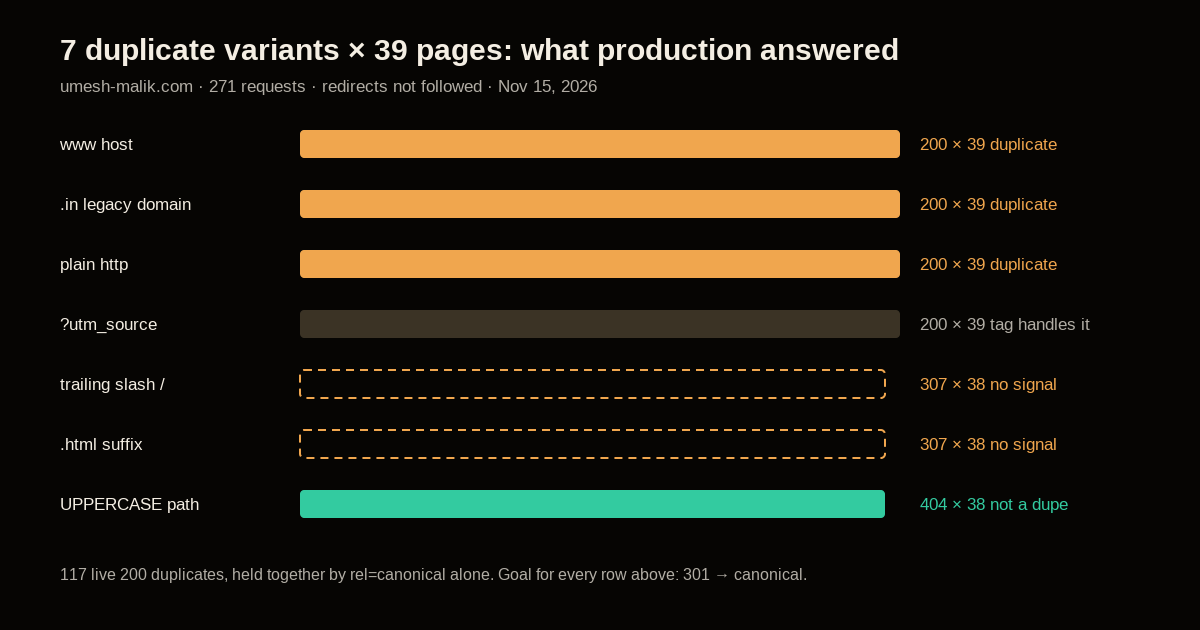
The query-string row is fine as it is. Tracking parameters are a normal duplicate that rel=canonical exists to handle, and you can’t redirect every utm_ link without breaking analytics. The host rows and the 307s are the ones to fix.
How to Fix Google Chose Different Canonical in 6 Steps
Export and inspect. In Search Console, open Indexing → Pages → Duplicate, Google chose different canonical than user, export the rows, and run URL Inspection on a few. Write down the Google-selected canonical for each one.
Classify each pair. Host or scheme difference, path difference, or a genuinely different page. Each needs a different fix, and the probe script below does the first two for you.
301 every host and scheme duplicate. Point
www,httpand any legacy domain at the canonical origin with a permanent redirect that keeps the path and query string. On Cloudflare that’s a single-redirect rule per host with Preserve query string on. Turn on Always Use HTTPS as well. HSTS helps browsers, but it does nothing for a crawler’s first request.Make path normalization permanent. Replace 302/307 trailing-slash and
.htmlredirects with a 301 or 308. If your host can’t change its default status code, add explicit rules for these patterns.Align the weak signals. Sitemap
<loc>, internal links,og:url, hreflang and JSON-LD URLs should all name the same URL as the canonical tag. Dedupe the sitemap. A URL listed twice with differentlastmoddates is a mixed signal of its own.Recrawl and validate. Resubmit the sitemap, use Request Indexing on the most important URLs, and click Validate fix. Google re-decides the canonical only after it recrawls the duplicates.
Here is the probe. It reads your sitemap, requests each variant without following redirects, and tallies what came back:
// canonical-probe.mjs — usage: node canonical-probe.mjs https://example.com/sitemap.xml [sample=40]
// For a sample of sitemap URLs, request common duplicate variants and report
// whether each one 301s to the canonical, 307s (no canonical signal), or 200s.
const [sitemapUrl, sample = 40] = process.argv.slice(2);
const xml = await (await fetch(sitemapUrl)).text();
const locs = [...new Set([...xml.matchAll(/<loc>([^<]+)</loc>/g)].map((m) => m[1]))];
const step = Math.max(1, Math.ceil(locs.length / sample));
const urls = locs.filter((_, i) => i % step === 0);

const host = new URL(urls[0]).host;
const variants = {
  www: (u) => u.replace(`://${host}`, `://www.${host}`),
  http: (u) => u.replace('https:', 'http:'),
  slash: (u) => u.replace(//?$/, '/'),
  html: (u) => u.replace(//?$/, '.html'),
};

for (const [name, make] of Object.entries(variants)) {
  const tally = {};
  await Promise.all(urls.map(async (u) => {
    const v = make(u);
    if (v === u) return;
    const res = await fetch(v, { redirect: 'manual' }).catch(() => null);
    let key = res ? String(res.status) : 'error';
    if (res && res.status >= 300 && res.status < 400) {
      const to = new URL(res.headers.get('location') ?? '', v).href;
      key += to === u ? ' → canonical' : ' → elsewhere';
    } else if (res?.status === 200) {
      const tag = (await res.text()).match(/rel="canonical"[^>]*href="([^"]+)"/)?.[1];
      key += tag === u ? ' (duplicate, tag ok)' : ` (duplicate, tag=${tag ?? 'none'})`;
    }
    tally[key] = (tally[key] ?? 0) + 1;
  }));
  console.log(name.padEnd(6), tally);
}
The healthy output is 301 → canonical or 308 → canonical on every row. 200 (duplicate, tag ok) means you’re relying on the hint alone. 307 → canonical means the redirect works for users and does nothing for indexing. Add your legacy domains to variants by hand, since the script can’t guess them.
When Is Google’s Choice Actually Right?
When the two URLs are two different pages that say the same thing. Two near-identical posts, a tag page that only lists one article, or a printer view without a canonical can all lead Google to fold one into the other. No redirect rule fixes that, because neither URL is a technical duplicate.
You have three honest options. Merge the weaker page into the stronger one and 301 it. Differentiate it until it stands on its own. Or accept Google’s pick and point your canonical tag at it. Leaving the conflict in place is the one bad option. Google may index neither page well, and the loser tends to show up later in Crawled, currently not indexed.
The same logic applies to a thin page that a template generates thousands of times. If Google keeps picking a sibling, the page probably has nothing of its own. That’s the soft 404 problem from another angle.
What Breaks if You Only Add Canonical Tags?
Three things, and none of them show up in your HTML:
- Live 200 duplicates keep collecting links. Anyone who copies
www.or an old domain from a bookmark creates an external vote for the wrong URL. A 301 forwards that vote; a 200 keeps it. - Temporary redirects look fixed and aren’t. A 307 passes a browser test, a “check redirects” plugin and a manual click-through, and still sends Google no canonical signal.
- Your canonical URL itself can’t redirect. If the declared canonical returns a 3xx, Google treats it as Page with redirect and picks something else, which is this status again with extra steps.
Fix the host redirects, make path normalization permanent, and align the sitemap in one deploy. Trace the new rules before you ship them, because stacking host and slash redirects is the classic way to cause a Search Console Redirect error. Google re-decides each URL on its next crawl, and finding orphan pages first makes sure every canonical has internal links pointing at it. If a duplicate in your report never declared a canonical at all, including PDFs and Markdown copies that can’t carry a tag, see fixing Duplicate without user-selected canonical. The rest of this technical SEO series lives in the AI search hub.
FAQ
What does Duplicate, Google chose different canonical than user mean?
It means your page declares itself canonical, but Google looked at the whole set of duplicate URLs and picked a different one to index. The page in the report is not indexed; the Google-selected canonical is. URL Inspection shows both the user-declared canonical and the Google-selected canonical side by side.
Is rel=canonical a directive Google must follow?
No. Google calls rel=canonical a strong signal, not a command. It weighs it together with redirects, HTTPS, sitemap inclusion and internal links. When those other signals point at a different URL, Google can and does override the tag.
Does a 307 redirect tell Google which URL is canonical?
No. Google’s redirect documentation says that for temporary redirects the indexing pipeline does not use the redirect as a canonical signal. Use a 301 or 308 for any duplicate that should consolidate into another URL, such as a trailing-slash or .html variant.
Should I fix this if Google picked a URL I am happy with?
If Google’s pick is a URL you are fine ranking, you can leave it, but update your canonical tags, sitemap and internal links to match it. Mixed signals cost crawl budget and can make Google switch its choice again later. Either agree with Google or change the signals until Google agrees with you.
How long does it take for Google to accept the new canonical?
Google re-evaluates canonicals when it recrawls the duplicates, which can take days to weeks per URL. After adding 301s, resubmit your sitemap, request indexing on the most important pages, and use Validate fix. Validation typically takes up to about two weeks.
Sources
- Google Search Console Help, Page indexing report
- Google Search Central, How to specify a canonical URL with rel=“canonical” and other methods
- Google Search Central, What is URL canonicalization
- Google Search Central, Redirects and Google Search
- First-party measurement, November 15, 2026: a build audit of all 653 prerendered pages and 29,566 internal links in umesh-malik.com’s
build/(0 canonical,og:urlor JSON-LD mismatches; 666 sitemap entries for 652 unique URLs), and a production probe of 39 sitemap URLs × 7 variants (271 requests, 3.5 s, redirects not followed)
Frequently asked questions
Google Search · Preferred sources
Prefer this site on Google
If you already read this writing, add umesh-malik.com as a Preferred Source. Google can then highlight it with a preferred badge in Top Stories, AI Overviews, and AI Mode — for you, not as a site-wide ranking boost.
Related Articles

Web Engineering
Fix Alternate Page With Proper Canonical Tag? Run 4 Checks First
Before you fix alternate page with proper canonical tag, check it: Google indexed the URL your tag named. Four checks find the rows that hide a canonical bug.

Web Engineering
Fix Duplicate Without User-Selected Canonical: 812 Copies Had None
Fix Duplicate without user-selected canonical with a canonical Google can read. My site had 812 Markdown twins with none; one Cloudflare header rule fixed them.

Web Engineering
Fix Redirect Error in Search Console: Trace Every Hop Like Googlebot
Fix Redirect error in Search Console by tracing each hop like Googlebot. A loop, an 11th hop, a growing URL or an empty Location: the tracer names which one.
Keep reading
Get new posts on AI, Claude Code & LLMs
New deep-dives on AI engineering, Claude Code, and developer tooling — follow along however you prefer.
About the Author

Software engineer writing about AI, Claude Code, LLMs, OpenAI, Anthropic, and developer tooling. 5+ years building production systems at Expedia Group, Tekion, and BYJU'S.